


As I am about to launch into making a scratch built 74 gun ship, I felt the need for a good quality small disk sander. On checking various vendors, and searching the topic in SOS, YouTube, and Google Images, I decided to make my own. Having recently made a drum thicknessing sander and being very impressed with the 750w AC Servo motor and controller from AliExpress, I ordered another identical motor with controller, and sat down to design my own disk sander.
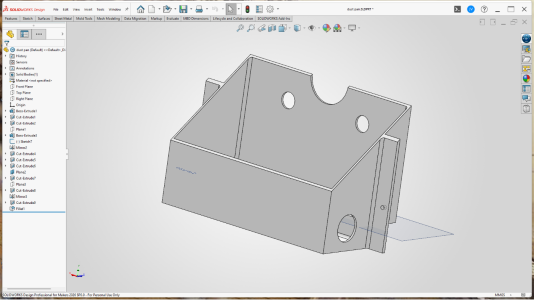
I was heavily influenced by the solidity and simplicity of the Byrne sander, and spent quite a few hours with Solidworks to put my own ideas into a design. See the first photo.
Why make my own? Well cost was a major factor. Second hand Byrne sanders are available on EbayUS, at prices which seem astronomical. And many vendors have stopped shipping to Australia, presumably because of the shipping costs. But the main reason is just that I like to make tools and machines. And I can. Plus, I have heard and read criticisms that the motors on the Byrne sanders are not variable speed, not reversing, and underpowered. The 750w/1hp Chinese servo motors are variable speed, reversing, and have effortless power as I saw in my drum sander. And at $aud130 including shipping, they are very cheap.
So I made my disk sander in 4 or 5 sessions in my workshop.
The making involved accurate marking out, milling, lathe work, and modifying designs as I proceeded. I ordered some adhesive aluminium oxide 125mm diameter sandpaper disks from AliE, and waited until they arrived before finalizing the design.
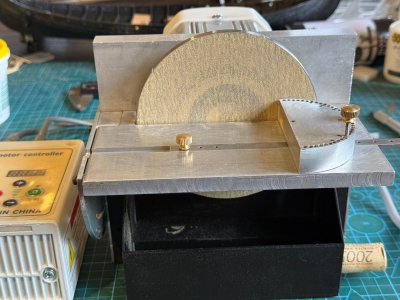
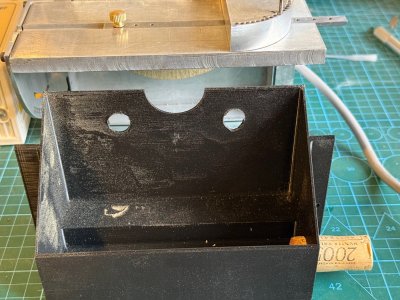
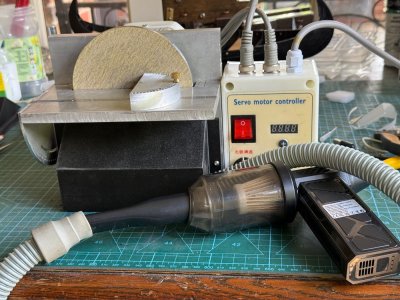
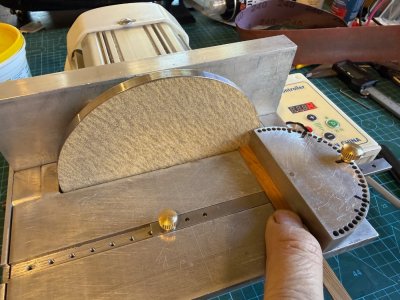
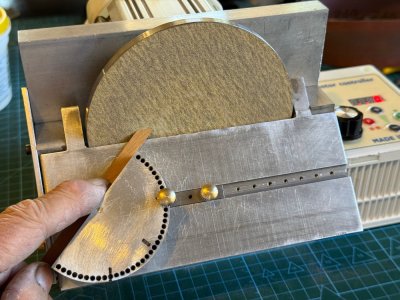
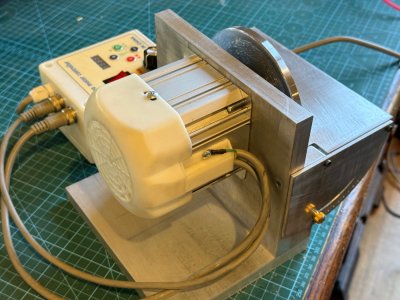
The photos are the almost finished machine. If you are interested in the details of the machining look at recent posts on my blog, johnsmachines.com
I still have to make a dust extraction port and dust collection well, so there will be one more workshop session for that.
Apart from the motor, controller and sanding disks, all materials and parts came out of my workshop. Total cost was $aud200.
The table tilts to 45 degrees in 5 deg steps and also continuously. The protractor fence is a hemi circle also in 5 degree steps. The angles are accurate to within a small fraction of one degree. I can run this machine from 200 to 2000 rpm without any need for bolting or clamping the base. Above 2000rpm it does need to clamped to the bench.
I can see several further enhancements being made, including an attachment for making disks and truncated cones 5-150mm diameter. And adjustable stops for repetitive work.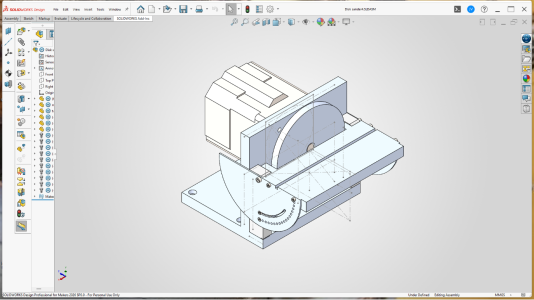
If there is interest I can draw up and post some plans.
I was heavily influenced by the solidity and simplicity of the Byrne sander, and spent quite a few hours with Solidworks to put my own ideas into a design. See the first photo.
Why make my own? Well cost was a major factor. Second hand Byrne sanders are available on EbayUS, at prices which seem astronomical. And many vendors have stopped shipping to Australia, presumably because of the shipping costs. But the main reason is just that I like to make tools and machines. And I can. Plus, I have heard and read criticisms that the motors on the Byrne sanders are not variable speed, not reversing, and underpowered. The 750w/1hp Chinese servo motors are variable speed, reversing, and have effortless power as I saw in my drum sander. And at $aud130 including shipping, they are very cheap.
So I made my disk sander in 4 or 5 sessions in my workshop.
The making involved accurate marking out, milling, lathe work, and modifying designs as I proceeded. I ordered some adhesive aluminium oxide 125mm diameter sandpaper disks from AliE, and waited until they arrived before finalizing the design.
The photos are the almost finished machine. If you are interested in the details of the machining look at recent posts on my blog, johnsmachines.com
I still have to make a dust extraction port and dust collection well, so there will be one more workshop session for that.
Apart from the motor, controller and sanding disks, all materials and parts came out of my workshop. Total cost was $aud200.
The table tilts to 45 degrees in 5 deg steps and also continuously. The protractor fence is a hemi circle also in 5 degree steps. The angles are accurate to within a small fraction of one degree. I can run this machine from 200 to 2000 rpm without any need for bolting or clamping the base. Above 2000rpm it does need to clamped to the bench.
I can see several further enhancements being made, including an attachment for making disks and truncated cones 5-150mm diameter. And adjustable stops for repetitive work.
If there is interest I can draw up and post some plans.