• Ships of Scale has incorportated an extra level of security when you log In. Please follow on-screen prompts to acknowledge that you are not a robot via a "Check Box" or a "Pictorial Check Box Puzzle". This is needed due to higher level of AI Activity Security.
  • SUBSCRIBE TO SHIPS IN SCALE TODAY!

    The beloved Ships in Scale Magazine is back and charting a new course for 2026!
    Discover new skills, new techniques, and new inspirations in every issue.

    NOTE THAT OUR NEXT ISSUE WILL BE July/August 2026
  • Win a Free Custom Engraved Brass Coin!!!
    As a way to introduce our brass coins to the community, we will raffle off a free coin during the month of August. Follow link ABOVE for instructions for entering.

A Peerless Ship - Modeling One of the Ships Named Peerless

Joined
Sep 17, 2026
Messages
11
Points
28

Hi all,

For my next project, I am planning on building none other than the Peerless by modifying a kit or kit-bashing (why I am choosing this method may become apparent later).

The problem I am hitting with Peerless is a lack of information; outside of port records and some immigration records documenting its journeys, there's not much out there. What makes this project a bit more fun and unique than most is that there's significant leeway not only for creativity, but in choosing which Peerless I am building (this will make sense with some background on the ships in question. See "Why the Peerless?").

Some old threads have been useful, but any advice, tips, tricks, or feedback would be appreciated re: my research, doing guesswork, and creating a model based on extremely limited information.

Additionally, I would appreciate anyone who has knowledge or expertise on shipping vessels from the 1850s and 1860s, who can chime in on my research, ideas, and conclusions.

Why The Peerless?
If you're confused as to what I mean by Peerless (or why the title says "One of" the ships named Peerless), that was not unintentional. Peerless (or the two ships named Peerless) were the subject of an extremely famous contract law dispute in England read by almost all Law Students and Lawyers since.

In the legal case, Raffles v Wichelhaus (https://en.wikipedia.org/wiki/Raffles_v_Wichelhaus), Wichelhaus ordered 125 bales of Surat Cotton from India to be delivered by Raffles aboard the ship "Peerless." There was one problem; there were two ships on the same Bombay to Liverpool shipping route named Peerless carrying Surat Cotton, with Raffles offering Cotton from the Peerless leaving port in December and Wichelhaus believing he was purchasing Cotton from the Peerless leaving port in October. By the time the December shipment arrived, the price of Cotton tanked, and Wichelhaus refused to buy the Cotton, claiming he had contracted for Cotton from the October shipment. The Courts held that, because there was no agreement (as the parties hadn't actually agreed on which Peerless would carry the Cotton), there was no contract and Raffles couldn't claim that Wichelhaus breached the contract.

In short, I am hoping to build one of these ships named Peerless from the case, as I have not seen or heard of anyone attempting a decent reproduction. The problem is figuring out, mostly from context and informed creativity, what either ship looked like.

See next post for relevant information on the ships with measurements and potential contemporary references.
 
What Was The Peerless?
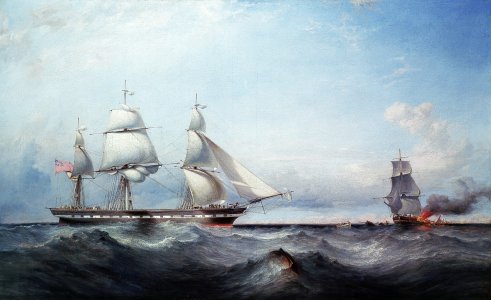
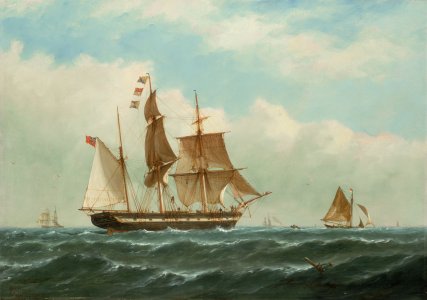
Well, it turns out that the Peerless was not as Peerless as the name suggests. In fact, the 1863 Mercantile Navy List identifies nine British vessels named Peerless. The only painting I could find of one of these Peerless ships is actually of one of these other ships with no relevance to the case (despite this, a number of legal sites, articles, and law school classes incorrectly identify this as The Peerless from the case).

Here is a painting of the Peerless, which depicts neither of the ships in question, but another Peerless built during the same period in England (often mistaken for one of the Peerless ships from the case). Notably, this is a barque named Peerless built in 1859:
bhc3541.jpg

The actual ships were captained by Robert Major and Thomas Flavin, respectively. Both were three-masted, ship rigged (square rigging on all masts), with "yellow" copper plating on the hull and a female figurehead. Major's Peerless, registered as number 20279, was built in 1857 in Dorset England and registered at 841 tons. Flavin's Peerless, registered as number 41935, was built in Quebec in 1858, registered at 1005 tons, and rebuilt in Nova Scotia in 1859 after being wrecked on heir maiden voyage.

For those following the story, it was Major's ship that left in October and Flavin's ship that left in December.

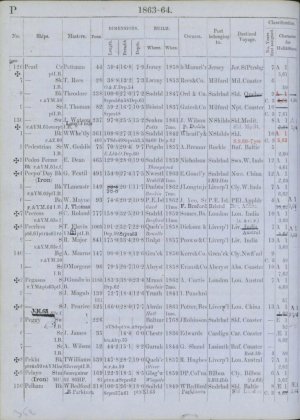
According to Llyod's Register for 1863-64, which lists the two ships together, the dimensions of the ships are as follows:
Detail
Peerless (Major)​
Peerless (Flavin)​
Recorded length
175.0 feet / 53.34 metres​
191.2 feet / 58.28 metres​
Breadth or beam
33.4 feet / 10.18 metres​
32.7 feet / 9.97 metres​
Recorded depth
20.8 feet / 6.34 metres​
22.0 feet / 6.71 metres​

Here is the Lloyd's Register page:
Record 1863.jpg

Candidates for Potential References
While no images or descriptions survive of either Peerless, the same can not be said of all shipping vessels of the period. I have collected some potential close matches based on the 1863-64 Llyod's Register for each ship.

Major's Peerles
Historical Ship
Lenght in Feet (Deviation %)​
Beam in Feet (Deviation %)​
Length divided by Beam (Deviation %)
Peerless175.033.45.240
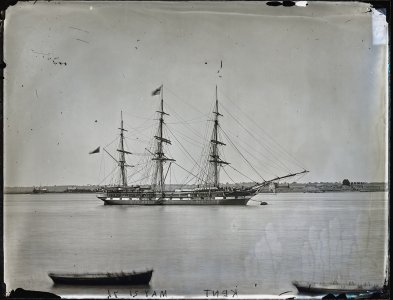
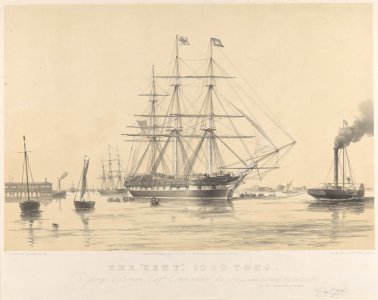
Kent (1853)174.3 (-0.4%)32.5 (-2.7%)5.363 (+2.4%)
Roxburgh Castle (1852)182.5 (+4.3%)34.5 (+3.3%)5.290 (+1.0%)
Northfleet (1853)180.0 (+2.9%)32.3 (-3.3%)5.573 (+6.4%)

While none are an exact size match, most appear quite close. Note that appear to be a bit proportionally narrower than Major's Peerless.

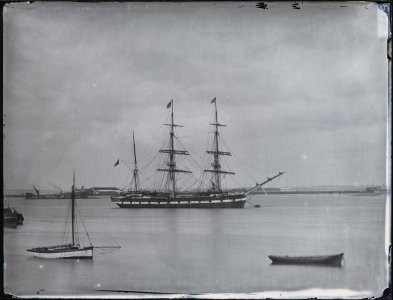
The Kent:
Kent (1853).jpg
Kent 1853 3.jpg

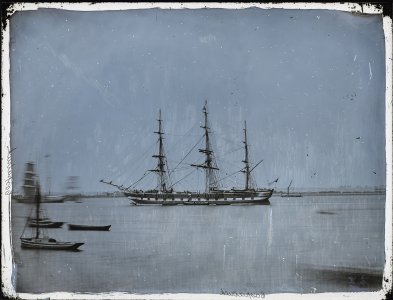
Roxburgh Castle:
Roxburg Castle.jpg

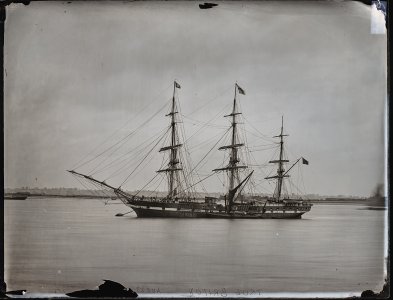
Northfleet:
Northfleet.jpg


Flavin's Peerless
Historical Ship
Lenght in Feet (Deviation %)​
Beam in Feet (Deviation %)​
Length divided by Beam (Deviation %)
Peerless191.232.75.847
True Briton (1861)195.5 (+2.2%)32.3 (-1.2%)6.053 (+3.5%)
Cospatrick (1856)190.0 (-0.6%)34.0 (+4.0%)5.588 (-4.4%)
Northfleet (1853)180.0 (-5.9%)32.3 (-1.2%)5.573 (-4.7%)

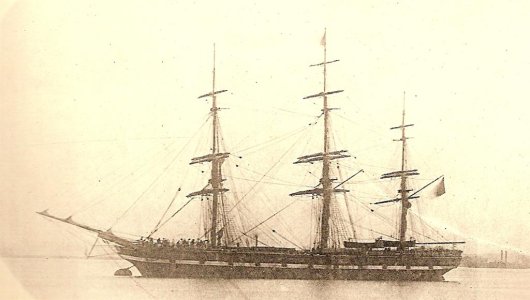
Again, not all exact matches. Northfleet is included twice, as the match wasn't super far off here numerically and there is a surviving photograph.

True Briton:
True Briton.jpg
True Briton 2.jpg

Cospatrick:
Cospatrick.jpg

Next: Finding a Kit to Match!
Any suggestions for kits that could be modified to make either Peerless would be greatly appreciated, as would any feedback on these comparisons (or any suggestions of other comparisons).

Again, I am hoping to do either Peerless, so there's a lot of leeway here (though I imagine either project would lend itself to a lot of creativity because both is essentially a blank canvas as to details etc.).

Next post will outline some kits I'm considering, though any suggestions would be welcome in the meantime.
 
Last edited:
Thanks for delivering this information. I just am thinking what my next ship model may be and I have 1) some desires and 2) some limitations. First I want to provide as many details as possible to my next model. Second, this is difficult as I am living in condo with no space for huge 1:48 ships. My fully rigged model must be not longer than about a meter long (three feet and a bit). I want this to be not a boat but a battle ship carrying some guns.

Your ship looks like good candidate. Thanks again.
 
Hi, apart from a few Cutty Sark's and the Mamoli Flying Cloud, merchant ships from the 1850's are a very rare breed with kit makers. Peerless, in a way :). The best you can do is to find building plans from an actual vessel that approximately resembles the one you want to build and go for a scratch build. I'm sure there are members on this forum to help you draw the outlines for a keel, bulkheads and the deck so you have a base to work from.
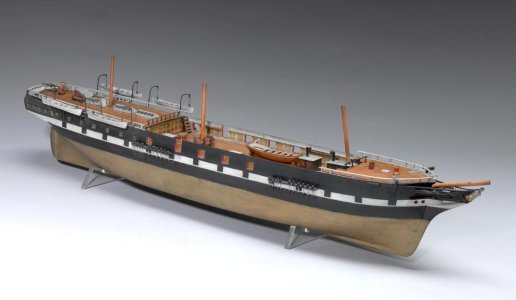
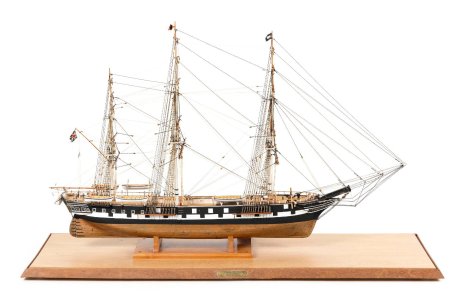
 
Interestingly, it looks like at least two models exist of True Briton, one at the UK's Science Museum Group and another which was auctioned last year.

It seems that the ships have almost a clipper like length to them (comparable to a Cutty Sark, Flying Cloud, or Flying Fish in pure dimensions) with the stylings of an earlier more squared off Frigate design (almost like an elongated HMS Surprise).

Any thoughts on potential kits or ways to approach this as I continue my research would be greatly appreciated!

Science Museum Group (Link: https://collection.sciencemuseumgro...trading-ship-true-briton-model-representation):
Science Museum Group.jpg

Auctioned (Link: https://www.eldreds.com/auction-lot/ship-model-of-the-frigate-true-briton-late-20th_AD54D4AAA8):
Auctioned True Briton.jpeg
 
Short Answer: You can’t

Longer Answer: A ship’s hull lines are what’s known as a “defining characteristic”. In addition to dimensions that you’ve picked off from Lloyds Register, the term hull lines includes things like deadrise, fineness, bow and stern shapes, and tumblehome. For sailing ships built in the 1850’s these characteristics were unique to each vessel as builders competed to balance carrying capacity and speed. Lloyds also says the Peerless was built at Quebec where ships cost less than those built in British yards.

David McGregor is the Dean of historians writing about British owned ships of this period. None of his several books mention Peerless, so apparently none of his excellent drawings are available for her. You, therefore, have no information about reshaping a kit to accurately produce Peerless’s hull lines.

Using a Cutty Sark or similar kit to build a model will just produce a Jackalope; a model of a three masted ship with a misshapen hull.

Roger
 
Short Answer: You can’t

Longer Answer: A ship’s hull lines are what’s known as a “defining characteristic”. In addition to dimensions that you’ve picked off from Lloyds Register, the term hull lines includes things like deadrise, fineness, bow and stern shapes, and tumblehome. For sailing ships built in the 1850’s these characteristics were unique to each vessel as builders competed to balance carrying capacity and speed. Lloyds also says the Peerless was built at Quebec where ships cost less than those built in British yards.

David McGregor is the Dean of historians writing about British owned ships of this period. None of his several books mention Peerless, so apparently none of his excellent drawings are available for her. You, therefore, have no information about reshaping a kit to accurately produce Peerless’s hull lines.

Using a Cutty Sark or similar kit to build a model will just produce a Jackalope; a model of a three masted ship with a misshapen hull.

Roger
Yes, this makes sense. I think the idea is to do my best to approximate what Peerless might have looked like in this period, which presents its own challenges and gives me some creative freedom.

Regardless, it's going to be some form of jackalope; likely a mix of features from a few ships in an attempt to get at what she likely looked like.

Here's what I know for certain: measurements, build location and date, number of masts and sail rigging style, number of decks (for one of the two Peerlesses at least), copper plating, and basic route/trade route information.
 
Since you don’t have a drawing of Peerless’s lines you don’t know how they differ from the reference vessels. A waterline model has the advantage of not showing
Siomething hat’s wrong.
 
Back
Top