• SUBSCRIBE TO SHIPS IN SCALE TODAY!

    The beloved Ships in Scale Magazine is back and charting a new course for 2026!
    Discover new skills, new techniques, and new inspirations in every issue.

    NOTE THAT OUR NEXT ISSUE WILL BE MARCH/APRIL 2026
  • Win a Free Custom Engraved Brass Coin!!!
    As a way to introduce our brass coins to the community, we will raffle off a free coin during the month of August. Follow link ABOVE for instructions for entering.

AI Is Here To Help

Hey Pat,

I too have used AI for research & info on shipbuilding.

Here is my take on AI:

Objective = 25%
Subjective = 25%
Fascinating = 25%
Creepy = 25%
 
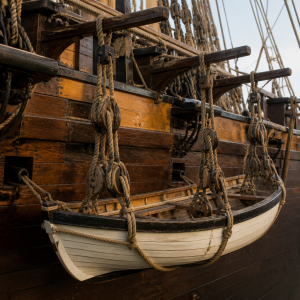
I asked AI what is wrong with this photo. Here is what it told me.

“Quite a few things are “off” if you look at it like a real age-of-sail ship instead of an AI-generated image.

Here are the biggest problems:
  1. The lifeboat rigging makes no mechanical sense
    • The falls (ropes) are tangled and routed incorrectly.
    • Several blocks appear to float or dead-end.
    • The tackle geometry would not actually lift or lower the boat evenly.
    • Some ropes appear to pass through other ropes or wood.
  2. The davits are inconsistent
    • The support brackets and arms change shape from one station to the next.
    • Some davits look too weak to support the boat load.
    • The mounting hardware is not symmetrical or historically believable.
  3. Impossible rope behavior
    • Rope thickness changes randomly.
    • Certain lines bend unrealistically sharply.
    • Some coils merge together organically like melted clay instead of laid rope.
  4. The blocks are malformed
    • Several pulley blocks have impossible sheave arrangements.
    • Some blocks appear fused into the rigging.
    • A few don’t even have a believable rope path through them.
  5. Boat suspension is wrong
    • The boat is hanging from too many conflicting attachment points.
    • The load distribution would twist the boat badly in real life.
    • Some lifting lines are attached at awkward or structurally weak places.
  6. Scale inconsistencies
    • Some ropes are enormous compared to nearby fittings.
    • Certain blocks are too large for the supposed boat size.
    • The spacing between davits doesn’t match the boat’s balance points.
  7. Deck and hull details blur into each other
    • AI smeared some plank seams and fittings.
    • Metal brackets mutate into rope textures in spots.
    • Several shadows/light directions are inconsistent.
  8. Historically questionable arrangement
    • On many sailing ships, boats were either:
      • stored amidships on skids/chocks, or
      • suspended from more orderly davit systems.
    • This arrangement looks like a hybrid fantasy setup.

This is actually a very typical AI image:

  • excellent mood and texture,
  • convincing at first glance,
  • but mechanically impossible when inspected closely.

For model work, this is exactly why AI reference images are dangerous for rigging unless cross-checked against real ship plans or museum photos.
 
AI basically repeats what it finds on the web. In doesn’t run an engineering analysis to see if what it’s found actually works. Post the picture and ask it (AI) explain how the rig will lower the boat. The picture looks like someone from Hollywood imagining how to lower a boat.

Most serious ship model builders acquire a library. In your case I recommend Seamanship in the Age of Sail by John Harland.

Roger
 
Hi All
Being retired electronics engineer and having worked with, on and for most computer communications, control and network systems from 1977 till 2015 when I retired. I noticed this new innovation called Artificial intelligence which is aptly named. An intelligence that is totally artificial and not thinking in the sense. It is like the earlier robots as it has no thought but just a very good comparison technology to refer to. So, when you ask an artificial intelligence something, it refers what it has in data regarding the subject you have requested and what it can search for not what is correct. Sometimes you can get something that is correct, but you have to frame the question correctly to obtain the answer you are looking for.
I find it useful for adjusting photos and checking documents but apart from that it is still very poor in its execution of structured requests.
The jobs it is taking if you look at the are generally data comparison and repetitive jobs not ones that require actual thinking at this point.
However, it is being used dangerously to write its own code for improvement of itself.

Just my 5 cents worth Thanks
 
Back
Top