• Win a Free Custom Engraved Brass Coin!!!
    As a way to introduce our brass coins to the community, we will raffle off a free coin during the month of August. Follow link ABOVE for instructions for entering.
  • PRE-ORDER SHIPS IN SCALE TODAY!

    The beloved Ships in Scale Magazine is back and charting a new course for 2026!
    Discover new skills, new techniques, and new inspirations in every issue.

    NOTE THAT OUR FIRST ISSUE WILL BE JAN/FEB 2026

Am I mad?

hello Odd Job

Greetings and a welcome from a fellow Brit.

Well, you started something there. Everyone has opinions on how best to help someone onto the greased slope of model making, and it’s a delight to read the differing viewpoints and suggestions. You and I sound not too dissimilar, and I have the idea that I appreciate where you are coming from.

If we were in t’pub with a jar we’d be chatting about modelmaking and life choices.

To answer the question - no , you aren’t mad. Square rigged ships are seascape enhancingly pretty, so of course you’d like to make one. People like us think of making things before buying something someone else made. Want a bird box that’s worthy? Make one (an outstanding build, you could make a living selling them in the right places). Want a model ship' made of wood’ - make one. Something that you can do in the house? A ship model would work. Needs a decent table/workbench of course, with a rail round the edge to stop things escaping. You’ll need a few new tools to do very accurate work on very small parts in tight grained timber. Nothing else apart from an interest in ships and how they are made.

As for what you build, it’s completely up to you. Large and complex ships with many masts, sails, guns involve probably thousands of small parts, each needing a high degree of accuracy. Large scales demand even higher detail, because people expect to be able to see the nails.
An early choice is whether to buy a ‘kit’ or act like a shipbuilder and start with a drawing and some suitable seasoned, fine grain timber. Maybe considering looks if you feel like leaving it unpainted. You’ll know enough about timber to make good choices.
Most of this forum is concerned with kits, and from what I’ve read, they are often either not well fitting, or not accurate, or both.

You need to consider what’s the main thing; is it the model at the end of the process, the process itself, the research and reading to make an accurate model, the time in front of the fire instead of in the cold workshop, or I find that the mental focus on the work in hand is good therapy in taking my mind off other unwanted stuff. Making bits of ship is good at that, when a few thou error can become cumulative.

Me? I’d read Harold Underhill’s “plank on frame models” to get a feel for the process, for the marking out, for the detailed work in building your own choice and getting it right. His techniques are the basic skills whether you work from a kit or pen, pencil and timber so it isn’t time wasted.

Of course, being a Yorkshireman, I think these kits that use widely spaced ‘frames’ are overpriced anyway, and by their nature there are hundreds of models just like the one you put together. I’d prefer something no’one else has in their window.


That’s my two pen’orth.

Jim

Oh, when I hit send on this I just found your post saying that you’ve gone for something, so you can ignore the ramblings above.
Good luck!
Hi Jim

I too am in Yorkshire near Wakefield, so maybe we might be able to have a jar together at some point.
 
Well I've made an executive decision and gone for this. I found it on offer at a reasonable price so this will be my entry into the world of model ship building. I intend to create a build log and will post about my experience. I will no doubt be asking for help along the way and know I can rely upon the experts on here to provide it.

Thank you all for your comments, I have appreciated them all. And maybe one day I will get to build the San Felipe.

Cheers everyone :)

Graham, I think the Beagle is a fine choice. One thing OcCre has in its favor are the clear building instructions with photographs (also available on their site in PDF so you can zoom right in), as well as build videos (also on their site). I look forward to following your progress.
 
And why would anyone with your imagination and abilities even want to be a serious kit modeller? Why not trying to build a ship like you build your bird feeders, with your own fantasy, from whatever materials that fall into your hands and from scratch? Something like this. No one is mad just for being somewhat imaginative and otherwise agreably deranged, for doing his own thing, his own way. There's your 'plan', the length on deck is about 4 breaths... The rest is up to you.
View attachment 568576
A ship built based on what you want it to look like would sell well in the retail market, look at all the fantasy works being sold for home decor use, who said it had to be build to specific plans and design.
 
Well I've made an executive decision and gone for this. I found it on offer at a reasonable price so this will be my entry into the world of model ship building. I intend to create a build log and will post about my experience. I will no doubt be asking for help along the way and know I can rely upon the experts on here to provide it.

Thank you all for your comments, I have appreciated them all. And maybe one day I will get to build the San Felipe.

Cheers everyone :)
Use the search tool and input the ships name, and see what others have posted and built. Review of this builds may reduce issue you come across as other have already identified them and hopefully come up with answers. That is one of the best reason I like SOS folks, always willing to provide help or humor when needed.
 
Hmm. 30 years ago I build the San Felipe as my third model (after Hannah and Constellation). It took me 15 years to finish it! It travelled around the country, gathered dust on shelves, and I always had a slight sense of guilt when I noticed it calling out to me for attention. The build wasn’t terribly difficult, but the repetitive nature of the work was what made me look at smaller challenges.

I finished San Felipe just as I retired and moved to the mountains. By that time, and with a smaller house, it was far too big to display! I ended up giving it to a good friend with plenty of space so that it did not have to travel cross-country in a packed UHaul.

With hindsight, I would still have made the model, but probably started 15 years later!
 
I'm building this Philip model from ZHL right now. In any case, I do not recommend it for novice ship modelers. Even with considerable experience in building models, I encountered some difficulties due to the incorrect initial design of the frame. And yes, I also bought the lining rails for the sides and deck separately, and many other things that I would have to make myself or buy like the same hinges for the gun ports. And the guns on the upper deck are a little out of size here. In fact, the only thing I needed from the kit was a precisely laser-cut frame, primary skin rails, and imitation resin ship carvings. In principle, my work is progressing quite successfully, but once again this should not be your first model.
 
Graham…you got a lot of advice in these postings. My experience is to remember building a model ship, no matter how small or large, simple or complex, is always one part at a time. Focus on the part. Do not get intimidated by the thousand other parts. Take up and focus on that one part and move on to the next.
 
Hi from Tampa, Florida Odd Job! I have learned a lot and considered a lot of the advice given. Your bird house is beautiful and proves you have the necessary skills. I also have some applicable skills- I’m a retired surgeon and specialized in reconstructive foot and ankle surgery so I was familiar with some of the tools and techniques when I started building. My old chief and mentor used to say that those who want to learn surgical techniques should take wood shop in school. Although I’m still a beginner- I’m on my 4th and 5th builds now- I have learned a lot so far. Forums like this one and various other sources have helped me tremendously.

My first build was the Krabbencutter by Billing Boats. It’s a shrimper not a crab boat (in German shrimp are called Krabben and crabs are called Krebs). Although the rigging is relatively simple if you don’t know how the rigging works you The instructions were pretty good but the plans were awful: the rigging was portrayed by a number of lines that were intersecting and almost parallel. Even with a straightedge I couldn’t figure out what went where. So I studied rigging and managed to figure out almost everything. Know what? It came out great. Although the kit quality is not good my build certainly was. All the lines work: I can raise and lower the outriggers and spars and open and close the nets. I wanted to try a square rigger but knew I should learn more. I bought the Rattlesnake but haven’t started it yet because I wanted to improve my skills. Do I followed Masini’s advice in his book Ship Modeling Made Simple: I bought the schooner Bluenose and have started rigging. I was very fearful and thought I wouldn’t be able to do it. Looked very intimidating. But ya know what? I’m doing very well with it and it’s not that bad. I just study the lines thoroughly and do it. If I make a mistake I just repeat it till I get it.

As others have said, it’s a hobby not life and death. So what if you mess up a little? No biggy, it’s part of the learning process. I’m sure plenty of experienced builders make mistakes but all of us are learning. If you love a certain model you will indeed fall in love with it and treat it like your loved one.

My heart is set on building the square rigger that’s in my cabinet. Hopefully it will help me learn to build even bigger square riggers that I want to build. And if I mess it up so what. I’ll just try it again.

SO DO IT!!
 
So I followed Masini’s advice in his book Ship Modeling Made Simple: I bought the schooner Bluenose and have started rigging. I was very fearful and thought I wouldn’t be able to do it. Looked very intimidating. But ya know what? I’m doing very well with it and it’s not that bad. I just study the lines thoroughly and do it. If I make a mistake, I just repeat it till I get it.

Books with the words "simplified" or "made simple" in their titles often disappoint because if a subject needs simplifying, it's not simple. If it's rigging that interests you, then focus upon how sailing rigs work, not just how the "strings" look on your kit plans. Once you understand the mechanics of wind power, you'll have no problems replicating it to scale.

That said, rigging is an evolved technology and it is particular to its period and location. A 17th century Spanish ship's rigging will be quite distinct from an 18th century British ship's rigging. There are many encyclopedic works on sailing rigs and rigging but if you have an interest in a particular period or type of vessel, it's obviously best to read any of the specialty books that address that period or type of vessel.

I envy you your surgical skill and experience. It was only in recent years that I discovered the rather extensive selection of YouTube tutorial videos teaching medical students instrument suture tying technique. They changed my life when it came to rigging scale models. I learned the theory of rigging by doing it on full-size vessels, so my biggest challenge in scale modeling was the technique of doing it at scale sizes. That's where surgical instrument knot tying was invaluable to me. You've come to ship modeling in the reverse order... you've got a complete mastery of the techniques of manipulating tiny knots in confined places and need now only learn the theory of where to tie those knots and why. I found learning the rudiments of instrument tying yielded a quantum leap in my modeling skill and I expect your learning the theory of rigs and rigging will do the same for your modeling abilities.

I would recommend any sailing ship modeler equip their ship modeling research library with the at least the three following rigging classics which have become my "go-to trifecta" for rigging information. There are more generalized (and perhaps less costly) books on the subject, but we're talking about reference resources here, so it's best to spend a little bit more if necessary and obtain the equivalent of The Oxford Dictionary of the English Language instead of trying to save money by buying a copy of Merriam-Webster's Collegiate Dictionary. (Which reminds me to mention that every scale ship modeler ought to have a copy of The Oxford Companion to Ships and the Sea, the definitive dictionary of all things maritime compiled by the OED. See: https://www.amazon.com/Oxford-Companion-Ships-Reference-Collection/dp/0198800509) All these books are available online and if price is a consideration used copies of all are presently available at substantially less cost.

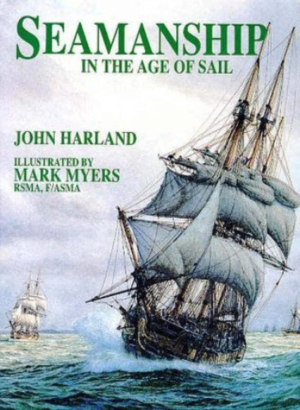
1) John Harland's Seamanship in the Age of Sail which is a great resource on how sailing ships are sailed and why they are rigged the way they are.

2) James Lees' Masting and Rigging of English Ships of War which is a complete compendium of British naval sailing rigs and rigging practices throughout the period when "Britania ruled the waves."

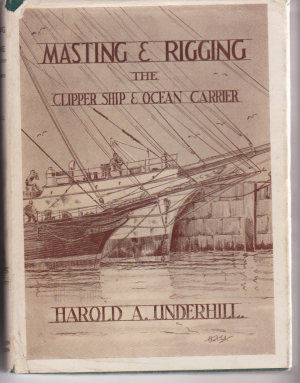
3) Harold A. Underhill's' Masting and Rigging the Clipper Ship and Ocean Carrier which focuses on merchant sailing rigs and rigging practices from approximately 1850 through the end of commercial sail.


1768164539717.png


1768165174414.png


1768165216816.png
 
Last edited:
Thanks for your recommendations re: the treatises on rigging and seamanship. I have been reading several works by Chapelle and others and have visited several maritime museums. The only reason I mentioned Mastini’s book is that he recommended the Bluenose (actually the Bluenose II) as a kit that would have relatively simple structure and rigging appropriate for a beginner. It did provide me with some basic knowledge and I did find it useful. Just as you can’t perform sophisticated surgical procedures without a foundation in anatomy you have to start somewhere. I thank you for your recommendations and I enjoy your posts
 
Sorry, I accidentally hit the ”post reply” tab prematurely. I also meant to say that I enjoy your posts and have learned from them. My late karate teacher used to say “Knowledge is acquired not given”.
 
Back
Top