I'm a new member working on a Spray kit from Bluejacket. I'm trying to add more detail to the anchor rigging than what's provided in the original kit but after much internet research cannot find any information on how the Spray (or similar smallish 19th century sloops) would have secured the anchor. Photographs of the spray show the anchor secured from the port side of the boat but I cannot make out how it is secured. It doesn't appear that the Spray used an actual cathead with associated blocks, lines and securing paraphenalia etc. Other modelers who have posted their completed Spray builds on the internet seem to have dealt with the anchor by placing it on the deck unsecured to stanchions, eyepins, etc. Does anyone know how anchors were secured on Spray-type sloops?

-

Win a Free Custom Engraved Brass Coin!!!
As a way to introduce our brass coins to the community, we will raffle off a free coin during the month of August. Follow link ABOVE for instructions for entering. -
PRE-ORDER SHIPS IN SCALE TODAY!
The beloved Ships in Scale Magazine is back and charting a new course for 2026!
Discover new skills, new techniques, and new inspirations in every issue.
NOTE THAT OUR FIRST ISSUE WILL BE JAN/FEB 2026
You are using an out of date browser. It may not display this or other websites correctly.
You should upgrade or use an alternative browser.
You should upgrade or use an alternative browser.

WELCOME TO SoS Pete
I have no idea if this is similar but maybe will be a little help. There are a lot of photos of fishing schooners from the late 19th century that might help. There are a lot of photos of similar vessels in the Library of Congress website that can be downloaded for free. Maybe there are some there that could help.
Allan
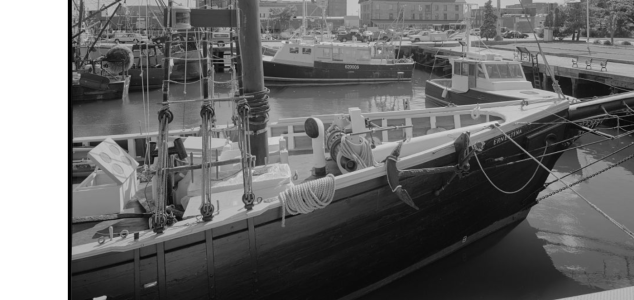
I have no idea if this is similar but maybe will be a little help. There are a lot of photos of fishing schooners from the late 19th century that might help. There are a lot of photos of similar vessels in the Library of Congress website that can be downloaded for free. Maybe there are some there that could help.
Allan

Thanks! This clearly shows the position of the anchor and the rigging line around the arms of the anchor. I'll check out the LoCongress files.WELCOME TO SoS Pete
I have no idea if this is similar but maybe will be a little help. There are a lot of photos of fishing schooners from the late 19th century that might help. There are a lot of photos of similar vessels in the Library of Congress website that can be downloaded for free. Maybe there are some there that could help.
Allan
View attachment 570159
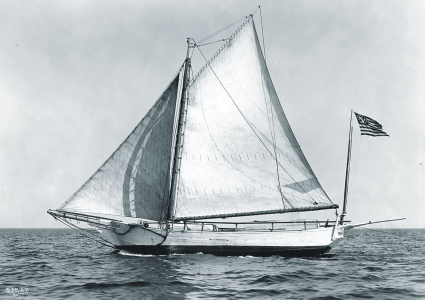
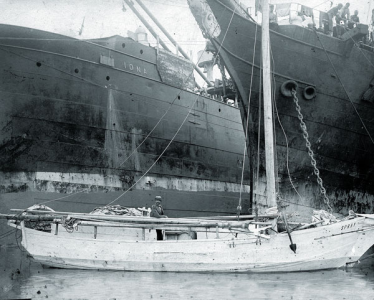
Yes thanks, I have these. They just didn't have the level of detail I was looking for.Just found these photos of the Spray. I am guessing you already have them, but just in case...
Allan
View attachment 570167
View attachment 570169View attachment 570171

I built a scratch model of the Spray many years ago from the published plans and many photos of the Spray in various books about Slocum. I no longer have all of my reference material but I've attached a picture of the bow of my model so you can see how I handled the anchors. FYI the Bluejacket kit produces a nice model but it is in many ways inaccurate when compared to Spray's plans and photos.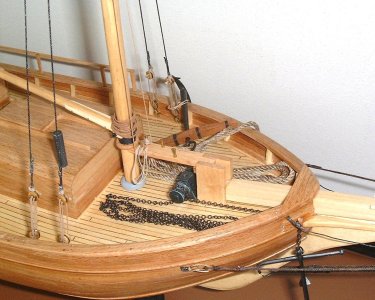
one thing that has me puzzled with anchors, especially on large ships with anchors weighing thousands of pounds...
realize weighing anchor on a rocking rolling ship can be and is an extreamly dangerous task. how is it the ship rails n decks arent getting destroyed with that swinging anchor being lifted over the sides? or even with the anchor secured to the side of the ship... rubbing steel against the hull or just the wrong wave slaming the ship as its dangling. oh yea the bill board, but from the ships ive built, they just dont seem to be enough protection.
realize weighing anchor on a rocking rolling ship can be and is an extreamly dangerous task. how is it the ship rails n decks arent getting destroyed with that swinging anchor being lifted over the sides? or even with the anchor secured to the side of the ship... rubbing steel against the hull or just the wrong wave slaming the ship as its dangling. oh yea the bill board, but from the ships ive built, they just dont seem to be enough protection.
Attached are the plans I used. They were supplemented by the many photos of Spray I found in various books to get the deck details. If you Google "Plans for Slocum's Spray" you'll have no trouble finding enough info for a scratch build. It was a fun project and well worth the effort.Nice model polydoc! I would like to know where to order the plans you mentioned, Spray has been on my future builds list for a while. Thanks
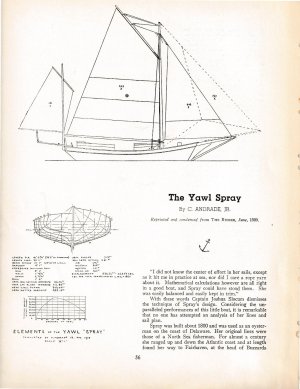
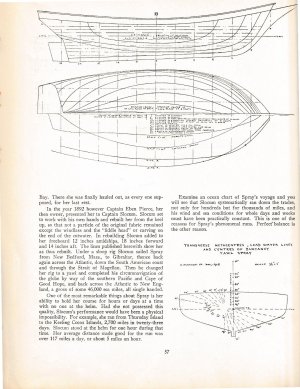
Very cool! Thanks for sharing!Attached are the plans I used. They were supplemented by the many photos of Spray I found in various books to get the deck details. If you Google "Plans for Slocum's Spray" you'll have no trouble finding enough info for a scratch build. It was a fun project and well worth the effort.
View attachment 571397View attachment 571398
Hello paul, when at sea the anchor ring was secured at the end of the cathead and the business end brought over the rail and lashed tight so nothing would move. I suspect the "proper" way of lashing the anchor to the rail varied with ship size, type and era. The anchor could also be brought onboard, its stock removed and everything lashed flat against the deck, for long passages.one thing that has me puzzled with anchors, especially on large ships with anchors weighing thousands of pounds...
realize weighing anchor on a rocking rolling ship can be and is an extreamly dangerous task. how is it the ship rails n decks arent getting destroyed with that swinging anchor being lifted over the sides? or even with the anchor secured to the side of the ship... rubbing steel against the hull or just the wrong wave slaming the ship as its dangling. oh yea the bill board, but from the ships ive built, they just dont seem to be enough protection.
 manipulations were done with the Burton pendant, a tackle with lots of purchase hanging from the topmast head. It had a hook at its lower end and served as a crane. I may be wrong but I think the billboard was there mostly to protect during manipulations, not necessarily as a permanent "pad" for an anchor fluke to rest against. Harold Underhill's "Masting and Rigging" is a great source of info for such details.
- Joined
- Jun 29, 2024
- Messages
- 1,565
- Points
- 438

Period books speak about a vessel “being within soundings”. In other words, the water was shallow enough where depth could be measured with the sounding lead. Beyond this the anchor was useless as the cable was not long enough to set the anchor with enough scope to be effective. I, therefore, agree with the post above that if the voyage would sailed beyond soundings that anchor would be brought inboard and secured. The cable would be stored and often the hawse holes would be plugged.
A model fitted with billowing sails and the anchor dangling from the cathead is the famous oxymoron.
Roger
A model fitted with billowing sails and the anchor dangling from the cathead is the famous oxymoron.
Roger
There was often an anchor lining from 2 " to 3" thick depending on the size on the ship and era, so the anchor did not bump against the planking. In looking at contemporary models, I am surprised many of them do not show this feature.how is it the ship rails n decks arent getting destroyed with that swinging anchor being lifted over the sides? or even with the anchor secured to the side of the ship...
No lining on a model of a 36, late 18th century
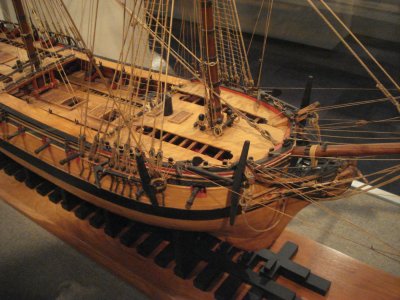
Lining shown on a 60, circa 1705
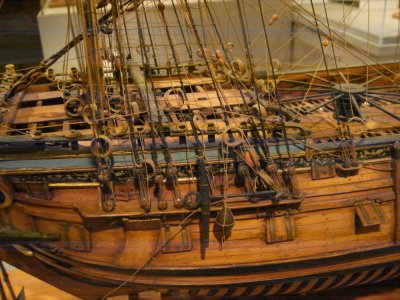
Something that really surprised me is that the scantlings for the linings are given for each rate in the Establishments, The Ship Builder's Repository, and David Steel's The Elements and Practice of Naval Architecture but not on any of the contemporary plans that I looked at.
even with a lining, you have the equivelent of a garbage truck dangeling uncontrollably like a wrecking ball with teeth from the moment it surfaces the water as the ship is rocking n rolling in the wave action. how is it kept from slamming the hull?
then how much weight can the rails endure as ur getting the anchor over it? its hard to imaging how tough the construction of these ship are.
ive been on schooners with a small achor, it was swinging occasionally hitting the sides as we lifted er up, but being so light, it didnt do any damage.
id love to see how they weighed anchor. i read about the process, i fully understand how its done and all the protections, but would love to see it done.
then how much weight can the rails endure as ur getting the anchor over it? its hard to imaging how tough the construction of these ship are.
ive been on schooners with a small achor, it was swinging occasionally hitting the sides as we lifted er up, but being so light, it didnt do any damage.
id love to see how they weighed anchor. i read about the process, i fully understand how its done and all the protections, but would love to see it done.
Last edited:
Not old time sailing but interesting.id love to see how they weighed anchor
There are other videos that I found but none of them show the catting so no help in answering your question.
Allan
amazing how much man power is needed to do anything on these ships and the risks. ill bet quite a few fingers became fish food.
thanks for the video.
thanks for the video.
It does not get any easier in modern times with machine power. Watch to the end.
Allan
Allan
omfg! they lost that one! smoke n flames... hahahahaha thats crazy.

Oupsie!It does not get any easier in modern times with machine power. Watch to the end.
Allan