• Win a Free Custom Engraved Brass Coin!!!
    As a way to introduce our brass coins to the community, we will raffle off a free coin during the month of August. Follow link ABOVE for instructions for entering.
  • PRE-ORDER SHIPS IN SCALE TODAY!

    The beloved Ships in Scale Magazine is back and charting a new course for 2026!
    Discover new skills, new techniques, and new inspirations in every issue.

    NOTE THAT OUR FIRST ISSUE WILL BE JAN/FEB 2026

APA ships, questions

Joined
Apr 19, 2020
Messages
164
Points
143

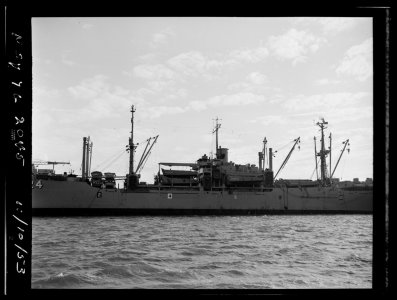
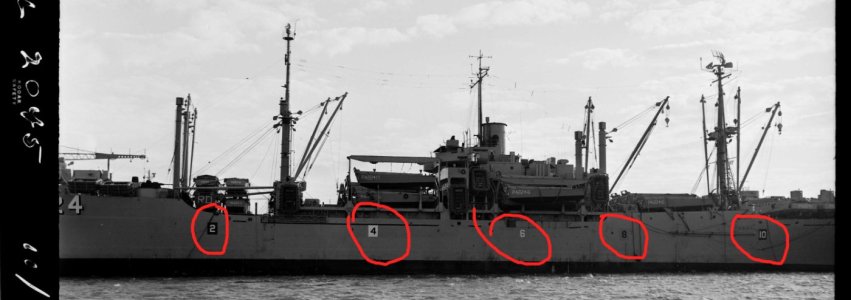
In this case, a question arose about applying numbers in colored squares on board for mooring a landing boat. What year was this approved? Was this in WW2?
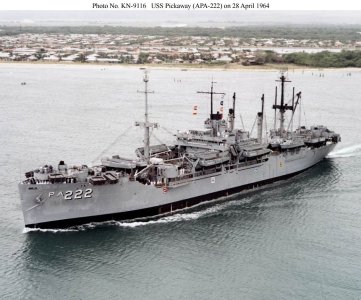
Haskell-class transports

222ц.jpg

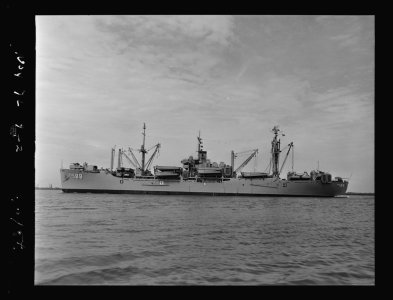
rg19nn-b1569-009-010_pr.jpg
 
Any explanation of the different colors of the number blocks?

I watched the 1956 film "Away All Boats," which was filmed aboard the APA-224 USS Randall. There, I heard commands for boats to dock at "green 6" and "red 2" (I think). I think this is convenient for identification when the numbers are not distinguishable from a long distance or in clear weather.
That's why the question arose whether these signs were in WW2, although I haven't come across any photographs from that time, only post-war ones from the 1950s.

rg19nn-b1570-004-004_pr.jpg
 
After two ad-hoc invasions that fortunately met slight resistance on the beaches (Guadalcanal was bitterly resisted only after the successful landing and North Africa against French forces) the US Navy and Marines appear to have tackled this problem with 1940’s industrial principals. For example the amazing variety of landing craft produced on short notice by American Industry. It therefore, would follow that aboard the attack transports systems were developed so the landing craft crews could land the right guys at the right places on the beach. These numbers would have served that purpose.

Roger

 
After two ad-hoc invasions that fortunately met slight resistance on the beaches (Guadalcanal was bitterly resisted only after the successful landing and North Africa against French forces) the US Navy and Marines appear to have tackled this problem with 1940’s industrial principals. For example the amazing variety of landing craft produced on short notice by American Industry. It therefore, would follow that aboard the attack transports systems were developed so the landing craft crews could land the right guys at the right places on the beach. These numbers would have served that purpose.

Roger
Mr. Pellett, in order to plan the creation of a model ship of the APA for WW2, do you know the time when the mooring markings for boats were applied to the side of the APA`s?

rg19nn-b1570-004-004_pr.jpg
 
Greetings everyone)
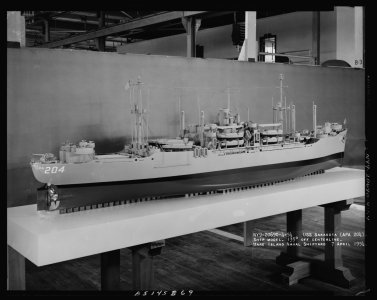
NARA has several photos of the 1954 model APA-204 USS Sarasota (Haskell class). What is known about her? Where is this model located now? Are there any modern photos of this model?

I also have a question about other C3-type transports converted into Bayfield-class APAs. Has anyone ever made models of these ships?

rg19nn-b1570-002-004_pr.jpg
 
1954 model APA-204 USS Sarasota (Haskell class). What is known about her? Where is this model located now? Are there any modern photos of this model?
The model was on display in the lobby of the Terrace Building in Sarasota, Florida and may still be there. The11.5-foot-long model was discovered by former crew member John Shilalie in Massachusetts in 1982. It was brought to Sarasota in 1989. You can call them to confirm A quick search brought up a phone number, but I have no idea if it is correct or a good idea to post it here on a public website.
Allan
 
Last edited:
Thank you very much Allan for the important information.
Unfortunately, I can't call Sarasota from Russia, so I'll have to rely on Google search, hoping someone took a photo of this model and posted it online...

I have some more questions, with respect:
Do you know any information on the Bayfield-class (APA-33) shipmodels converted from C3 cargo ships? Have any models of these ships been built in the US?
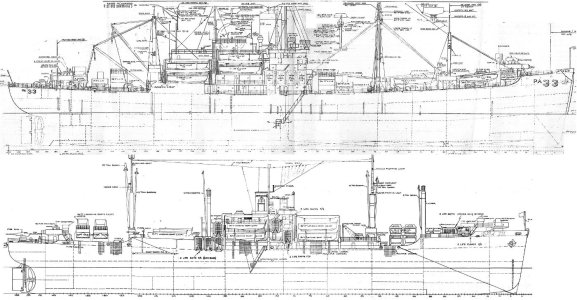
I've now prepared two sets of plans for the Haskell and Bayfield class, and I'm drawing lots to choose which one to build after Easter (April 12th, I think I'll have completed as much work on the current project as possible by then).
...although I'm more inclined towards the Haskell class :)

APA.jpg
 
Last edited:
Found the following ---- hope it is helpful.

  • Shipscribe.com (USS Bayfield Class, Part 1): Offers detailed information, dimensions, and photographic evidence of the conversion from C3-S-A2 cargo vessels, including deck layout changes.
  • USN Dazzle (Measure 32 Design 3D): Provides specific camouflage and modification drawings for the Bayfield-class (specifically Design 3D), useful for modeling the vessel as it appeared around January 1944.
  • NavSource Naval History: Features high-resolution photographs of the USS Bayfield (APA-33) off the New York Navy Yard in November 1943, showcasing the conversion, including the added twin 40mm gun mounts and additional deckhouses.
  • MARAD Vessel History Database: Provides technical specs, including a 492-foot length, 70-foot beam, and the original C3-S-A2 design details.
  • Outboard Profiles of Maritime Commission Vessels: Contains drawings of various C3 cargo ship conversions.
    NavSource +7
Conversion Details for Modeling:
The Bayfield-class ships were heavily modified from their original cargo configurations (originally designated for the Maritime Commission, such as Sea Bass and Sea Snipe) to function as amphibious attack transports. Key features to include in a model based on these drawings:
  • Additional Deckhouses: Two additional deckhouses were added aft of the stack for command facilities.
  • Armament: 2 5-inch guns, 8 40mm guns, and 24 20mm guns were typically added.
  • Boats: Large davits for Higgins boats (LCVP) and other landing craft were installed along the sides.
  • Kingposts: Additional short kingposts were installed just forward of the bridge.
    NavSource +4
These vessels were mostly built by Western Pipe & Steel Company in San Francisco and converted at Atlantic Basin Iron Works in Brooklyn
 
Back
Top