

- Joined
- Nov 10, 2019
- Messages
- 524
- Points
- 453

With this post, I’d like to give a small insight into how I try to reproduce the characteristic French block designs with strops from around 1830 in model scale.
For my work on the rigging of my French corvette La Créole (1827, scale 1:48), I have produced the blocks over an extended period, following contemporary French practice. The shapes are based on the Atlas du Génie Maritime, while the dimensions follow the tables published in Jean Boudriot’s monograph.
All blocks are made from service tree (Elsbeere), whose very fine grain provides an excellent scale appearance. From a block size of about 5 mm in length, I fitted real sheaves. Historically, these sheaves were almost always made of ironwood (lignum vitae), an extremely hard, self lubricating wood widely used in naval rigging. In model scale, blackened brass comes very close to the look and character of the original material.
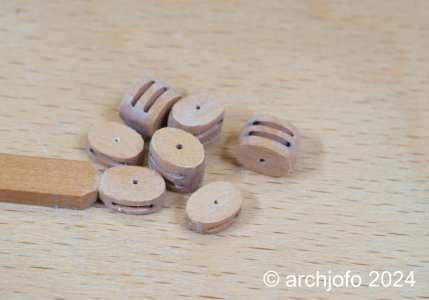
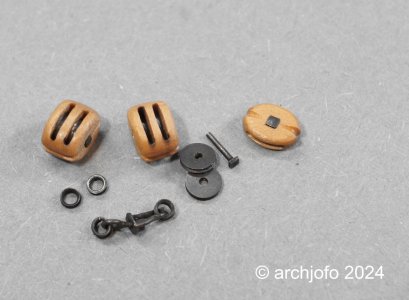
The block with a square head pin corresponds to French construction of the early 19th century.
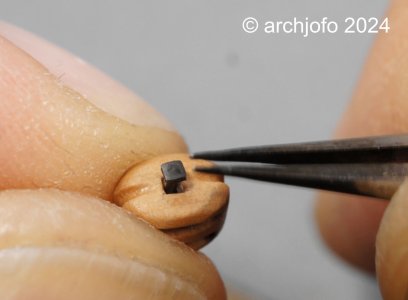
The stropping also follows period practice: – wherever the originals used served strops, I reproduced them in the same manner, – long splices were used for stropping lead blocks, as documented in French rigging.
The ends of the block strops are hardened with a drop of CA glue, then cut at an angle and bonded. These joints are covered by the characteristic flat seizing, which not only hides the connection but also adds structural strength.
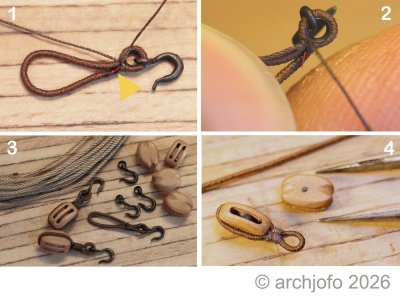
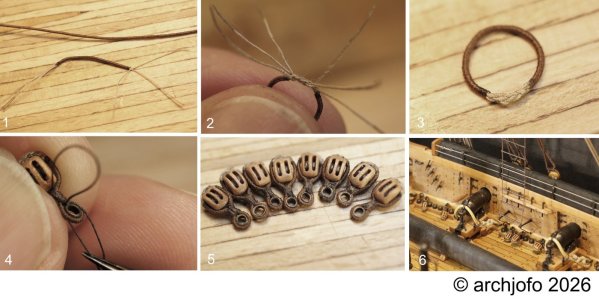
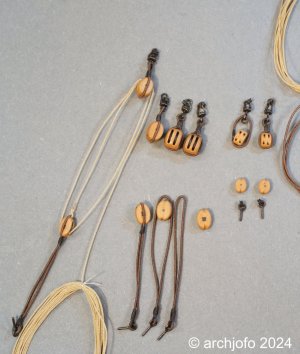
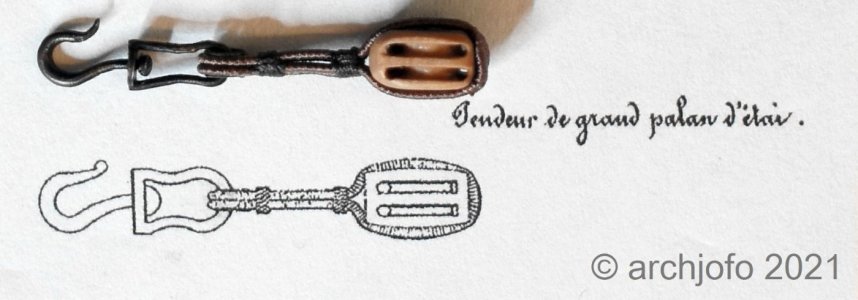
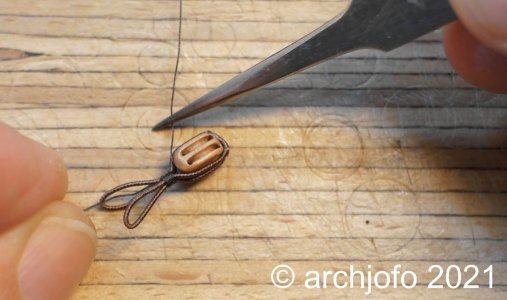
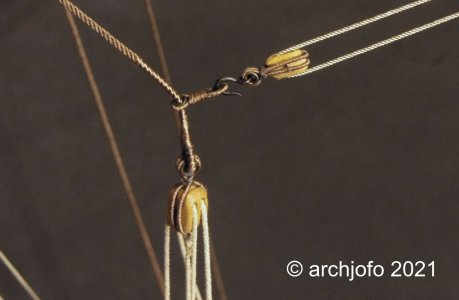
The examples shown include lead blocks, blocks for the topping‑lift tackles of the lower yards, as well as the block of the stay tackle, some fitted with the typical swivel hooks commonly found in French rigging of the period.
Only a few exemplary block types are shown here; the rigging of La Créole naturally includes many additional types and sizes according to French naval practice.
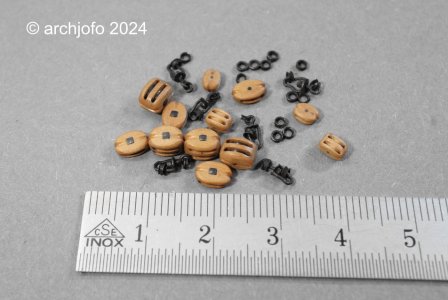
For my work on the rigging of my French corvette La Créole (1827, scale 1:48), I have produced the blocks over an extended period, following contemporary French practice. The shapes are based on the Atlas du Génie Maritime, while the dimensions follow the tables published in Jean Boudriot’s monograph.
All blocks are made from service tree (Elsbeere), whose very fine grain provides an excellent scale appearance. From a block size of about 5 mm in length, I fitted real sheaves. Historically, these sheaves were almost always made of ironwood (lignum vitae), an extremely hard, self lubricating wood widely used in naval rigging. In model scale, blackened brass comes very close to the look and character of the original material.
The block with a square head pin corresponds to French construction of the early 19th century.
The stropping also follows period practice: – wherever the originals used served strops, I reproduced them in the same manner, – long splices were used for stropping lead blocks, as documented in French rigging.
The ends of the block strops are hardened with a drop of CA glue, then cut at an angle and bonded. These joints are covered by the characteristic flat seizing, which not only hides the connection but also adds structural strength.
The examples shown include lead blocks, blocks for the topping‑lift tackles of the lower yards, as well as the block of the stay tackle, some fitted with the typical swivel hooks commonly found in French rigging of the period.
Only a few exemplary block types are shown here; the rigging of La Créole naturally includes many additional types and sizes according to French naval practice.