


• Ships of Scale has incorportated an extra level of security when you log In. Please follow on-screen prompts to acknowledge that you are not a robot via a "Check Box" or a "Pictorial Check Box Puzzle". This is needed due to higher level of AI Activity Security.
  • SUBSCRIBE TO SHIPS IN SCALE TODAY!

    The beloved Ships in Scale Magazine is back and charting a new course for 2026!
    Discover new skills, new techniques, and new inspirations in every issue.

    NOTE THAT OUR NEXT ISSUE WILL BE July/August 2026
  • Win a Free Custom Engraved Brass Coin!!!
    As a way to introduce our brass coins to the community, we will raffle off a free coin during the month of August. Follow link ABOVE for instructions for entering.

Bomb Vessel Granado 1:96 from Admiralty plans and P. Goodwin

Joined
Apr 18, 2025
Messages
580
Points
273

Location
Kent Weald, South East England
Having a pause from the 1:96 Enterprise, which is close to completion, and starting on the Granado scratch-build.

Working in CAD the hull still needs some adjusting but I couldn't resist making a 3D print to see what she is like in the real world. Print will complete later this afternoon........................

I've made the top of the timbers five inches moulded at the rail, but every other model I see, and Goodwin, seem to suggest they are much thicker. There is a notion that they needed to be stronger for the mortars, but I can't see how that would work as most of the recoil would be downward towards the heavily reinforced hull. With the additional weight of the mortars so high above the centre of gravity, it seems that saving weight by having the thinner timbers would be possible? Furthermore, the bomb vessels Comet and Furnace have much thinner top timbers according to Admiralty plans Please do enlighten me if you have knowledge of this subject.

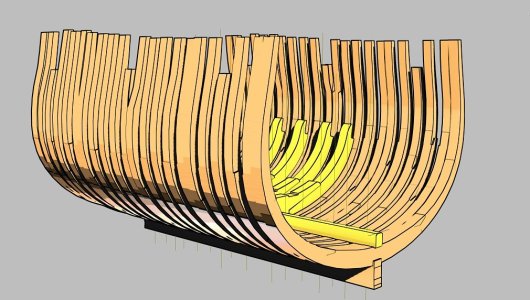
The CAD image below shows the model smoothed and processed for 3d printing. The actual CAD model is lower res to allow for more adjustment......


InitialCAD.jpg
 
it‘s interesting to see another Granado as scratch project. I made my reconstruction in 2D. I could not work in 3D and for preparing parts is 2D fine.
If I look at your 3d model there are some problems at the stern, which you can also see at your printed model. It looks that the stern view is not correct. If you#re interested, I can send you a PDF of my lines.

Yes please Christian,

I've been working on the stern for the last two days with little progress and would greatly appreciate your input. One of the problems is that I work in Autodesk 3ds Max. It’s not actually drafting software, but I used it professionally in the past and have found it difficult to learn contemporary drafting software. It is quite possible to design a perfectly good model with 3ds Max and translate it into plans/CNC use DXFs. It just takes a few extra processes.
 
Last edited:
Hi,
It#s not good to show your mail here. It’s better to send me a personal message. Give me a few days, then I am at home.
I did not trace the original drawing. I made a reconstruction with curves and the correct room and space distance.
 
My first trial of an all English boxwood frame.

The material is surprisingly difficult to work with. Much harder than Castello and brittle in small pieces but holds a good edge and polishes nicely. I have a large supply of logs. Some 150 years old with growth rings not much larger than a single pore. All genuine Buxus Sempervirens, and confirmed by microscope. Sourced locally from Sussex. Usual spalting but completely hardened and mineralised. It works and polishes the same as the rest of the timber.

I'm going for a modified J. Staudt cross-section in 1:72 based on the double/three single frame pattern by P. Goodwin. Liquid hide glue works well. May use epoxy in places, also works very well. Single frames are proving problematic, because the chocks are extremely brittle. As expected, they break regardless of grain direction, so I will be trying to sort that out next week. I'm not ready to give up yet :-)

Most of the smaller frame pieces will be cut oversized by laser with final shaping and sizing by hand. Thicker stuff all cut by hand/bandsaw.


2568.jpg
 
Greetings, Richard. I'm looking forward to this build. To see this model at this scale in box is a rare treat.

I used castello on my Kingfisher and I can confirm it is only marginally harder than European pearwood. For the Kingfisher carvings (and now for the Saint Philippe carvings) I am using boxwood from South Africa (Buxus macowanii) (spellcheck wants me to change this to macromania ROTF). I've not actually used European boxwood so I cannot make a comparison - but my exotic wood provider says he cannot tell the difference visually and that they process similarly. To that end I don't believe that would solve your problem but I could send you a sample from across the pond if you want to give it a try.

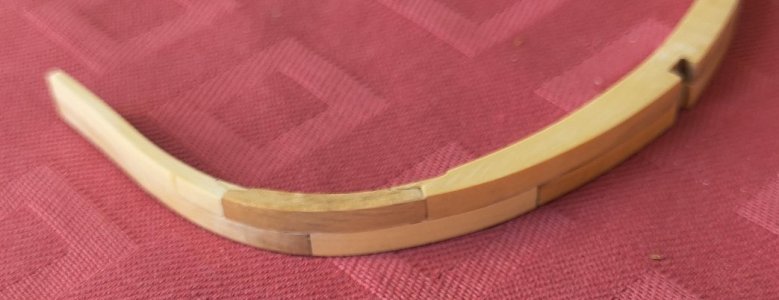
Alternatively, you could model faux chocks by lightly scribing the joints. I know it fails the test of authenticity but at this scale it might not really be an issue.
 
I recently came across my stock of English boxwood, harvested in the green over 20 years ago. It might be ready for use now, and thoughts have turned to what type of vessel, and what specific ship. I have fewer years left in me than when that stock was laid down, and my tastes have changed from '3 masted ship' to show off the multiplicity of lines and rigging to 'made the way the full size was made, with frames every couple of feet, bent planks treenailed in place, and deck fittings that look the part, and maybe work.

All of that to say I'm following this log with great interest.

J

.
 
Greetings, Richard. I'm looking forward to this build. To see this model at this scale in box is a rare treat.

I used castello on my Kingfisher and I can confirm it is only marginally harder than European pearwood. For the Kingfisher carvings (and now for the Saint Philippe carvings) I am using boxwood from South Africa (Buxus macowanii) (spellcheck wants me to change this to macromania ROTF). I've not actually used European boxwood so I cannot make a comparison - but my exotic wood provider says he cannot tell the difference visually and that they process similarly. To that end I don't believe that would solve your problem but I could send you a sample from across the pond if you want to give it a try.
Alternatively, you could model faux chocks by lightly scribing the joints. I know it fails the test of authenticity but at this scale it might not really be an issue.

Hi Paul,
Yes, I'd heard about macromania! :) My understanding is that it is almost identical in almost every way to sempervirens.

I rather like using the English boxwood as it came from nearby to me in Sussex, where timber for the navy was also sourced during the 17th to 19th centuries. You could say it has a sort of pedigree.

We could do a swap. I'd be interested to hear your opinion of the English boxwood as you'll then have experience of both types. It very stable, old and good quality material but exceptionally hard. It can be polished to resemble 'tigerseye', with less figuring, and it holds its shine even with handling!

The problem with scoring the chocks is that my boxwood has a myriad of different shades from bright Yellow to muted yellow, light brown, dark brown and blue-ish grey and the I'd like to take advantage of this by making each element of the frame distinctive. I'm not trying to make a realistic looking model. Rather I'm going for something where the appearance is dominated by the shapes, structural design and wood character.

Below shows some of the colour range...

2574.jpg
 
Last edited:
I recently came across my stock of English boxwood, harvested in the green over 20 years ago. It might be ready for use now, and thoughts have turned to what type of vessel, and what specific ship. I have fewer years left in me than when that stock was laid down, and my tastes have changed from '3 masted ship' to show off the multiplicity of lines and rigging to 'made the way the full size was made, with frames every couple of feet, bent planks treenailed in place, and deck fittings that look the part, and maybe work.

All of that to say I'm following this log with great interest.

J

.

Hi Jim,

Deciding on what to make is half the battle.

I don't know if you've opened up any of your logs, but I have found that the amount of usable material varies so sawing and milling is a challenge in order to get the best out of it. Then there is also the question of colour. Polishing by hand dramatically changes the colours. Some of the spalted grey patches are almost black when raw. However, they appear as dark brown and resemble walnut when polished. I look forward to seeing your project evolve.

2575.jpg
 
So this is the frame layout.

I'm using J. Staudt plans for the moulding and trying to match the room and space to P. Goodwin's double/ 3 single layout. I've included compass timber in rough accordance with Goodwin. Sweep port and gun port locations are preserved as is the floor timber locations. Top timbers look thick but all will be processed to correct, just over 1mm, dimensions. I probably won't go any further with the CAD until I'm sure the frames will work. Garboard rebate doesn't show on image, but it is there. The CAD is not perfect, but its good enough for plans and rough laser cutting.

Tech1.jpg
 
Greetings, Richard. I'm looking forward to this build. To see this model at this scale in box is a rare treat.

I used castello on my Kingfisher and I can confirm it is only marginally harder than European pearwood. For the Kingfisher carvings (and now for the Saint Philippe carvings) I am using boxwood from South Africa (Buxus macowanii) (spellcheck wants me to change this to macromania ROTF). I've not actually used European boxwood so I cannot make a comparison - but my exotic wood provider says he cannot tell the difference visually and that they process similarly. To that end I don't believe that would solve your problem but I could send you a sample from across the pond if you want to give it a try.
Alternatively, you could model faux chocks by lightly scribing the joints. I know it fails the test of authenticity but at this scale it might not really be an issue.

Thank you Paul,

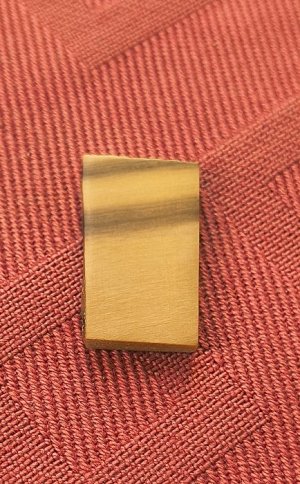
Your wood sample arrived today. I must say its a beautiful colour and very expertly milled. You are lucky to have access to this material.

It does seem similar to English. Compared to English, the English has a slightly higher pitch when taped, which may be from moisture during transport, or cell structure, but it is a lovely looking material. It files in a similar way. I'll polish a piece up, and wax it, to see how it looks, I suspect it will be beautiful.

Regarding progress on this project I am finding it difficult to source English boxwood of consistent colour. I may have to save my stock for smaller models than 1:72 and use Castello, which is plentiful. You are lucky to have access to this material.

Image below compared to three average pieces of Sempervirens.

2738.jpg
 
I'm glad the sample finally arrived. Almost a month for an envelope to travel from the US to England :rolleyes:.

Thanks again Paul,

I imagine customs held it for weeks. They make a significant profits from import duties on goods, so a small package probably gets put on the back-burner! bit is a lovely piece of material.

Interestingly, I compared its acoustic properties to a much larger piece of Semperviren (150mm x 30mm x 30mm, no taper) and the the larger piece had a clearer higher pitched ring suggesting that the English wood is much harder, despite their identical Janka rating at ~2800!
 
They look for woodwurms at customs

Many years ago I worked on a new pipe organ for a church in Nigeria. We imported wood from South America so that it would/should not become a meal for the the native Nigerian bugs. When we ripped one large plank there a was a void with several huge beetles. They were of course dead, but perfectly preserved standing up like museum exhibits. Somebody had the smart idea of placing them on the designer's draughting table. I can still hear the screams!
 
Back
Top