• Win a Free Custom Engraved Brass Coin!!!
    As a way to introduce our brass coins to the community, we will raffle off a free coin during the month of August. Follow link ABOVE for instructions for entering.
  • PRE-ORDER SHIPS IN SCALE TODAY!

    The beloved Ships in Scale Magazine is back and charting a new course for 2026!
    Discover new skills, new techniques, and new inspirations in every issue.

    NOTE THAT OUR FIRST ISSUE WILL BE JAN/FEB 2026

Build Log: Rowing Boat Clyde Model Dockyard 1:6 scale clinker / lapstrake by Kimosubby [Kim Holland]

Joined
Nov 21, 2024
Messages
34
Points
58

This kit was a Christmas present to myself, I could not resist it, and I have just started.
The company is new to me, but looking up the history they actually are one of the oldest around.
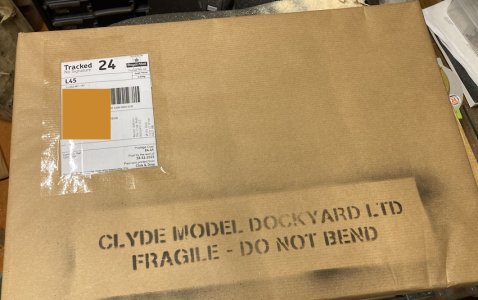
The kit arrives very neatly packaged, wrapped in brown paper and stencilled with the company name.
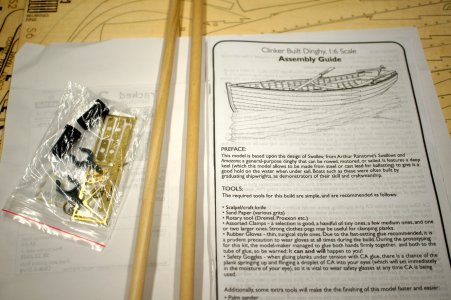
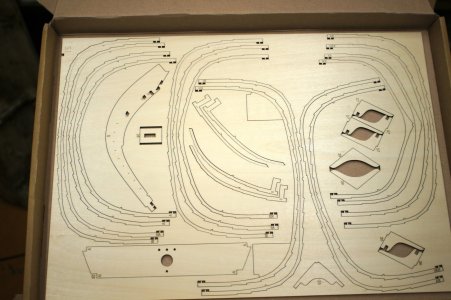
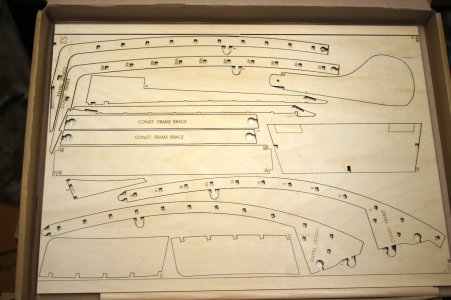
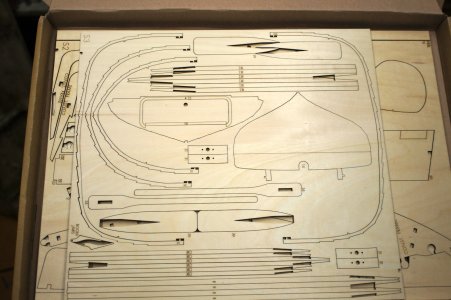
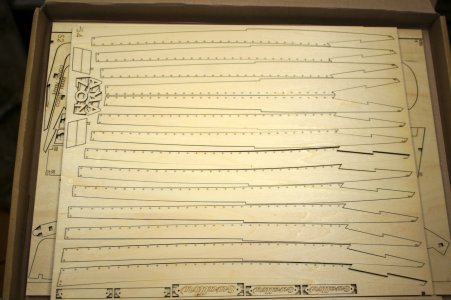
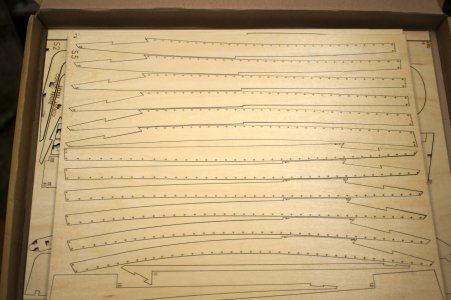
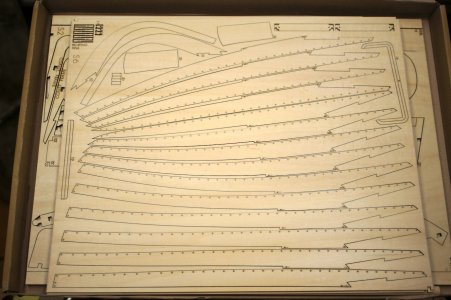
The contents consist of 6 sheets of ply all cut for the various parts, a small bag of fittings, two lengths of dowel and a booklet of instructions.
Here displayed for you.Instructions dowel Fittings.JPGSheet S1.JPGSheet S2.JPGSheet S3.JPGSheet S4.JPGSheet S5.JPGSheet S6.JPG
 
The scale is big, so the construction has to be good as any faults/defects will be really obvious.
The intention is to paint the finished model and use radio gear to sail it.
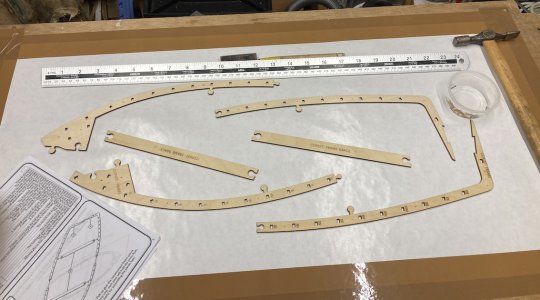
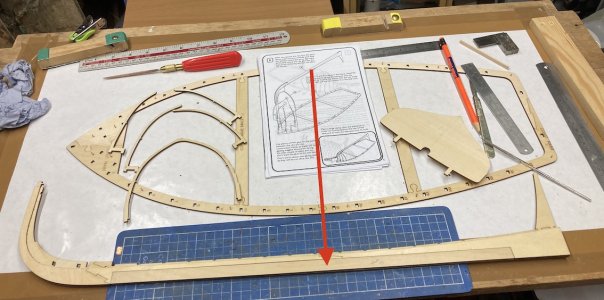
Step one today was to glue up the construction board. Using a large piece of blockboard as the base, a piece of
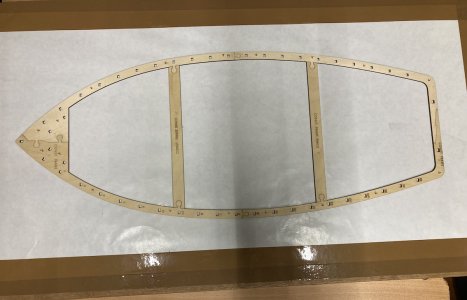
freezer paper was taped on, shiny side up, on which the construction base is assembled. Small nails were also used to secure it to the build board. PVA glue used on the joints.
These joints were really tight fitting, just very gentle sanding to remove laser soot. Very impressed with the scarf joint at the stern
of the construction base, with the glue it went together really firmly.
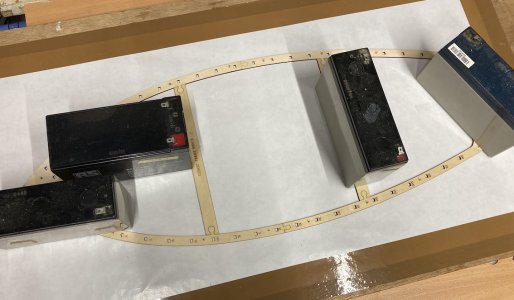
Once all in place nailed down, leaving the heads protruding. The joint were weighted down as shown, always handy to have a few 12V batteries around.

IMG_3195 copy.jpgIMG_3196 copy.jpgIMG_3198 copy.jpgIMG_3171 copy.jpg
 
Last edited:
The build starts with assembling the keel parts. There are four parts in the central part, with two superb scarf joints. This centre; part then has three parts each side added to give it some strength and create the rabbet. The keel can be ballasted with stainless steel or lead. I'm opting for brass. To give the keel some rigidity during construction I used the wooden ballast shape in the ballast slot. I taped it in with masking tape strips.
IMG_3201 copy.jpg

Now the anticipated tricky bit. I practised with a dry run using the first four ribs and the keel. the first three ribs are very wobbly and the fourth gives it some stability. The glue will probably help as well to keep it all together.

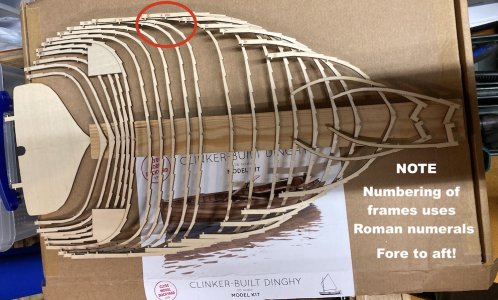
It is essential to have cleaned up all the ribs where they connect the keel and base board. It is also vital to have them set out in the construction order, easy to hand. I arranged them like this. NOTE the numbering uses Roman numbers, be warned.
IMG_3202 copy.jpg

It actually worked very well following the instructions, with the glue assisting to keep the bits nearly in the correct place, I was able to get the fourth rib in place. The first and second ribs are individual pairs, the third and fourth are single spanning units.
It also helps using plenty of glue in the construction board, it allows lots of adjustments to be made.
Eventually I was happy that all the ribs were correctly located in the keel and the base board.

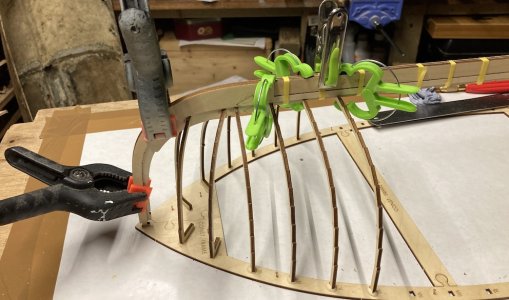
Like here :- this is the sixth rib in place. The bow stem is also glued into the construction base. The clamps are from flower shop, and are wide and strong enough to hold the ribs to the keel. The large black clamps are to weigh the bow end down.
Each rib seems to be easier to fit as I progress, tucking the rid slot up into the keel slot, then walking the ribs ends slowly to their slot in the base board where they pop into the "pond" of glue awaiting them.

IMG_3206 copy.jpg
 
Back
Top