• Win a Free Custom Engraved Brass Coin!!!
    As a way to introduce our brass coins to the community, we will raffle off a free coin during the month of August. Follow link ABOVE for instructions for entering.
  • PRE-ORDER SHIPS IN SCALE TODAY!

    The beloved Ships in Scale Magazine is back and charting a new course for 2026!
    Discover new skills, new techniques, and new inspirations in every issue.

    NOTE THAT OUR FIRST ISSUE WILL BE JAN/FEB 2026

Build Log: Rowing Boat Clyde Model Dockyard 1:6 scale clinker / lapstrake by Kimosubby [Kim Holland]

Joined
Nov 21, 2024
Messages
43
Points
58

This kit was a Christmas present to myself, I could not resist it, and I have just started.
The company is new to me, but looking up the history they actually are one of the oldest around.
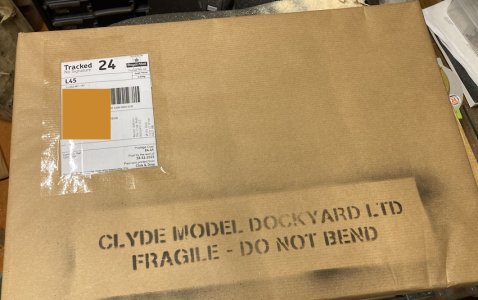
The kit arrives very neatly packaged, wrapped in brown paper and stencilled with the company name.
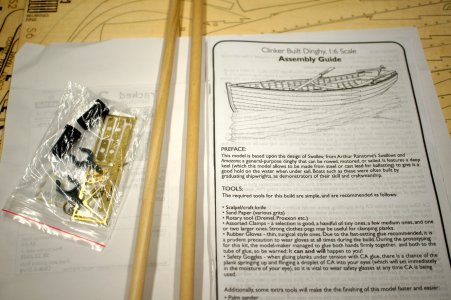
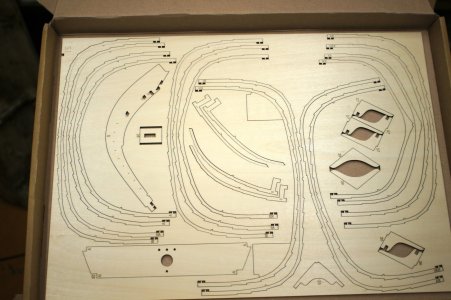
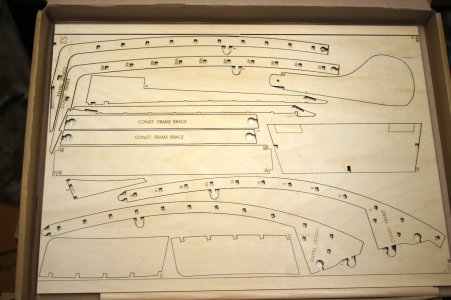
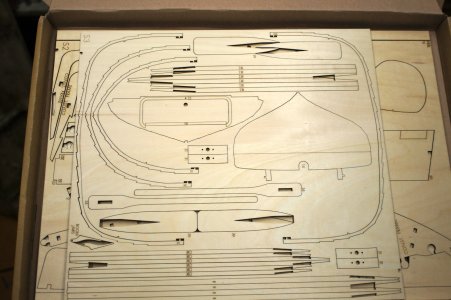
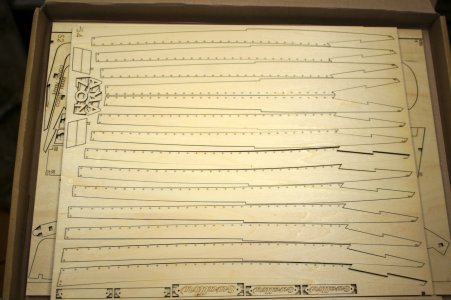
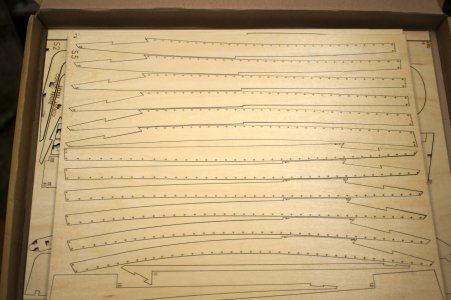
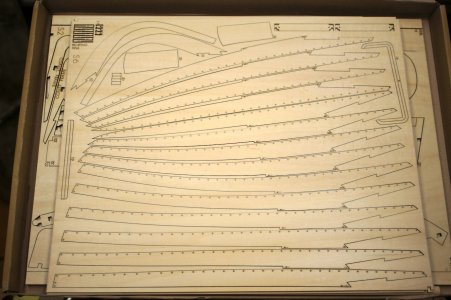
The contents consist of 6 sheets of ply all cut for the various parts, a small bag of fittings, two lengths of dowel and a booklet of instructions.
Here displayed for you.Instructions dowel Fittings.JPGSheet S1.JPGSheet S2.JPGSheet S3.JPGSheet S4.JPGSheet S5.JPGSheet S6.JPG
 
The scale is big, so the construction has to be good as any faults/defects will be really obvious.
The intention is to paint the finished model and use radio gear to sail it.
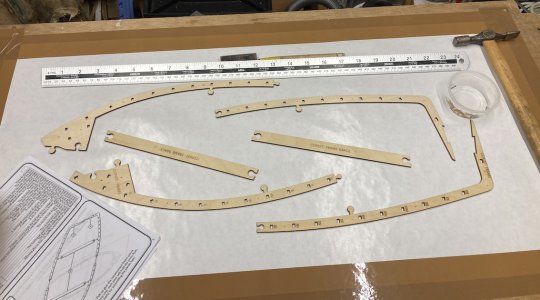
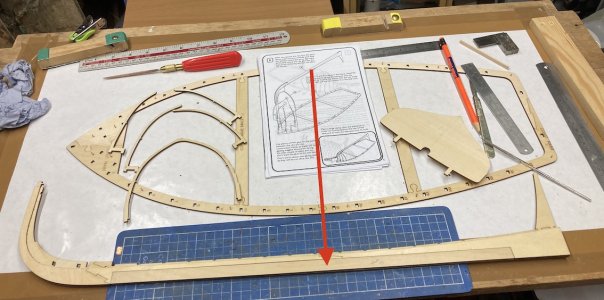
Step one today was to glue up the construction board. Using a large piece of blockboard as the base, a piece of
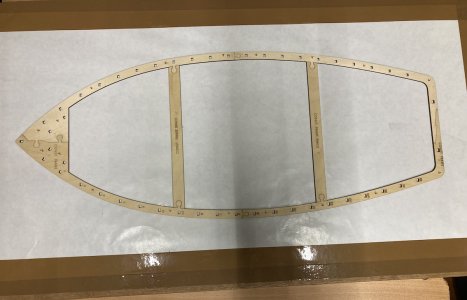
freezer paper was taped on, shiny side up, on which the construction base is assembled. Small nails were also used to secure it to the build board. PVA glue used on the joints.
These joints were really tight fitting, just very gentle sanding to remove laser soot. Very impressed with the scarf joint at the stern
of the construction base, with the glue it went together really firmly.
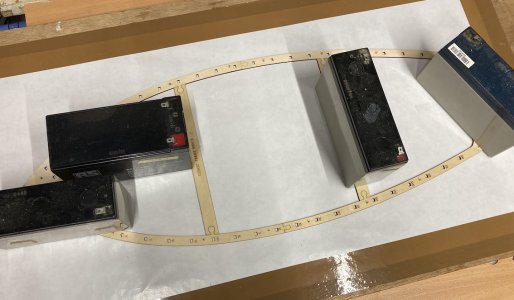
Once all in place nailed down, leaving the heads protruding. The joint were weighted down as shown, always handy to have a few 12V batteries around.

IMG_3195 copy.jpgIMG_3196 copy.jpgIMG_3198 copy.jpgIMG_3171 copy.jpg
 
Last edited:
The build starts with assembling the keel parts. There are four parts in the central part, with two superb scarf joints. This centre; part then has three parts each side added to give it some strength and create the rabbet. The keel can be ballasted with stainless steel or lead. I'm opting for brass. To give the keel some rigidity during construction I used the wooden ballast shape in the ballast slot. I taped it in with masking tape strips.
IMG_3201 copy.jpg

Now the anticipated tricky bit. I practised with a dry run using the first four ribs and the keel. the first three ribs are very wobbly and the fourth gives it some stability. The glue will probably help as well to keep it all together.

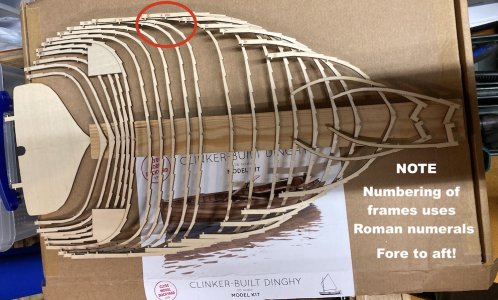
It is essential to have cleaned up all the ribs where they connect the keel and base board. It is also vital to have them set out in the construction order, easy to hand. I arranged them like this. NOTE the numbering uses Roman numbers, be warned.
IMG_3202 copy.jpg

It actually worked very well following the instructions, with the glue assisting to keep the bits nearly in the correct place, I was able to get the fourth rib in place. The first and second ribs are individual pairs, the third and fourth are single spanning units.
It also helps using plenty of glue in the construction board, it allows lots of adjustments to be made.
Eventually I was happy that all the ribs were correctly located in the keel and the base board.

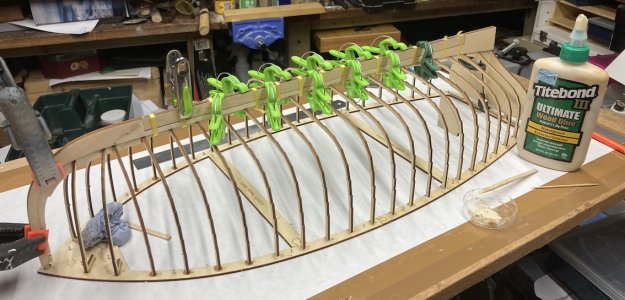
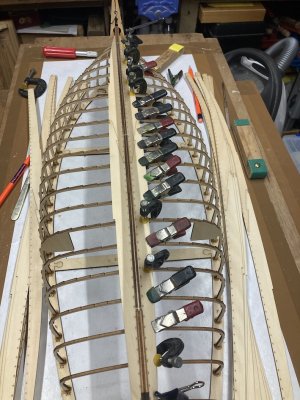
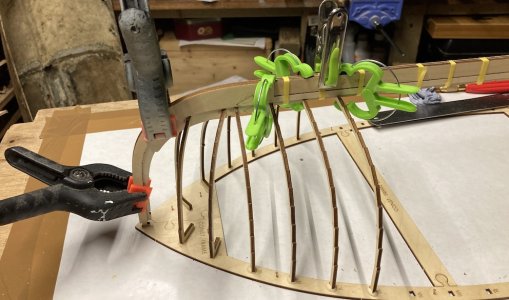
Like here :- this is the sixth rib in place. The bow stem is also glued into the construction base. The clamps are from flower shop, and are wide and strong enough to hold the ribs to the keel. The large black clamps are to weigh the bow end down.
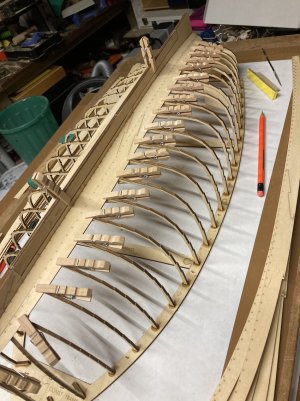
Each rib seems to be easier to fit as I progress, tucking the rid slot up into the keel slot, then walking the ribs ends slowly to their slot in the base board where they pop into the "pond" of glue awaiting them.

IMG_3206 copy.jpg
 
Busy weekend. Have completed the insertion of all the ribs and the transom. All looking good, all ribs correctly located and the transom is square with the stern post as far as I can tell.

IMG_3207 copy.jpg

I also managed, whilst the workshop temperature was near 10'C, to glue all the planks. The scarf joints are so good, really tight fitting. I have only had to lightly sand about 5 of them for them to come together. Used CA for all these joints as per the instructions.

IMG_3210 copy.jpg

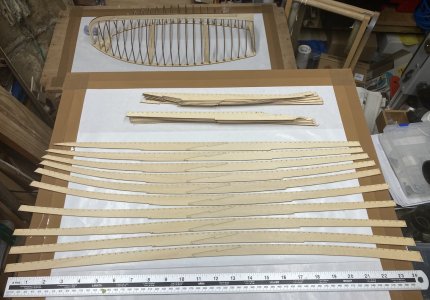
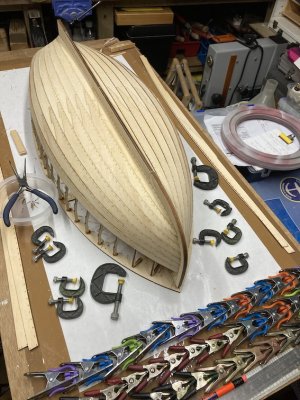
The image shows top, the completed hull and ribs; the port side planks ready to bond; the starboard planks all glued and laid out in order, garboard plank at the top.
Stacked like this shows the shape each plank has before they are put onto the hull. A good indicator to anyone planking a hull as to what the plank's shape actually is in various locations on the hull.

Aye, Kimmo
 
A good morning to you Grant, thanks for your interest.

Yes the "frames" look fragile, but remember this way of building is in reverse to real life when the "ribs" would be steamed and bent into place after the hull planking had been formed up about temporary bulkheads made of scrap timbers.
All the planks are glued up now as well as the inwales, outwales and risers. They'll be obvious when I start installing them, but first have to do the planking. Just waiting for some clothes pegs so as I can make lots of wood clamps for the planks. It's a bit like Goldilocks syndrome - not too strong, not too weak, but just right, medium wood clothes pegs turned inside out.

Other good news, the keel ballast weight, a piece of brass 420 x 6.3 x 12.4 is on it's way too.

Aye, Kim
 
Started the planking. The instructions suggest doing the planking with CA glue as it is quicker. I prefer to use wood glue, and clamps. It's far too easy to get planks in the wrong place with CA and these planks are all pre shaped and cut.

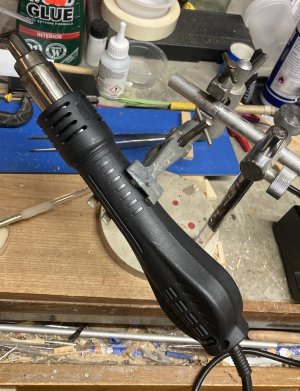
Firstly the planks require bending and twisting to the shape of the hull. The first planks either side are the garboard strakes, A. To bend them I used an SMD hot air gun, which I had purchased after reading the thread on this website regarding plank shaping. These planks are cut from plywood so soaking was not a real option. They formed very well with the hot air gun, just wetted them where the bends were needed, running the plank over the SS barrel or holding directly in the hot air nozzle flow, Temperature used was 200"C on the control display.

plank bender.jpg

The formed planks were glued in place with PVA glue and held in place with either small metal spring clamps, the odd small nylon G clamp or with inverted wood pegs. Due to the temperature in my workshop, I let them have 24 hours to set before the clamps came off.

garboard planks.jpg

The second plank B are easier to shape, with more gentle curves. The pre-shaping takes a lot of strain out of the glue joints, hence I used the inverted wood peg clamps here along the plank run. The overlap area with plank A is also glued.

Plank B each side.jpg

Currently, plank C is glued and clamped on the hull. Some fairing is done of the plank edges to get a tighter joint, but the process is quite simple will proceed till plank H is fitted. Then I will release the hull from the build board to add some internals.

Kim
 
Great work. I may be ordering this kit. Would a standard electric plank bender do the job? I’ve never seen an SMD hot gun used before.
 
Hi Robster, thank you.
Yes, it's an excellent kit, so far all the parts have been very well cut. The instructions are good as well, very exact.
I decided on a brass keel weight, slightly heavier than SS, ordered from Metals4U cut and delivered no problem to Isle of Man.
I'm pre-bending the planks to take the stress and strain off the glue joints. I am one of those people that have a reaction to CA vapours, so I try and avoid using it too much. Mind, I have been using Mitre bond glue pack (50g CA + accelerator), £6 a pack, and not had too much reaction.
I'm using wood glue, Titebond III for the planking, and leaving the clamps on for 24 hours. Slow, but I have other builds underway (and a bedroom to decorate!)
There is no reason why the electric plank bender would not work, it's just that with the hot gun I also got a neat soldering iron as well. I can also use the hot air stream to help bending odd shapes and twists, and it also doubles as a neat small paint/glue stripper too. AND, in this cold weather, it warms the area of work and my fingers.
Planks D were on last night so E this afternoon.
Aye, Kim
 
If I go ahead mine will be a static display model so no weighted keel needed. Those planks look great. Varnish or paint?
 
The instructions suggest removing the build from the base board after fitting the garboard planks. I have left mine attached till after the fitting of planks G and H, that's 8 each side, as it gives a stronger assembly area.

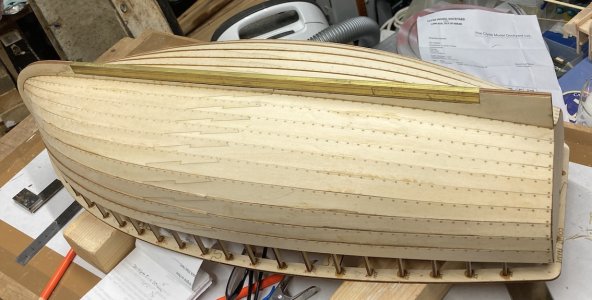
Here's the build after those planks IMG_3220 copy.jpg
I have used a lot of clamps one at each rib point and extras at bow and stern.

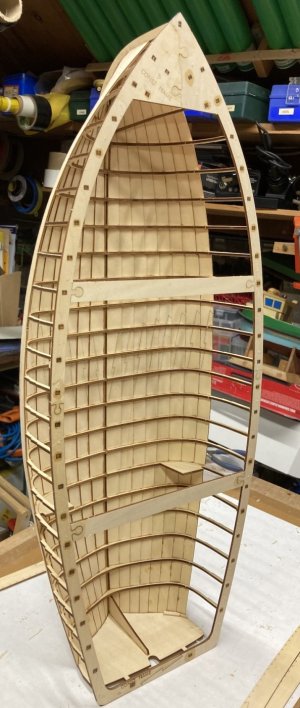
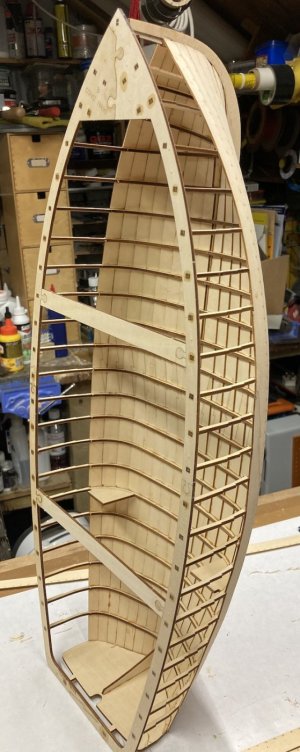
I "pulled the pins" after this freeing the construction base from the base board. It is necessary at this point as there are now items to be installed within the hull. It also gives access to to all the joints and plank seams that will need sealing as per the instructions. There are small gaps to be filled and I plan to add some strengtheners at bow and stern and I want to sail this boat with radio control.

IMG_3221 copy.jpg IMG_3222 copy.jpg
Looking good from this angle balanced on her transom.
Total weight of the assembled so far is 256g, the keel ballast, brass bar weighs close to 300g.
 
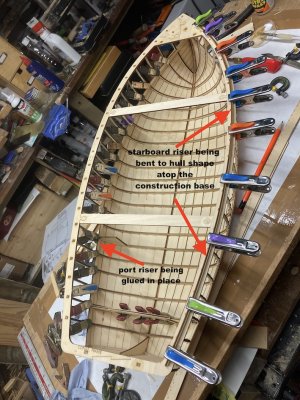
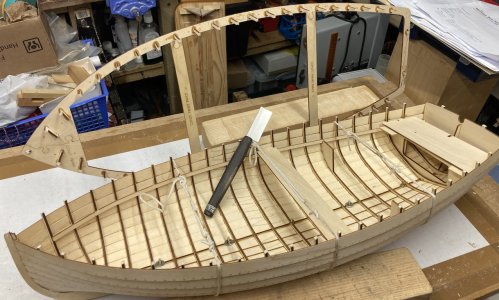
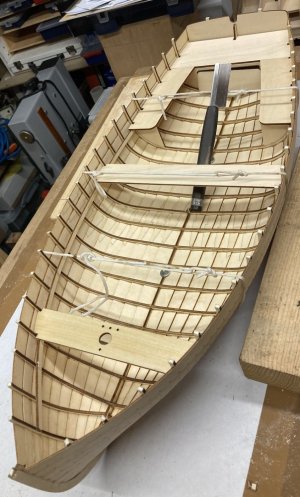
Added the risers to both sides. The thwarts are seated on these as well.
The front piece of the stern locker also glued in place. This has a slip in front access.
I am anticipating making an opening in the rear thwart for easy access into this locker, possibly hinged but maybe just use magnets to seal it. There will be electronics in here and the receiver plus a servo for the tiller bar.

IMG_3232 copy.jpg
 
Hello Kurt,

It is a nice large scale and will look really good under sail out on the Lake.

The kit is supplied by The Clyde Model Dockyard Ltd. see below

Clyde MD.png
 
Back
Top