
• Win a Free Custom Engraved Brass Coin!!!
    As a way to introduce our brass coins to the community, we will raffle off a free coin during the month of August. Follow link ABOVE for instructions for entering.
  • SUBSCRIBE TO SHIPS IN SCALE TODAY!

    The beloved Ships in Scale Magazine is back and charting a new course for 2026!
    Discover new skills, new techniques, and new inspirations in every issue.

    NOTE THAT OUR NEXT ISSUE WILL BE MARCH/APRIL 2026

Building the Harvey

Joined
Oct 23, 2024
Messages
18
Points
8

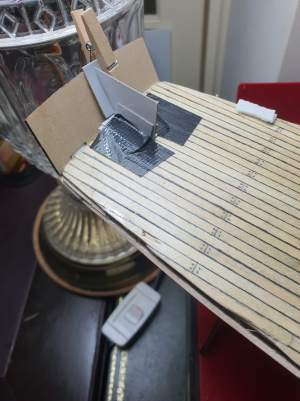
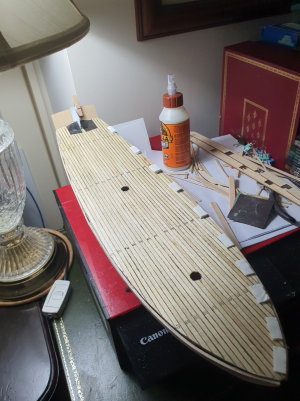
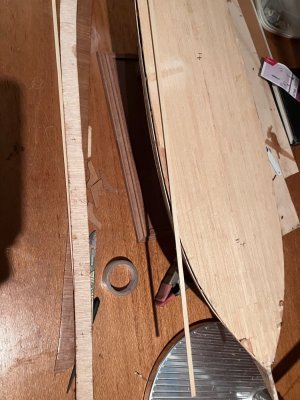
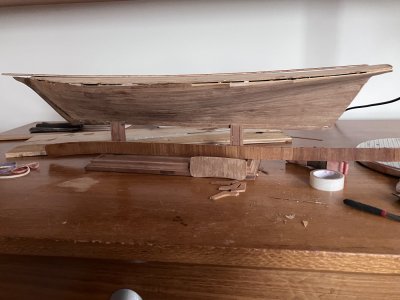
IMG_2761.jpegHi, I have finished planking the hull (Badly as it is my first go at a model, not sanded yet) and am at a loss as to how to attache the bulwark's.
I ca get the stern end attached to the transom but how to fix the rest along the deck is a mystery.
The bulwark is a long strip of ply. I have glued vertical strips to the inside and need to cut the canon ports.
Should the outside of the bulwark be inline with the hull and the planking be continuous. In this case I would need t cut back the deck planks.
Is there anyway using some tempoarry support while the glue sets.
Regards
Bill

 
I have glued vertical strips to the inside and need to cut the canon ports.
The frames should have come up above the deck line to the height of the plank sheer so there would be something to which the bulwark planking could be attached. Your idea of adding extensions that act as top timbers should work but care needs to be taken that they are in line with rest of the hull. I assume you have the kit drawings so you can see how high these extensions should go.

Planking.....Patience..... This takes practice and even then a good tutorial helps. With a quick search you can find two of the best have been listed numerous times here at SoS including a short treatise by David Antscherl as well as a four part video by Passaro.

Allan
 
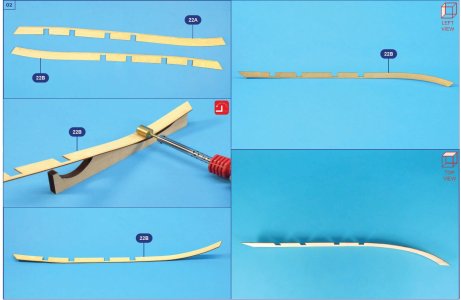
Just to give you some Idea, what I did was fabricate a cardboard holder for the rear pannel (double sided sticky tape) and used the tape for the side pannels after bending (soaking and Special soldering iron)

Halcon 1A.png

Halcon 3A.png
 
Just to give you some Idea, what I did was fabricate a cardboard holder for the rear pannel (double sided sticky tape) and used the tape for the side pannels after bending (soaking and Special soldering iron)
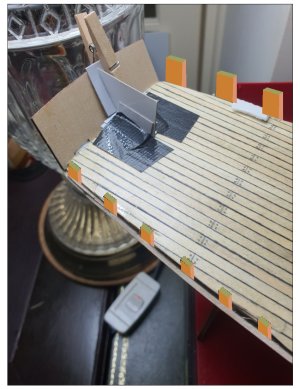
I am confused, sorry, not doubt just me. There have to be top timbers installed to support the planking inboard and outboard for the bulwarks. It looks like there is room to slip these pieces between the deck planking and hull planking or close to it. Maybe trim away some of the deck planking. I have no idea on the spacing of the top timbers, but am guessing about 24 inches. Sorry these are not to scale, 'twas just a quick sketch onto your photo.
Allan
'1774187201711.jpeg
 
Last edited:
Just a suggestion in the interest of helping you make a better model:

In addition to determining the accurate placement of top timbers to support your bulwark planking, you may want to think about doing some research on deck planking schedules for laying plank. Butts are never laid out adjacent to one another on the same deck beam as you have depicted them and they are fastened on every deck beam they cross. The prototype of your vessel does not have four deck beams with every plank butt meeting on the four in a row athwartships. Note also that your deck planking is likely out of scale as to length. Plank stock was rarely longer than 20 to 24 feet long and all planks were not necessarily the same length.

Also, while seam stopping may be visible at plank butts, fasteners are not. Deck planking fastenings are either trunnels (wooden pegs) or metal fasteners which are counter sunk and plugged with a wood species identical to that of the deck planks. Therefore, the deck plank fastenings are not visible at the scale you are working in.
 
Hi and thanks for all your comments. This is my first model and obviously I have a lot to learn re planking hull and deck. have found it impossible to use the brass pins as they bend too easily I have had Parkinsons for many years so none of this is easy. The kit had no support for the bulwarks except for two uprights on the forward frame and the transom. The waterway along the deck could provide some support,. The next skill to acquire is bending/steaming the waterway wood I guess. Will have to research that. Alans idea looks good. Once again thanks.
Regards
Bill
 
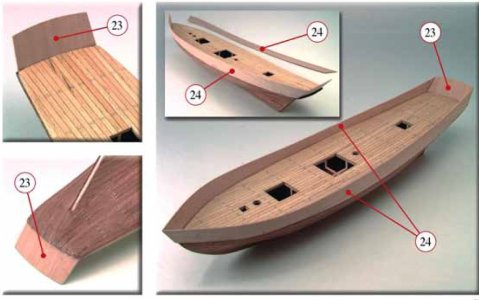
You should have a DVD with the kit that shows the construction process, here is one image from that DVD, The side stringers are added later. They are for show but add nothing to the construction (they are just glued to the side pannels

Ins 1.jpg
 
Hi and thanks for all your comments. This is my first model and obviously I have a lot to learn re planking hull and deck. have found it impossible to use the brass pins as they bend too easily I have had Parkinsons for many years so none of this is easy. The kit had no support for the bulwarks except for two uprights on the forward frame and the transom. The waterway along the deck could provide some support,. The next skill to acquire is bending/steaming the waterway wood I guess. Will have to research that. Alans idea looks good. Once again thanks.
Regards
Bill

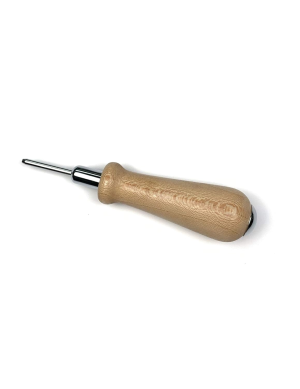
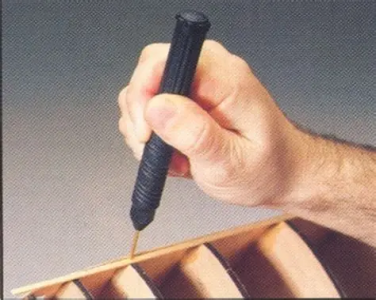
Whoever designed that kit should be hung from a yard arm! ;) Brass pins are really not a very practical fastening device on ship models. As you've discovered, they aren't strong enough to be driven into most modeling wood. To avoid bending and splitting the wood, a hole slightly smaller than the pin's diameter to receive the pin should first be drilled. A pin driver can be of some help, but it must be the proper size to fit the pin and finding properly sized pins can be a bit of a problem, as well.
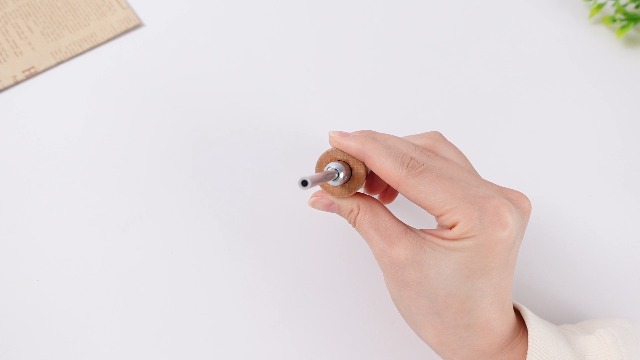

https://www.amazon.com/Pusher-Model-Making-Trains-Trolleys/dp/B0DJY86W79
1774236296721.png
1774236016670.png
 
I have a lot to learn re planking hull and deck.
Do a search here at SoS and you will find both videos and written information on how to plank a hull like on a real ship IF that is your goal. Couple are attached below)

For the deck it was usually a three or four butt system, never a two butt like the kit shows. For the hull, if the bottom is to be painted or covered with copper it really does not matter how you plank it as it will be covered. Then again, planking the hull can be finicky so practice helps, even if it is to be covered over in the end.

Allan

Part 1 of 4 part video

Primer on spiling by David Antscherl
 

Attachments

Another bit abt preparing & fixing the pannels, although this suggests cuting the ports for the guns before bending. I dont think this is a good idea ( I know I chose not to)

Halcon 2A.jpg
 
I think the most important part of fitting the bulwark on this kit is going to be pre-shaping them.
You need to curve them to the shape to follow the hull before you ever try to glue it. That is what they are doing in the instructions with the thing that looks like a soldering iron. The shape will need to be almost perfect since you don't have any frames to attach them too.
 
Thanks again.
The model was purchased over 30 years ago and i have carried it over 3 continents before starting the build. No DVD, The contents do not look anyhting shown in your pics. Instructions are minimal and the contents list a mystry. I have managed to borrow from else where some updated ones. I have ordered a bending iron/.
The water ways seem to need bending width ways instead of in the vertical. See pic. IMG_2762.jpegCan this be done?
 
With laser-cutting technology, etc., these days kits are quite different than they used to be. Even as recently as thirty years ago. Of course, thirty years ago, there were still a lot of kits available in "brick and mortar" hobby shops that had actually been gathering dust for twenty years before that The Italian kits weren't fast movers. The kits of 30 years ago and before were really scratch-building projects in a box. You got some usually very sketchy plans, often no step-by-step instructions at all, and a few blocks and bundles of sticks and string in the box. If you were lucky, you'd get a roughed-out solid basswood hull blank to get you started, but that was about it. You had to cut and fit all your wooden parts. There were no super-accurate laser-cut parts sheets like there are now. Good luck with it!
 
The water ways seem to need bending width ways instead of in the vertical.
The bending iron probably will not work for the edge bending that you describe, that is, having to bend across the breadth. As the curvature is relatively small, a quick solution may be to soak the plank overnight then temporarily attach it in place on the model until it dries. You can heat it with a hot air gun to reduce the drying time to a few minutes. The principal is the same as in the video in post #9 above, episode 3.
Allan
 
Hi. Have a look at my build log for the Santa Maria (I now longer have the photos on my tablet) as I have just done a similar task. Hope it helps.
 
well I did not realize your kit was so old. You are therefore undertaking an interesting (& difficult) task
 
Back
Top