


• Win a Free Custom Engraved Brass Coin!!!
    As a way to introduce our brass coins to the community, we will raffle off a free coin during the month of August. Follow link ABOVE for instructions for entering.
  • SUBSCRIBE TO SHIPS IN SCALE TODAY!

    The beloved Ships in Scale Magazine is back and charting a new course for 2026!
    Discover new skills, new techniques, and new inspirations in every issue.

    NOTE THAT OUR NEXT ISSUE WILL BE MARCH/APRIL 2026

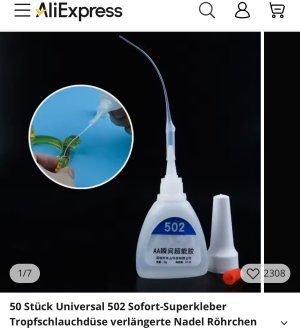
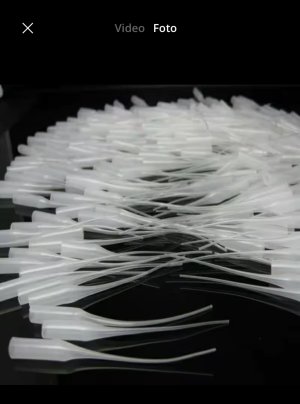
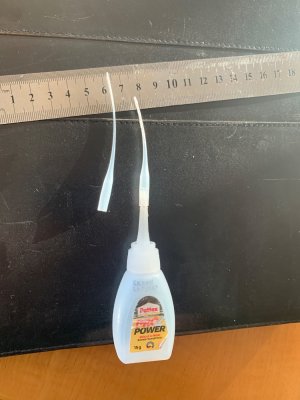
Ca glue oozing from fine tip

Another trick I was given, is to store local in-use bottles inside a small storage contain, IE peanut butter jar, with some descant in the bottom to absorb moisture in the air. Makes for quick access when needed, and can be done with recycled jars, and descant packs that come with many shipments these days.

 
What brand of Archival PVA do you use on the models you build?

As I mentioned, I've been using the "Bad PVA" ("PVAc" - Titebond) for ages, the same and everybody else. I didn't even know there was a difference until the other day. I am intending to switch over to using Paraloid B-72 as a general adhesive replacement for polyvinyl acetate adhesive ("Titebond II") after doing some experimenting. (Paraloid B-72 is the more versatile adhesive/sealer which is far more conveniently reversable owing to its acetone solvent base. Polyvinyl alcohol adhesive is primarily for paper and light fabric applications. If I use a polyvinyl alcohol adhesive at all, I'll pick one from the many on the market. I anticipate picking the brain of a painting restorationist friend of mine to pick the best quality and source.

There are a number of retail brands of archival "acid-free" or "ph-neutral" polyvinyl alcohol adhesive. It's commonly sold in top end art stores and online retailers who specialize in archival preservation materials. The major brands appear to be:

ARCARE acid-free archival-quality PVA adhesive. (http://arcare.com/pva-adhesive-archival-quality/ )
and

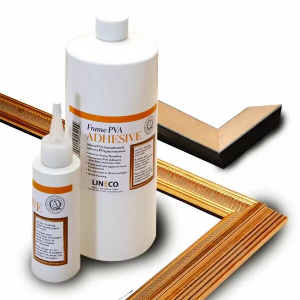
Lineco Archival Ph Neutral PVA Adhesive. https://www.universityproducts.com/frame-pva-adhesive.html

Like Titebond, archival PVA adhesive comes in various formulations for different applications. One of the products sold under the Lineco label is "Frame PVA Adhesive," which is for use in gluing wooden picture frames and may be a good choice for ship modeling, but I'm unable to discern from the advertising whether it is ph- neutral or not. It gets confusing. Some of the archival material is described as "ph-neutral polyvinyl acetate, rather than polyvinyl alcohol. There are lots of archival adhesives. See: https://www.universityproducts.com/conservation-materials/conservation-adhesives

1776704722639.png
 
Last edited:
I use medium gap filling generic CA glue marketed under Hobby Lobby and Model Expo. Nothing fancy. It works. Mostly I use Titebond II. So, my models won't be around 3000 years from now, but that's okay.

It's not the model that falls apart in three thousand years that bothers me, either. It's the one that starts falling apart in ten or twenty years. ;)
 
I have another observation if you are willing to wonder about. Removing char to assemble a model., Up until a few years ago I never removed char because I was concerned it would change the dimensions of the part. The glue held and looked good. Now that I began removing char, mainly because the char would show on the finished model. I leave my ships "natural", unpainted, which would cover up char marks. I have heard, read, numerous easy ways to remove char, including scraping with a sharp blade held perpendicular to the char, using vinegar and other chemicals and whatnot, I take this as another "sea story", and finally sanding.
What is your take on removing char.

Char - soot - elemental Carbon.
I see two two theoretical methods to remove it. Chemical and Physical

Chemical
1) Dissolve it - My memory is fuzzy on this but either Carbon has no solvent or the solvent is not one you would want to go near
2) Displace it - the possible methods would leave the wood that remained deformed.

Physical
Amorphous elemental Carbon - soot and graphite does not stick to itself all that well. A successful bond of wood would probably require that the carbon layer be thin enough for the bonding agent to penetrate beyond the carbon layer and into the wood matrix behind it.

If the matrix is plywood - the inner layers are probably end grain or side fibers of a weak wood species best hidden. The bond is probably inherently weak. The edges of plywood molds are probably best pre-treated with a soaked-in and fully polymerized layer of PVA. This substrate should hold.
If the matrix is the synthetic plastic MDF crap - no idea - the material itself is in a different universe from anything I consider as appropriate to use.

If you are scratch and painting with natural or a dye solution* treated wood - perhaps a saw is the better method to free the wood parts from their stock?

* actual dye molecules dissolved in water or alcohol (better) - not a stain - which is large clumps of dye particles suspended in a solvent and polymerizing binding agent mixture.
 
I have another observation if you are willing to wonder about. Removing char to assemble a model., Up until a few years ago I never removed char because I was concerned it would change the dimensions of the part. The glue held and looked good. Now that I began removing char, mainly because the char would show on the finished model. I leave my ships "natural", unpainted, which would cover up char marks. I have heard, read, numerous easy ways to remove char, including scraping with a sharp blade held perpendicular to the char, using vinegar and other chemicals and whatnot, I take this as another "sea story", and finally sanding.
What is your take on removing char.

I have next to no firsthand experience with laser cutting as a scale ship modeling technique. I can, however, second what Jaager said above. What I do know is what I've picked up listening to the struggles of others with laser cut kits. Beyond that, I can only reliably express my sincere condolences to those who have spent what they may have spent buying them. :)

I don't know of any "magic bullet" to remove charred wood from laser cutting. Scraping and sanding are all that come to mind. Any abrasion of the char will necessarily change the shape of the part as cut by the laser to some degree as demanded by the depth of the char and the angle of the laser-charred kerf. In addition to the detrimental effects on accuracy tolerances caused from char removal, there are the collection of technologically inherent limitations affecting accuracy tolerances when cutting wooden ship model parts with laser beams. Although the tolerance range is theoretically quite minimal, (potentially +/- .01"-.02" at best), in ship modeling, the phenomenon of cumulative error makes it surprisingly easy for a small error to quickly grow so large that poorly fitting parts seriously detract from the quality of the model.


I have never dealt with laser cutting char because I haven't built a kit since well before laser cutting was available... well before the manufacturers invented "plank on bulkhead" model construction so they could start "flat packing" kits like miniature IKEA bookcases. Long ago, kits were basically a roughly machined solid wooden hull blank, raw wood, fittings, and plans. Building them was no different than scratch-building, save that you didn't have to do your own lofting. If you understood basic naval architectural drafting conventions and had basic woodworking skills and tools, as many of us did, it only took a kit or two before you realized that any model you wished could be built better and for less from scratch. [I don't want to rekindle the "scratch vs. kit costs" debate here, but I can't resist asking how ModelExpo can put kits on sale for half their listed price as in their current sale and not be going out of business. The markup on them must be huge.]

I can understand laser-cut kit parts for "toy store level" kits designed for kids, but to my way of thinking, the adult modeler deserves a higher-quality, more sophisticated, model for what manufacturers charge for these laser-cut ones. If it's just assembling pre-cut parts that a kit is about, molded styrene plastic parts produce a much better fitting model that is much easier to assemble, but a lot of people buy the wooden ones, it seems, so I guess I'm an outlier.

I would not expect that a laser-cut kit model to be suitable for a "bright" finish, the nautical term for a varnished natural wood finish. Not only would the removal of the char be tedious and messy, but questionably efficacious. Char isn't necessarily even. When the kerf must turn a curve, for instance, it must slow down, and when the laser beam slows down, it burns more deeply because its heat remains constant while the beam does not. Not only that, but, while I've not seen every one, I've yet to see a laser-cut kit made of wood "worthy" of a bright finish. Most kit wood is of such low quality, regardless of the manufacturer's claims, that it won't take a fine bright finish. You can't polish a turd. The original bright-finished ship models are an artistic presentation style occasionally seen in 17th century contemporary models and a high refinement of this presentation style has been employed in some builder's office steamship models. Currently, some very highly skilled master modelers in France and Belgium, primarily, are working in this style. It is a very lovely presentation, in my opinion, but it can only be carried off adequately if done on a very high-quality model built with the highest quality finish woods. Thus, there's no shame in painting a model well. I don't know who it was that convinced a generation of modelers to try to try to put a bright finish on run-of-the-mill kit models, but if a modeler wants to finish their kit model bright, that's their call and none of my business.

I guess what I'm really trying to say as gracefully as possible is that the best way to remove laser-cutting char from your models is not to buy it anymore.
 
I'm not aware of any PVA or CA glue that's degrades THAT fast...

No, of course not, but "archival" is a concept that is much broader than just how long something should last. Perhaps even more important than longevity is "reversibility." Age doesn't enter into that at all, really, but if some damage is suffered early in the model's life, or even while it's still on the builder's bench, being able to disassemble the damaged parts without causing even more damage in order to repair and restore the model becomes a very valid reason for using "archival" adhesives that are easily reversible.
 
Back
Top