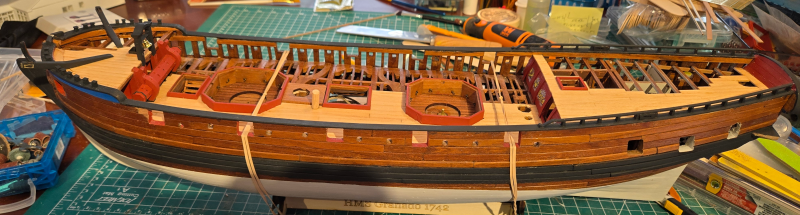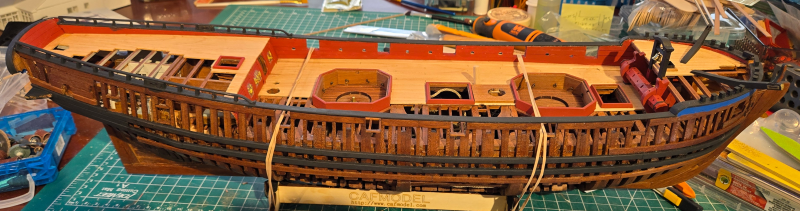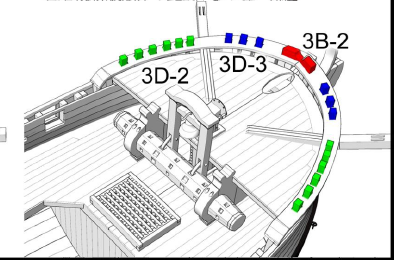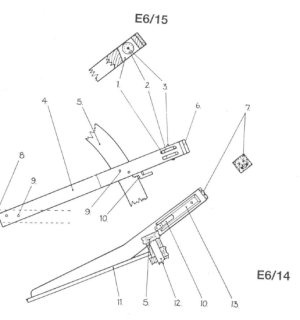

• Win a Free Custom Engraved Brass Coin!!!
    As a way to introduce our brass coins to the community, we will raffle off a free coin during the month of August. Follow link ABOVE for instructions for entering.
  • PRE-ORDER SHIPS IN SCALE TODAY!

    The beloved Ships in Scale Magazine is back and charting a new course for 2026!
    Discover new skills, new techniques, and new inspirations in every issue.

    NOTE THAT OUR FIRST ISSUE WILL BE JAN/FEB 2026

CAF Granado 1/48 PoF Bomb Vessel by Signet

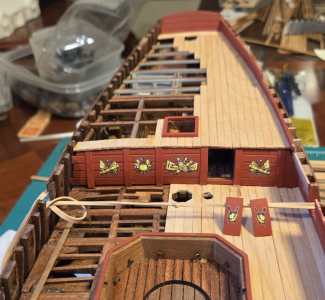
I build the quarterdeck bulkhead as shown in the plans, but use thinner and smaller material for the vertical pieces. The decals went on fine, but are quite glossy. A few coats of Vallejo Mecha Matt Varnish dulled them down quite a bit. The outlines are still visible in this photo, but not so much in real life:
1767556520354.png
Even though I used Micro-Sol, I couldn't get the decals to meld into the planking. The half-doors to the cabin accommodation will be added on later and left open (but not hinged).

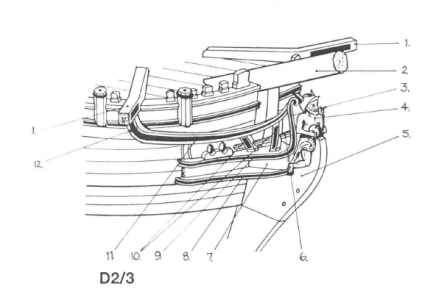
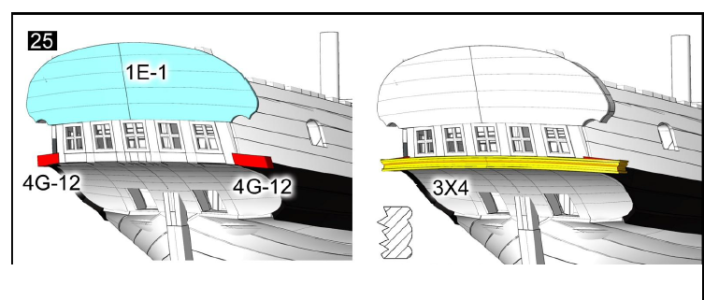
I've done the stern decoration at the wales line differently than the instructions show. The instructions show:
1767556934605.png
My problems were 1) I have been unable to produce the complex sections using the razor scrapers supplied, and 2) I felt unable to bend the 3x4 strip in 2 dimensions and glue it in place.

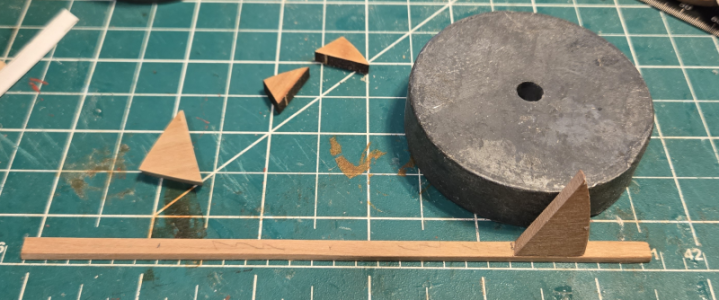
I bought some 1mm x 2mm double half round brass strip that I will use for the fancy section. I then cut a 2x5mm strip to use to replace the 3x4, and tapered it all sides to fit better. The little almost-triangular platforms that go on either side would be glued to this strip to assist in locating, gluing and securing the assembly.

Since the brass strip would be added later, the triangles needed to be larger. Here one's glued to the modified 2x5 strip:
1767557179381.png
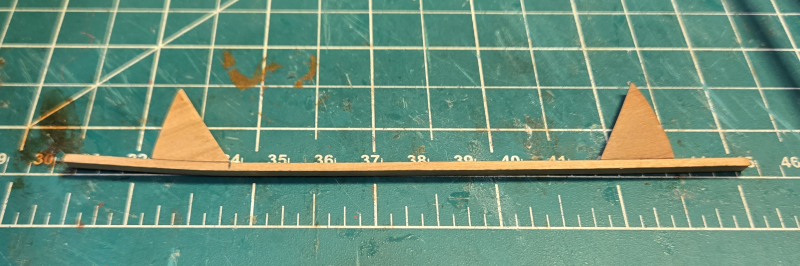
I ended up remaking these triangles to be smaller later, but the procedure is the same.
1767557453556.png

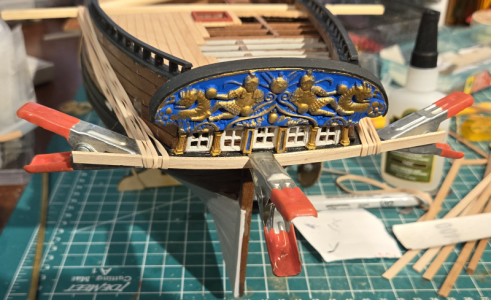
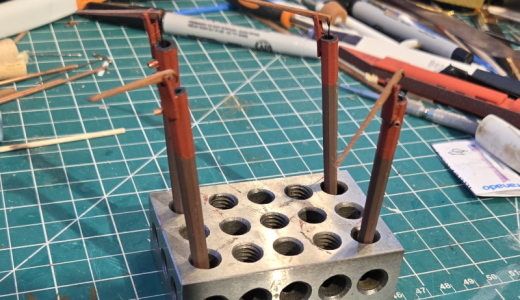
With a triangle at each end, rubber bands can pull the strip and triangles into place for gluing.
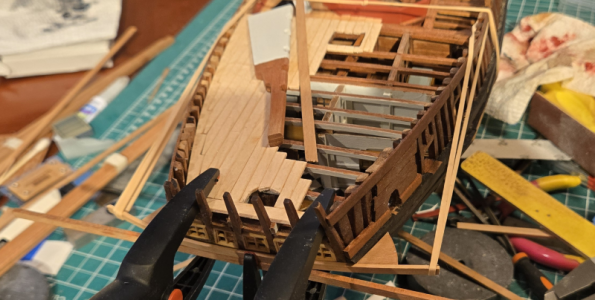
1767557249339.png
The other clamps are to hold everything vertically.
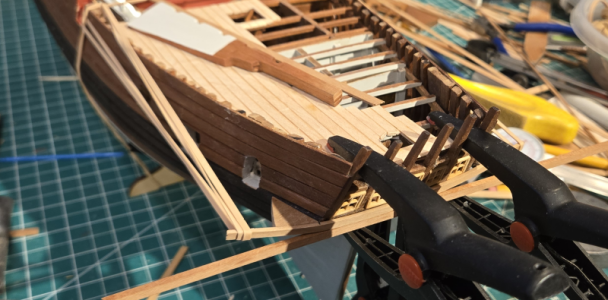
1767557326983.png

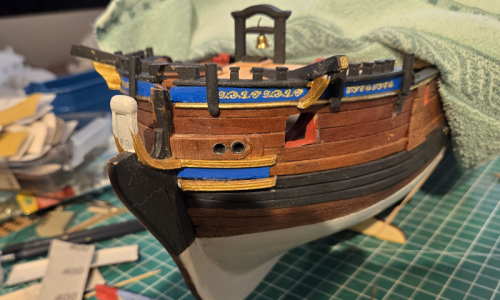
This ends up a pretty secure assembly, ready for adding other decoration:
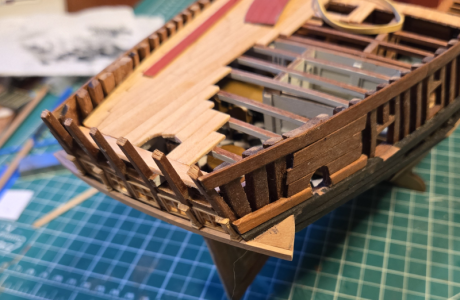
1767557543222.png

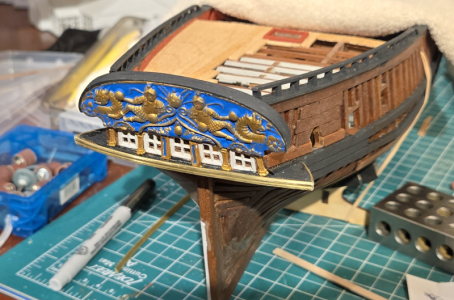
Speaking of other decoration, I haven't decided when to add this, but it's easier to paint off of the model:
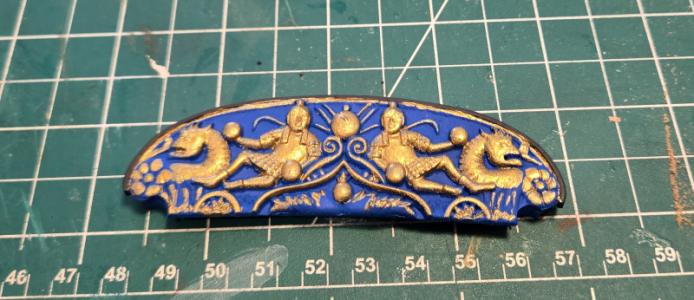
1767557652068.png
If you think it doesn't look very good (as I do as well), you're sitting too close to your computer screen.

To be continued.....
 
Tom at CAF said he'd have a solution for me in a bit, so I'm going to continue with the rest of the build in the meantime.

I decided to work on the Belfry. The small brass bell included is nice, but the piece included for the ringer (?), uh, isn't. It didn't really work as a ringer, or support, or anything, really, so I used a ring and nail instead:
View attachment 568296
A is the included "ringer". B are the rings and C are the nails, put together to make a ringer and bell support D.

The result is much better, and looks pretty good from the side, where you can't see the ring:
View attachment 568297

I then mounted the bell onto the bell pivot (the extension of the ring acts as a lever), and assembled it with the top:
View attachment 568300
The bell pivot actually "rings", using small nails as a pivot. I used a temporary spacer at the bottom to keep the vertical arms parallel. I also placed shims under each arm to center the top piece , which is wider, then weighted it while glue dried. BTW, the two vertical arms are different length because one side will sit on the main deck, while the other will extend through the deck structure to the beam below.
View attachment 568298
I was concerned it would be too flimsy, but ended up fairly strong, if not manhandled. I dropped it a couple times, of course, but it survived.

I then checked the fit in the required location, and found a problem:
View attachment 568302
There isn't room for the belfry to fit between the foredeck and the windlass shaft. Okay, what have I done wrong now? I knew from doing the foredeck planking that it was a bit long, compared to the plans, but it was all based on the windlass support, so still should have been okay for the belfry.

Taking the plans, I determined that they do indeed indicate an problem interference at this location:
View attachment 568305
In blue is the belfry uprights, red is the windlass shaft (rotated to its maximum width) and magenta is the interference. Same in below:
View attachment 568307

So, I checked out Goodwin's side cross section:
View attachment 568308
It appears that the windlass should have been further aft, or the foredeck further forward, creating clearance rather than interference.

I decided to fix the problem by moving the belfry forward into the foredeck by notching the uprights to clear the foredeck cross beam and deck:
View attachment 568310
This isn't realistic, of course, because this would severely weaken the uprights, and we wouldn't want to cut into the crossbeam. But it should look okay, and be far preferred to rebuilding everything.

After mounting the belfry as well as the windlass assembly, we have:
View attachment 568311
And while there is very little clearance between the windlass shaft and the belfry uprights, there is at least some:
View attachment 568312
View attachment 568313

I'll end this chapter here, and begin a new post.
Smart recovery here!
 
Hello ,The kit includes two fasteners for the bottom of the masts, one for the main mast and the other for the mizzen mast. If you still want to try this installation plan, I can mail you another set of these parts。
Hi Tom, its me Daniel. I just sent you a PM. I hope you got it. I will be looking for your PM answer
Cheers
DANIEL

HI Signet

Sorry about this posting.

I keep trying to communicate with Tom by PM and every time his address at the bottom of the PM has a line over it. I am not sure what that means. So I just wrote a new PM and quoted his post with the aim to check if he got my PM. My aim is to have a private personal chat with Tom, that's all.

Nevertheless, if you want, I can delet this posting.

Thanks
Daniel
 
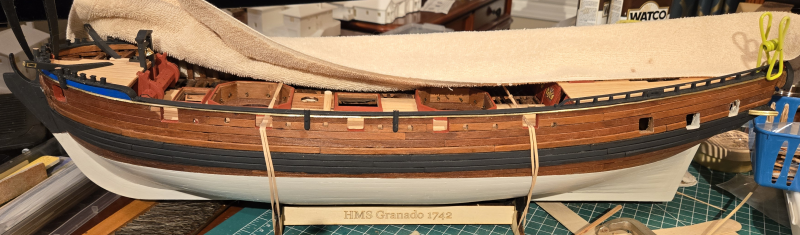
While I haven't posted in a while, I have continued to work on the model. I've been skipping around, trying to think ahead, etc. so my work has been disjointed. And therefore, my posting will be too.

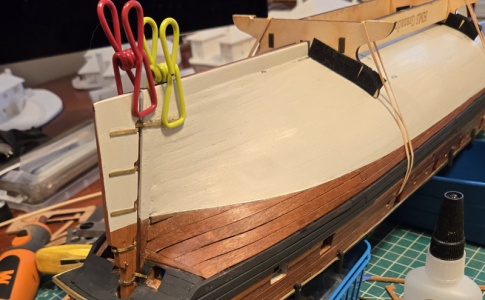
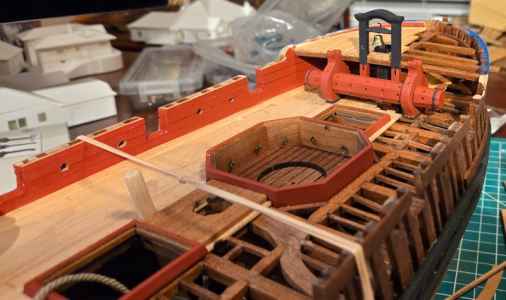
The next task for me was to plank the inner sides of the model above the decks. This worked out okay, so they were painted the same Red Oxide as the other red areas.

1769547057908.png
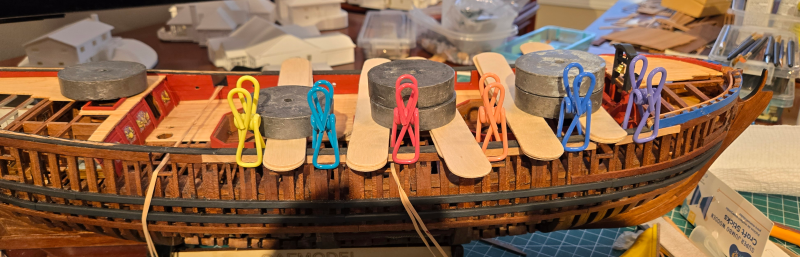
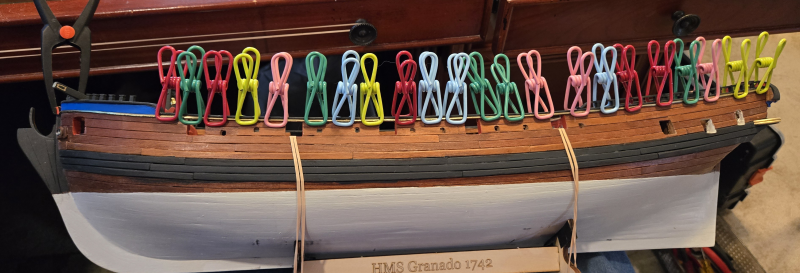
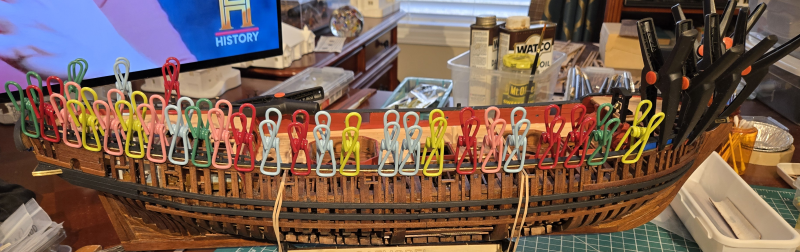
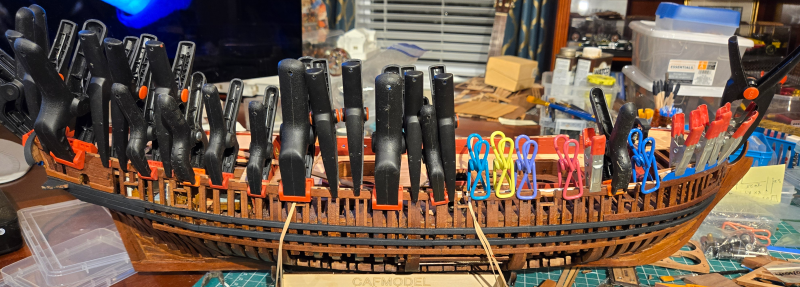
I love me my clamps.
1769546922465.png
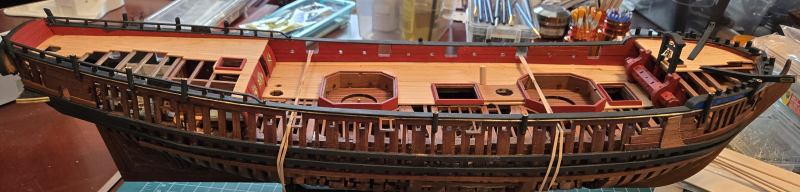
I like the contrast of the red, light deck and darker wood.

Next is to position and glue the planksheers. I'd noticed ahead of time that the bow of my model was a bit longer and pointier than on the models. Thus, the planking and such didn't fit that well at the bow. And therefore, the pre-shaped planksheer didn't fit that well either, but I made it work.

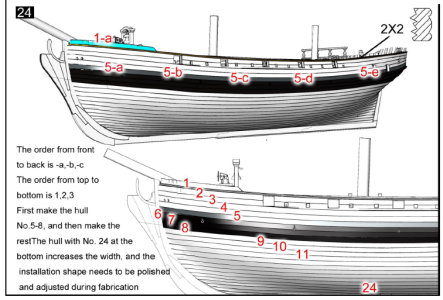
One error I've made all along is in planking. To allow the frame to be removed from the docking template, I'd glued the top outer plank in place a long time ago. I placed it at the top of the frames. But I selected plank number 2, visible in the instruction below, to be positioned at the top of the frames.
1769546203099.png
While, in retrospect, it's obvious to me that the moulded 2x2 strip should go at the top, somehow that wasn't obvious to me at the time. I figured that the 2x2 should go on after the planksheer was installed, and go under it to the outside. I liked this idea anyhow, because my shaping skills appear to be zero. As in, I spent hours shaping and sanding this strip afterwards, only to get something that didn't look like it had been touched. So I planned to get some quarter round brass to add in this place later. This moved my planking up on the model by 2mm, which caused some solvable problems later. It did move the wales down by 2mm, reduced the gun portals height by 2mm, etc. An advantage was it left the top of the gun portals open for shaping and sanding.

Knowing that the planksheers would overhang the structure a bit, and also that due to my error I needed room for the 2x2 strip replacement mentioned above, I tried to keep the planksheers flush with the inside planking and overhanging the outer planking by about 2mm for the above mentioned strip. This was not possible in all places, but I tried.
1769547265791.png
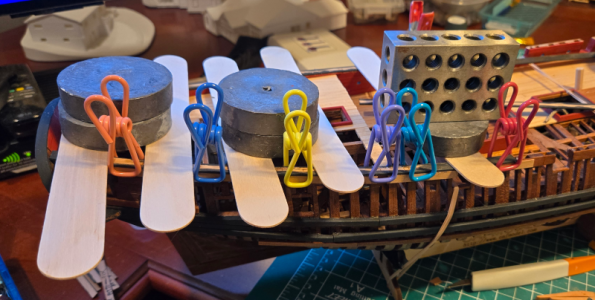
I used craft sticks positioned from side to side with weights to keep the planksheers level. And in most places, added a 2mm strip to the outside temporarily to try to get the 2mm offset.
1769547425267.png

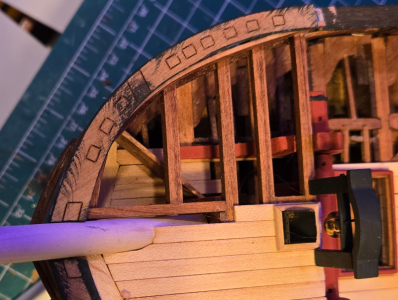
I mentioned above that my bow doesn't match up with the plan's bow, and therefore not with the included forecastle planksheers:
1769547614361.png
Luckily, here the 2mm piece need not be added, but the overhang of the planksheer was certainly going to vary. With sufficient extra material, tools and skill, I would make new ones, but given what I have, there it will be.
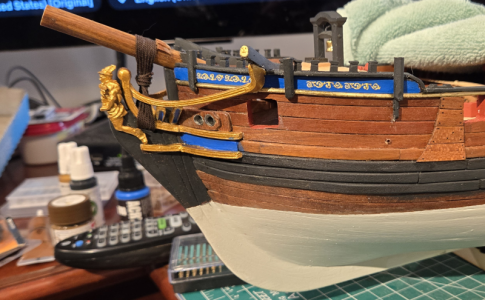
After adding all the planksheers, and the added rail at the quarterdeck, we have:
1769547803883.png
1769547864174.png
The ship is looking much more complete now.

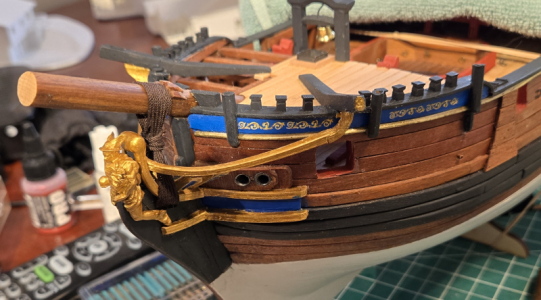
I've also added the catheads. From the instructions, it looks like they should fit entirely under the forecastle planksheers:
1769547960989.png
but at least on my model, they did not, but rather required cutting away part of the planksheers. But according to Goodwin's book, they do cut through them:
1769548094580.png
For once I ended up with something correct.

I tried carving the faces into the ends, but ended up painting them gold and using a Sharpie. I also tried painting the rectangular trim (13 above), but ended up painting it just black. The black I am using is AK Interactive Nato Black AK11360. There's just enough gray in it to satisfy me that it's not pure black, yet doesn't look like gray. Very difficult to find, and then I only bought one bottle instead of 2.
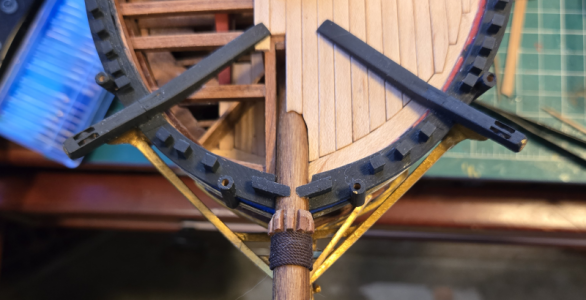
That's enough for this episode. I'll be starting another one shortly.
 
Continuing on, I thought I'd work on the stern next. As posted above, I added a 2x4mm strip going across to the 2 semi-triangular extensions. But after adding the decorative portion at the stern, it's location seemed off, and the triangular parts too large, so I redid it:
1769548754319.png

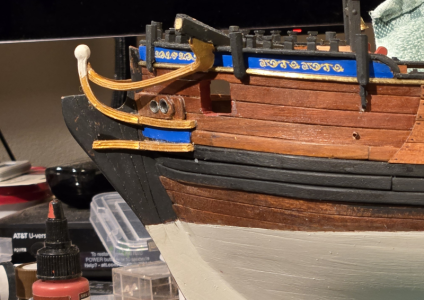
Here I've added brass double-half-round molding measuring 4mm x 1.4mm to replace the carved piece that I'm unable to make:
1769549087015.png
I think it's a reasonable facsimile of the specified 3x4 moulded strip.

Time to add the 2mm brass half-round piece I mentioned above:
1769549230926.png
These clamps worked so well (and so much better than all my other dozens of clamps) that I bought 50 more to add to my 10 obtained from the dollar store. They don't slip around as much, and in this case helped keep the brass strip against both the hull planking and planksheer after gluing with CA.

On to the next chapter...
 
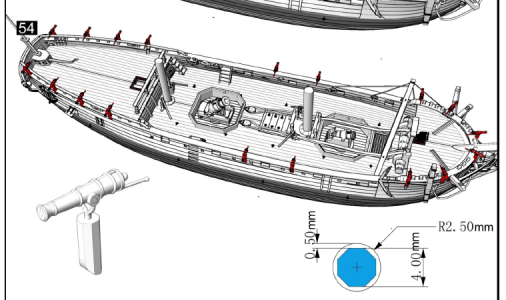
Next I thought I'd work on the swivel gun pedestals, 18 of them. I knew I'd have to drill holes into the top of them for the gun swivels, so took a look at them first:
1769549715708.png
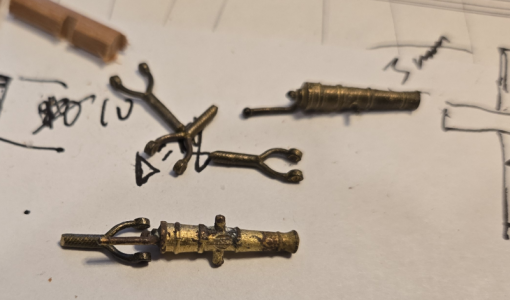
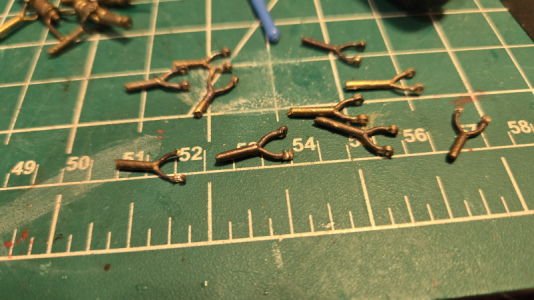
I probably shouldn't be, but I was a bit disappointed that the swivel mounts did not have holes for the gun trunnions. I tried drilling them, but had problems. I thought about removing the trunnions and gluing them in place, but emailed Tom about that, and he suggested first drilling with an 0.8mm drill then with a 1.3mm drill. I tried that on a couple swivels, and while one side worked pretty well, the other broke out the side of the mount. They work, if glued in place, but not what I wanted. I have an idea for doing a better job on the other 16, but I'll leave that problem for later. Or maybe someone will suggest a better way.

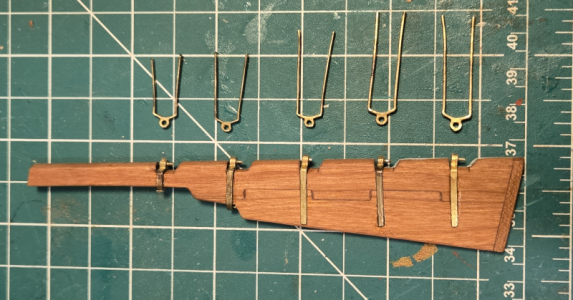
BTW, I have found the brass castings included in the kit vary quite a bit in hardness. For example, I tried drilling out a 4-pounder's shallow bore to make it deeper and gave up. Some other parts, however, drill pretty readily, like the yokes above. I've had to anneal some parts by heating them and letting them cool slowly.

Back to the pedestals - they are all to be 4mm octagonal. CAF suggests making them this way:
1769550249799.png
taking a 4mm dowel (not sure if that was included) and cutting 8 sides into it. Huh??!! Why not instead use 4mm square material, and only cut 4 sides??

Well, it turned out I had 2 strips of 4mm square in the kit that I could use (hoping I don't need them for something else). I'd made a V-groove block to facilitate drilling the center of pieces, so used that along with some shims and such to hold the 4x4 at a 45 degree angle, while pulling it under an end mill mounted in my drill press. That seemed to work at first, but as I removed a couple sides, it became harder and harder to keep it correctly placed, and sometimes the strip would rise to high and cut too deep. Nevertheless, I ended up with 2 strips that, if you're far enough away, could be mistaken for octagon-shaped.

Then I, in my engineer's hat, measured the proper angle at each of these where it overhangs the planksheer, wanting to make 2mm slots halfway into the octagonal strips, and at the proper distance from the top of the pedestals. And cutting each end at the proper angle. And cutting also for the 2mm brass strips. While changing angles and saw cut depths for each cut. While holding the octagonal shape correctly. The results were definitely substandard. But again, at far enough away....

Oh, and also make a jig to hold each pedestal in place while drilling the holes for the yoke. Whew, what a job!

But, when I went to fit these pedestals in place, they weren't quite as accurate as I though. And I needed to change the depth and location of slots due to variations in the hull planking location and angle, brass strip and planksheer! I felt they were almost useless. And I still didn't like the pseudo octagonal shape.

So I decided to make a new octagonal shape. But guess what - I'd used all my 4x4 stock. So, I took 2 pieces of 2x5 stock included as planking, glued them together, and trimmed off one side to 4mm to match the other. This time, no fancy end mill a drill press, I jused a rotary tool in a Dremel and did it by eye. And it ended up better.

I won't show any photos of that long process, because I really screwed up and wasted a lot of time. I'm sure all of you have done much better and have a different method. In the meantime, for my next octagonal use, I just pray that someone, somewhere, will decide to produce octagonal forms for me to buy!

I started with the easy center pedestals, and then moved on to the forecastle:
1769552238813.png
I like the way the brass strip looks - certainly better than I'd have been able to do with a 2x2 strip moulded.

So I glued the brass strip on the starboard side:
1769552372535.png

Here are all the pedestals in place.
1769552507383.png
I've also touched up the black paint on the planksheers, so have gotten some on the brass. That will be cleaned up later.
 
Time to mount the rudder. I've been avoiding it to keep it from getting damaged in handling. But it's time.

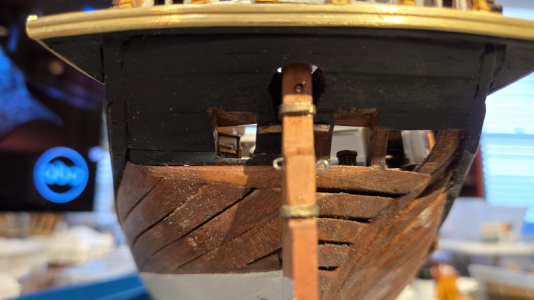
First I mounted the rudder-side hinges in place, matching them with the hull-side hinges:
1769552731704.png
Even though I'd enlarged the cutouts into the rudder some, to allow installing the other hinge halves, I still had problems getting the rudder halves up tight against the top to provide the most room, and installing the other halves.

Holding the rudder at the proper height with my new favorite clams, In first installed the uppermost hinge:
1769552903274.png
I then installed the bottommost hinge. This holds the rudder in place fairly well, as long as the model is right-side-up.
Sorry about the hull cracks; you don't usually see them, and I haven't filled them (which I know I shouldn't have to do).

After those 2 hinges are properly located and mounted, it becomes very difficult to mount the other hinges without making a huge mess of CA glue all over the hull, as well as having them stick in the wrong place. Since I intended to fix the rudder as securely as possible, to help prevent possible breaking or dislocation, I decided to cut the hinges in half. And since I would no longer be moving the rudder, I placed a brass pin though the rudder into the stern post:
1769553263813.png
I see my dust is showing. I hope to clean it up and maybe put another coat of finish to help. The above photo also shows the rings for the rudder chains - easier to drill and locate before mounting.

Here is one of the rudder hinges cut in half as a test:
1769553380178.png

The test worked well, and I was able to easily locate each of the port side hinge halves easily and securely.
1769553457741.png
Adding the other side was a snap.

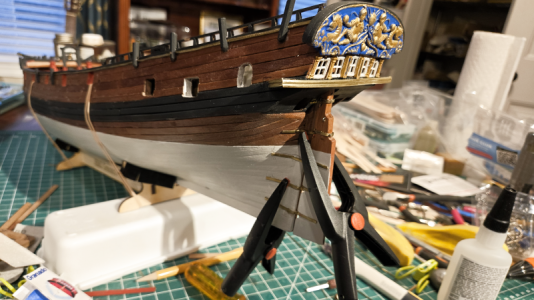
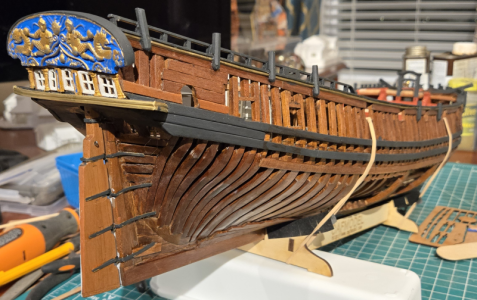
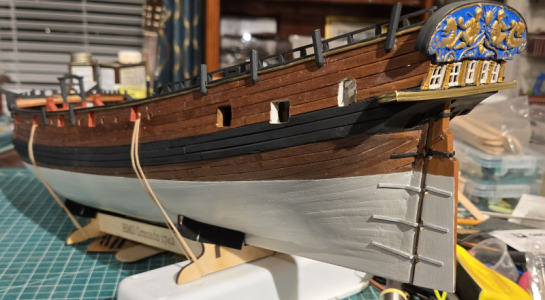
The resulting rudder mounted with hinges:
1769553575352.png
1769553607989.png

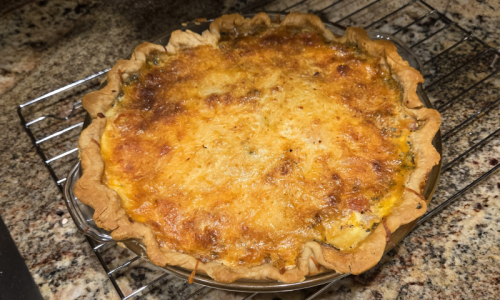
Ah, the wife has just baked a quiche, which looks great, so I've got to go:
1769553720236.png
 
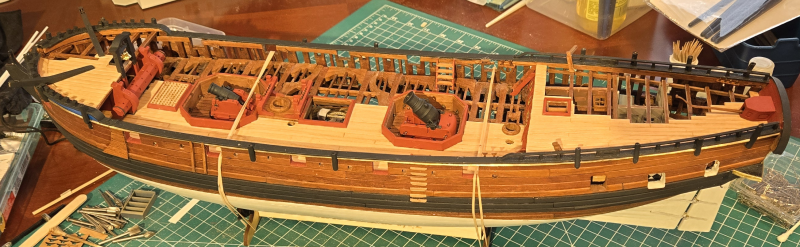
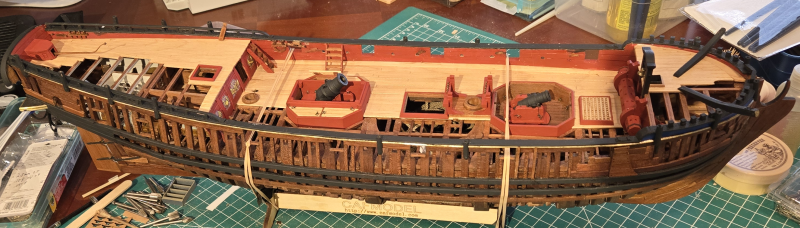
I've been working on the mortars lately, which mostly went without problem. Well, if you don't count mounting the 13" mortar upside down, losing one of the mounting parts and breaking another. So I'll just show photos of them mounted in place, which represents the current state of the model:
1769553928226.png
1769553965079.png
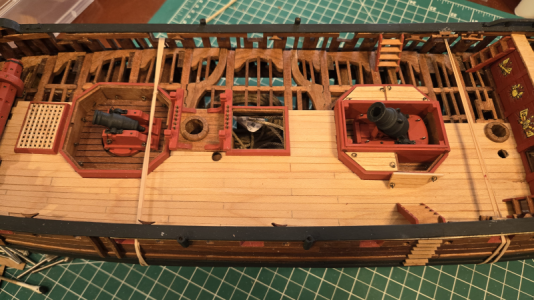
I see I still have to clean the black paint off the brass. Here I've added side steps and ladders, tiller housing and tiller, kevel and other cleats, and hatch grating. I added belaying pins to the bitts around the mainmast, which I think adds a nice detail touch. The cover and structure around the 13" mortar is removable in 2 piece to ready it for combat. I have the covers done as well, but forgot to add them. I've also mounted the mast collars, which Tom kindly provided because I was unable to make the ones included work. He probably used all the included parts and turned them on a lathe, but whatever method used, they fit and work great.

Another pics showing the mortars better:
1769554622081.png
I've added bolts on the mortar beds per Goodwin, using Tichy Train Group products, but you can't see them well here. They do improve the look, though.

That's it for now. I have to decide on what to work on next. Trying to avoid small bits that will break off when handled for now. See you next time!
:cool:
 
Back
Top