
• Win a Free Custom Engraved Brass Coin!!!
    As a way to introduce our brass coins to the community, we will raffle off a free coin during the month of August. Follow link ABOVE for instructions for entering.

"Calara agua a proa" Translation Help

Joined
Sep 23, 2018
Messages
102
Points
88

Location
Bay Harbor, Michigan, USA
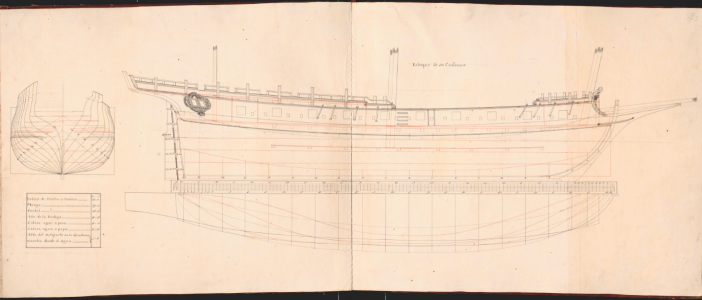
I am hoping to get a translation of "Calara agua a proa" as used in Spanish ship plans. The word agua suggests to me the calara phrase listed on plans refers to displacement (referencing the waterline); perhaps the distance from the waterline to the lowest point of the hull at the measurement point. On the other hand, my Spanish plans do not show a waterline and this distance is sneakily pretty darn close to the distance (at the measurement point) from the bottom of the gund deck to the top of the deadwood (i.e., the actual usable hull area).
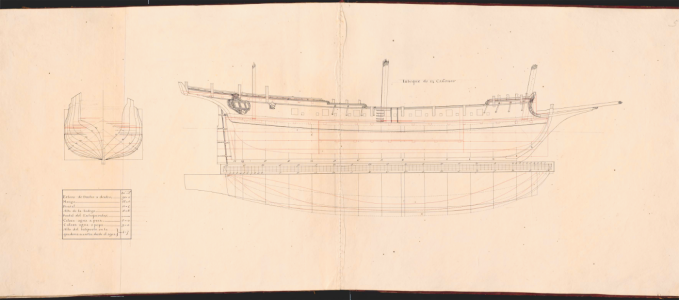
AMN PB-album-06-04 type 2.png

AMN PB-album-06-05.png
 
Last edited:
Old Spanish is quite different from the Spanish written today. In traditional wooden boatbuilding (carpintería de ribera), the word “calara” does not exist as a technical term; what does exist is the verb “calar.” The form “calara” may be an old or dialectal variant of that verb, but it is not the name of any part or concept specific to the trade. My guessing is that the meaning in the context of old boat plans is most likely: “calado a proa” (forward draft/draught) and “calado a popa” (aft draft/draught).
 
Positioning a waterline was not as clear cut in the 1700’s as it is today. Shipwrights knew how to compute the volume of a hull at various waterlines so by multiplying this by the density of water could calculate displacement for any given waterline. They could not, however, predict the weight of the finished vessel with any degree of accuracy. They might have a rough estimate for the timber that they purchased but often had no way to compute exactly how much made it into the finished hull. They, therefore, did not know at which waterline the vessel would float until it was launched.

Once the hull floated, they could compute how much deeper it would float with masts, rigging, armament, stores, etc. added.

There were also no freeboard standards prior to the mid 1800’s. The vessels’ masters were supposed to use their judgement.

Roger
 
Entiendo que se debería haber escrito "calará", que es la forma futura del verbo "calar" (sumergir un barco).
Se especifica "calará agua" porque utilizando sólo el verbo "calar" se entendería como "calar masteleros".
Espero haberme explicado correctamente.

(traducido por translate.google)
 
Back
Top