If you've ever been a fan of the British or American
Antiques Roadshow television programs, (or "programmes," as the Brits spell it,) you must have surely seen the segments where the lady proudly shws the expert the "old chair" that she found in her grand aunt's attic which she's stripped, sanded, and coated with polyurethane varnish. Remember the look on her face when the appraiser tells her what she has there is an exquisite example of an actual Chippendale work which
would have been worth six figures if only she hadn't stripped and sanded off the original finish and coated it with Minwax "wipe on poly" like Norm told her to do on
The New Yankee Workshop, but now it's only worth a few hundred bucks.
When it comes to ship models, you don't ever want to be like that lady on Antiques Roadshow!
Roger beat me to it in large measure, but I do want to underscore what he has said:
Before you do anything to your model, read, and learn everything in at least the two books Roger recommended. They are
essential to any proper restoration of this model:
Caring for Ship Models: A Narrative of Thought and Application by Rob Napier, is available from Seawatch Books at
https://seawatchbooks.com/products/...tive-of-thought-and-application-by-rob-napier. As this is a new book, you'll probably have a hard time finding a used copy, but it's worth checking Amazon to see if anybody has one. It's not a cheap book, but worth every penny and, in my opinion, a book that should be on the bookshelf of anyone who aspires to be a serious ship modeler.
and
The Junks and Sampans of the Yangtse by G.R.G. Worcester available from the U.S. Naval Institute Press at
https://www.usni.org/press/books/junks-and-sampans-yangtze. This seriously large volume is the English language "Bible" of traditional Chinese watercraft.
There simply isn't anything else in the English language that treats the subject adequately. Originally a two or three volume work (I can't remember which,) it was once one of those "rare unicorns" for which collectors which collectors paid hundreds of dollars whenever a copy came on the market. The Naval Institute Press combined the original volumes into one 656 page, 900+ illustration, "coffee table sized" volume in, as I recall, the 1970's, and that printing quickly sold out. After that, even those copies were bringing around $350 a piece until the Naval Institute Press did a second printing in 2020 which is now selling new for around $45. Amazon has a single used copy for $32 right now, so grab it!
https://www.amazon.com/Junks-Sampans-Yangtze-G-Worcester/dp/0870213350# (Like the stock market, the book market has its ups and downs. Expect
Junks and Sampans to go up in price as soon as the second printing is no longer available new from the publishers.)
Download and read the construction and conservation standards Andy has provided above:
https://www.navsea.navy.mil/Home/Wa...ications-for-Building-Exhibition-Ship-Models/
https://www.shipmodel.com/pdfs/ship-model-classification-guidelines-1980.pdf
These standards are an excellent summary of how ship models need to be built if they are to last longer than you do.
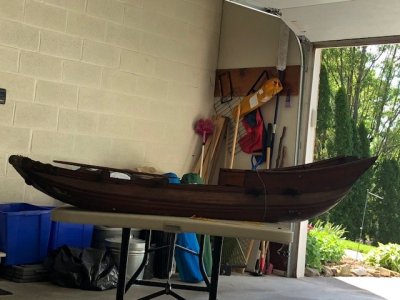
Ignore anything to the contrary offered by the ship model kit manufacturers and YouTube "influencers!" Kit building isn't even in the same zip code as where this model is at. Your goal isn't to make this model look brand new. Your goal is to make this model look as if somebody took good care of it ever since it was built. (And, when all is said and done, you
must put it in a proper display case or all of your efforts will soon be for naught.)
To Roger's sage advice, I cannot emphasize enough:
Read and understand Napier's book on ship model restoration. DO NOT go looking for "advice" on YouTube or similar online sources. This is a model which deserves to be property repaired and conserved.
Follow Napier's instructions to the letter.
DO NOT listen to self-appointed experts who are going to tell you to coat it with "wipe on poly," varnishes, paints, or anything else. In terms of what you do to the surface and its "patina,"
less is more. DO NOT use cyanoacrylate ("Superglue,") epoxy, or polyvinyl acetate ("Titebond") and similar adhesives. Again,
follow Napier's advice to the letter!
In order to repair and conserve this model, you will have to first learn how the prototype vessels were constructed, rigged, and sailed. They were not constructed, rigged, and sailed like the Western vessels of the same period. The Western sailing vessel harnesses the forces resulting from engineered tension between the opposing forces of wind and lateral resistance to the water to make the vessel "sail into the wind." The Chinese sailors approached sailing by
avoiding tension rather than creating it. They let the wind and the currents push them with the least resistance possible. They did not "strap her down and beat to windward." The basic engineering theories of Chinese and Western sailing vessels are opposite to each other, as, consequently, is their construction and rigging. To do this job right, as with any restoration, you will have to "get inside the head" of the man who built the model, just as he "got inside the heads" of the men who designed and built the prototype. Close to
nothing you will find written about Western sailing vessels will be applicable to this vessel nor to Western modeling techniques, so you will be on your own in that respect. Let the model itself and Worcester's book be your guides. They will be your best teachers. You must walk in their footsteps. Step slowly and carefully, Grasshopper.

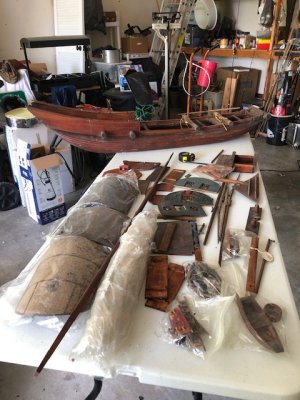
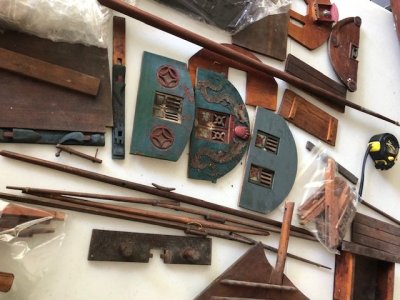
As Napier's book will tell you, 1) Take pictures of everything. Nobody's memory is all that good. 2) Label all the parts (small plastic ziploc sandwich bags are useful for this.) 3) When you work with small parts, exercise extreme care to maintain control of small parts. (These have a way of "jumping off workbenches and disappearing into the ozone.) 4)
In all things you do with this project, take your time.
AND... Don't be afraid to ask us questions about process, materials, tools, and techniques. This is the place to get your questions answered.