• Ships of Scale has incorportated an extra level of security when you log In. Please follow on-screen prompts to acknowledge that you are not a robot via a "Check Box" or a "Pictorial Check Box Puzzle". This is needed due to higher level of AI Activity Security.
  • SUBSCRIBE TO SHIPS IN SCALE TODAY!

    The beloved Ships in Scale Magazine is back and charting a new course for 2026!
    Discover new skills, new techniques, and new inspirations in every issue.

    NOTE THAT OUR NEXT ISSUE WILL BE July/August 2026
  • Win a Free Custom Engraved Brass Coin!!!
    As a way to introduce our brass coins to the community, we will raffle off a free coin during the month of August. Follow link ABOVE for instructions for entering.

Chinese Junk Ship Model Approx 90 Yrs Old in need of restoration: Advice needed!

As a restoration guy I think I would use a good quality furniture polish and polish every piece of wood first.
The wood is completely dried out after 90 years of exposure to the environment.
I would then assemble the parts to make sure they actually go together.
Once I was absolutely sure of the assembly of said parts I would use a little bit of Franklin hide glue to glue them securely together.
I would then look closely at the mast to determine where the sails were located as there should be obvious differences in coloration on the mast where the sails/yards/booms were attached.
Use beige colored threads and line to rig her.
If you can’t find the right sized line in beige you can use white line and use a wood touch up marker in beige to color the line before attaching to the model.
You need to keep the “aged” look to everything you do on this model.
Best of luck with this project.
She’s quite the piece of history.
 
As a restoration guy I think I would use a good quality furniture polish and polish every piece of wood first.
The wood is completely dried out after 90 years of exposure to the environment.

As a "furniture restoration guy," I might tend to agree with you, depending upon the original finish of a piece, but as a "ship model restoration guy" I'd have to yell, "Don't put anything on it until you are sure it is compatible with what's on the surface already!" (And, of course, furniture polish is not exactly the best coating for a faying surface in any event.)

The OP stated in another forum (of decidedly less competence that this one!) that he had identified a collection of apparently identical Chinese models in the online inventory of the Royal Museum at Greenwich. If such models are worthy of space in the RMG's collection, this one may well be one of a particular collection of models which has become separated from that original set or, in any event, one which is of equal value and worthy of professional level attention. (We have previously advised him to obtain and read Rob Napier's Caring for Ship Models ship model restoration handbook and I again strongly urge him to take any advice he may obtain online with a large piece or rock salt! I do hope he does that before doing anything else!) He would do well to email a set of photos to NMG with an enquiry regarding his model. They may be able to provide him with valuable information regarding the provenance of his model and perhaps a better idea of its value, as well as critical information regarding restoration.

My concern with applying anything to the material of this model is that at present, even with respect to apparently bare pieces of wood, nothing is known of what's there now. It must be presumed that the Chinese modeling technology of the time was not the same as Western modeling technology of that time. It's not yet known, for instance, whether the paints on the model are water-based or oil-based. Most modern furniture "polishes" contain solvents of some kind, many of which could as easily operate more as "paint stripper" than anything else on thin coats of aged pigment. Most modern furniture "polishes" may also contain moisturizing or sealing agents that can affect the moisture content of the wood. The wood of this model, for better or worse, has been "settling" to its present moisture content equilibrium for a hundred years or more. The last thing it needs at the moment is anything that is going to risk creating any radical change in its moisture content and the back-and-forth stresses created by changes in the ambient humidity conditions.

As the saga of this "barn find" ship model unfolds, it becomes increasingly apparent that this may be a model of considerable value, not merely monetary value, which may be of no moment given that he apparently with good reason has no interest in selling it, but because it may have significant academic historical value. I will hazard to presume that there is no one on this forum, and perhaps no one outside of a Chinese museum or RMG conservator who is qualified to properly restore this model without their input. If it were my model, I wouldn't do a thing to it until I had all the information useful to a restorationist in hand. As much as I expect that there will be many of the "canons and gingerbread" period ship modeling fraternity disappointed to hear it, I must emphasize that one of the greatest laments of researchers and conservators who deal with collections of truly historically valuable ship models in the top museums around the world is the fact that so many of the otherwise treasured surviving contemporary ship models have lost much of their usefulness as historical records from the well-intentioned but nonetheless ham-fisted fiddling of previous "restorers" who have obliterated their historical integrity (and whose erroneous "amendments" are perpetuated by kit model manufactures who slavishly replicate them in their replicas.) Given the apparent sophistication of its original owner, I presume this model isn't merely a bit of "tourist souvenir junk." It may be part of a significant collection of contemporary models, perhaps even associated with Worcester, the man who "wrote the book" on the subject of Chinese sailing vessels. It may be the only surviving historically accurate model of its type of vessel. Who knows? Yet.

It's one thing to encourage a novice to undertake "restoring" a heirloom vessel of no particular value. Nothing ventured, nothing gained, as they say. It's quite another to encourage someone, however well intentioned, to start trying to "restore" what might be a very academically valuable part of what is already a rather slim historical record of the subject matter. Ship model "doctors" should abide by the ethics of all "physicians:" "First, do no harm."
 
Last edited:
Yeah I can agree with you Popeye.
It maybe if some value.
And yes it probably would be a good idea to have someone who is very knowledgeable about that time period of this models build.
Time will tell.
 
I referred to this above but sometimes this stuff “gets lost in the shuffle.” There is (or was) a collection of Chinese Junk models at the Science Museum. It’s called the Wartz Collection. Wartz and Worcester were both officials in the Chinese Customs Service; apparently an organization from when British gunboats patrolled Chinese Rivers. In is book Worcester writes that he helped Wartz with the the collection.

I would contact the Science Museum before proceeding to work on the model.

Roger
 
There is (or was) a collection of Chinese Junk models at the Science Museum. It’s called the Wartz Collection. Wartz and Worcester were both officials in the Chinese Customs Service; apparently an organization from when British gunboats patrolled Chinese Rivers. In is book Worcester writes that he helped Wartz with the the collection.

Good catch! It was just a wild guess that there was a collection of Chinese models and Worcester was a British customs official on the Yangtse at the same time as the San Pablo was on the U.S. China Station, so... It looks like we may be getting closer to learning something more about this model. If it is as similar to the RMG's Chinese model collection as the OP said it was, it may have once been part of Wartz's collection, or perhaps built by the same modeler.
I did a bit of AI digging and came up with this:

Fate of the Science Museum’s Chinese Ship Models​

The Science Museum in London once displayed a remarkable collection of Chinese junk models in its Shipping Galleries, part of the Water Transport section. This display included the Frederic Maze Collection of Chinese Junks, donated to the museum in the 1930s by Sir Frederick Maze, Inspector General of the Chinese Maritime Customs Service hpchina.blogs.bristol.ac.uk. Maze was motivated by a desire to document what he saw as a “vanishing era” of Chinese shipping, and the models were intended to preserve the appearance and craftsmanship of these traditional vessels.

For over six decades, the Maze Collection was on public display alongside other global ship models, including British and foreign craft hpchina.blogs.bristol.ac.uk. However, when the Shipping Galleries closed in 2012 to make way for the new Information Age gallery, the models — along with the rest of the maritime collection — were moved to off-site storage in specially constructed protective crates Science Museum Blog. These crates buffered the fragile models from temperature and humidity changes that could cause damage.

The models remain in storage, with their protective covers left in place until someone requests to see them. In 2017, the museum invited photographers Anderson & Low to document the collection through its protective casings, using ambient light to create painterly, atmospheric images. These photographs were exhibited in the Voyages show, offering a new artistic perspective on the models while keeping them safely preserved Creative Review+1.

In summary, the Chinese ship models from the Maze Collection are still part of the Science Museum’s holdings, but they are no longer on public display. They are preserved in climate-controlled storage, occasionally brought out for special exhibitions, and have recently been showcased in a creative, non-traditional format to keep them visible to the public.

It may be that there were two Chinese ship model collections associated with the British Customs Service on the Yangtse, a "Maze Collection" and the "Wartz Collection," or, perhaps these two are actually one in the same, having maybe changed hands between private collectors and then been acquired by the Science Museum. It's also possible that these Science Museum models are those now in the RMG's collection. As I recall, the Science Museum deaccessioned a lot of their ship models with the lion's share being transferred to the NMG and the remainder being auctioned off by a London gallery in fairly recent times.
Anyway, perhaps this bit of information will motivate the model's present owner to investigate further with the curatorial staff at the Science Museum. I hope he does and keeps us informed of what he learns!


 
Oops, my mistake, it’s the Maze Collection !

Ah ha! That clinches it! All he has to do is go straight to the Science Museum and I'll bet he'll discover that he has one of those Maze Collection models or at least one from the same source! I have to think that the U.S.N.'s China Station worked closely with the British Customs Service on the Yangtse during those times and the captain of the U.S.'s patrol craft would likely have known the British Customs Service staff, including Worcester. That connection would be very significant to the model's provenance.

The OP said the model was originally owned by the captain of the U.S.S. Panay. This was the ship sunk by Japanese aircraft while patrolling the Yangtse in the famous Panay Incident in 1937. (Worcester's books were published in 1948, as I recall.)

See: https://en.wikipedia.org/wiki/USS_Panay_incident and https://en.wikipedia.org/wiki/USS_Panay_(PR-5)

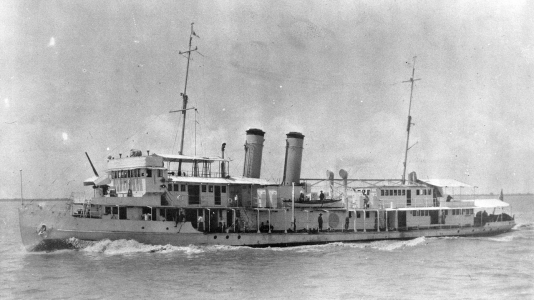
U.S.S. Panay circa 1928:

1786412672564.png

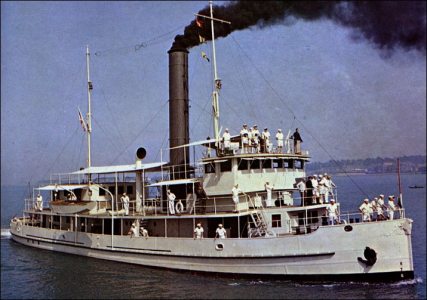
Panay is one of those vessels I've always thought might be worthy of modeling. For those who may be interested, Panay was the inspiration for the fictional U.S.S. San Pablo, AKA the "Sand Pebbles" in the book and movie of the same name.

The movie prop, U.S.S. San Pablo ("Sand Pebbles"):

1786412819133.png
See: https://www.thesandpebbles.com/san_pablo/demise_sanpablo.html
 
Interesting story on the Sand Pebble Popeye.
I had always wondered what and how she became what she was.
Thanks!
 
This is a spectacular find. The detail is stunning. I hope you'll keep us apprised of what you suss out restoration-wise, and log your efforts. I'd love to see the thing fully assembled.
 
From Vice Amiral F.E. Paris, a book on China vessels. During his trip around the world he documented all the ships he encountered on his way. It's a collection of 6 books with 360 detail and drawings plans.
I have a pdf book on Chinese Juncos of Macao Museum but it's too large to upload here (540 pages).
 

Attachments

From Vice Amiral F.E. Paris, a book on China vessels. During his trip around the world he documented all the ships he encountered on his way. It's a collection of 6 books with 360 detail and drawings plans.
I have a pdf book on Chinese Juncos of Macao Museum but it's too large to upload here (540 pages).
A treasure worth saving! Thanks much!

Google translate works fine:

ESSAY ON THE NAVAL CONSTRUCTION OF NON-EUROPEAN PEOPLES, or collection of ships and canoes built by the inhabitants of Asia, Malaysia, the Great Ocean, and America
 
Just browsing around breaking in a new phone and found myself rereading this thread

Any news?
How are the researches going?
Any decisions about what to use?


Enquiring minds and all that…
 
There’s nothing wrong using the parts that you have to assemble it. Using a reversible glue means that you or someone else can relocate a part if you put it in the wrong place. Be careful not to disturb the paint. Sails and rigging are another matter. You’ll first have to figure out what material they used. Being Chinese, silk, cotton or some sort of paper are candidates. The model was built before use of synthetic resins. I would talk to someone who conserves fabric or paper to discuss options for preservation. I wouldn’t hang them on the model as they would be very fragile and won’t last long in sun light.

It appears that your package includes masts and some other spars. An option would be to rig them without sails but with minimum rigging. Of course if you feel ambitious you could make new sails. Neither option would detract from the model’s value as they can be removed in the future without damaging the model’s value.

The best reference on Chinese Naval Architecture that I know of is The Junks & Sampans of the Yangtze; a massive tome written by and illustrated with drawings by C.R.G. Worcester, who was once a River Inspector with Chinese Maritime Customs. My copy was published by the US Naval Institute Press but I’m sure that the original editions were published in Great Britain.

The promotional flap on the book mentions that he was also involved with the Maze Collection of Chinese watercraft models at the Science Museum in London. Another research resource?

I must confess that I’m a “recent China Hand.” Back in the 1980’s and 1990’s when we viewed China as a market and not a rival I made seven trips to China looking for business and negotiating contracts for supplying pipework to China’s expanding electric utility industry. It’s a fascinating country!

Roger
I believe you should keep the old sails and incorporate them into the display if possible. They are probably valuable by themselves.
When I had my business at Van Nuys airport we replaced the linen aileron and rudder coverings of a WWII Japanese Zero as they failed the punch test and were not airworthy. They ended up as a display in a museum in Kagpshima, Japan.
 
Back
Top