

• Win a Free Custom Engraved Brass Coin!!!
    As a way to introduce our brass coins to the community, we will raffle off a free coin during the month of August. Follow link ABOVE for instructions for entering.
  • SUBSCRIBE TO SHIPS IN SCALE TODAY!

    The beloved Ships in Scale Magazine is back and charting a new course for 2026!
    Discover new skills, new techniques, and new inspirations in every issue.

    NOTE THAT OUR NEXT ISSUE WILL BE MARCH/APRIL 2026

CNC Serving machine

  • Thread starter Thread starter johnv
  • Start date Start date
  • Watchers Watchers 6
Joined
May 30, 2024
Messages
198
Points
143

Location
Geelong, Australia
Recently I finished the Mini CNC Mill which about which I posted some photos of the progress..
At the time I was just starting the standing rigging on the Mamoli Constitiution, and not happy with my first build efforts. Mainly with the seizing. I was making my own ropes and they were going quite acceptably, but the seizing was another matter.
Incidentally, I plan to use the mini mill to make the spars. I will post results soon.
Then I had a thought. I know that some modellers use a hand cranked apparatus to do the serving, and I wondered if I could make a CNC machine to achieve better results than I could manage using simpler traditional methods.
The electronics and MPG from the mill could be easily swapped over to operate the CNC serving machine.
So, after playing around with designs, and getting some useful advice from this site, I came up with a plan. Ordered various components, and waited for them to arrive before finalising the plans.
Some components were 3D printed, and some were machined. Many were purchased from China.
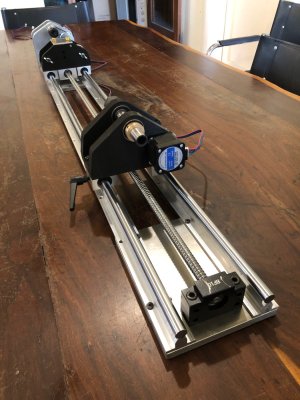
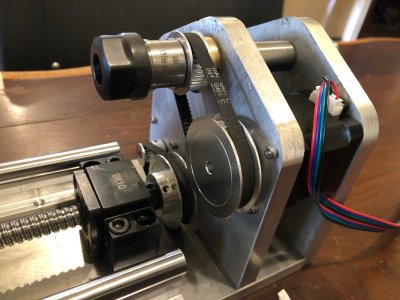
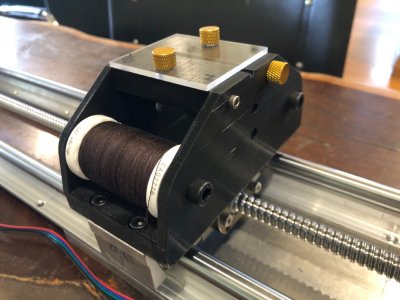
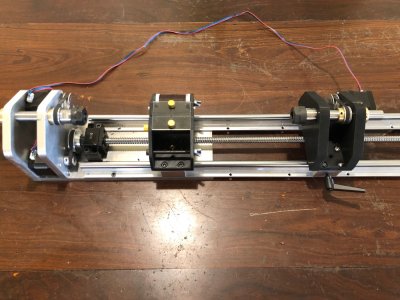
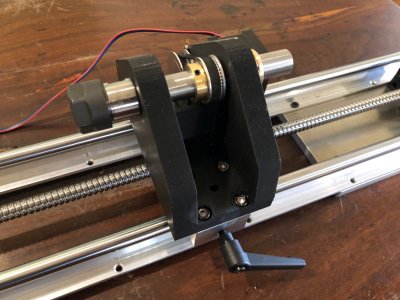
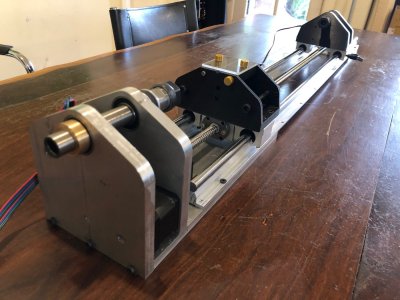
The mechanical parts of the machine are shown in the following photos. 800mm between centres. Nema 17 steppers. Electronics-Control box not shown here. See CNC Mini Mill thread.
When I have tested it, and made any adjustments I will show a video.IMG_5457.JPGIMG_5457.JPGIMG_5453.JPGheadstock.JPGbobbin holder.JPGserver2.JPGtailstock.JPG
 
Time will tell.
The advantage of CNC is that very fine adjustment of the pitch of the serving thread is possible. Using a ball screw means that there will be very little backlash. And also the speed of the overall process can be finely adjusted.
The tension of the serving thread is less precise, but adjustable. There will be a learning curve.
Lateral movement of the rope might be a problem, but the groove can easily be remade narrower, if necessary, by reprinting it. (ps or making it in metal.)
I should have some initial results in a day or two.
 
Last edited:
First serving runs today exceeded my expectations. The machine worked close to perfectly, and after trying variations of the settings, and finding that I could push the machine speed to the limits of the Nema 17 motors, I did a 600mm length of serving 1mm diameter home made rope in about 2 minutes.
I can see a couple of areas to improve. The spool carrier groove needs to be smoother, and I will make a replacement top plate from metal, and spend time polishing it. And I will design and make a V shaped extension carrier top plate to allow close access to the top plate thread hole for seizing close to deadeyes. (p.s. did not need a V plate. Just a feeding hole very close to the edge of the top plate. See my nest post)

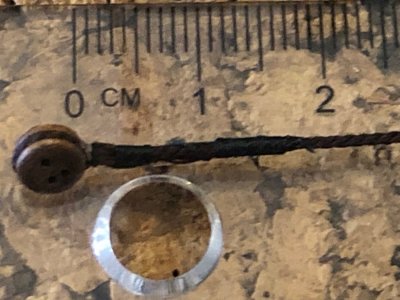
The first photo is 2mm x600mm rope, served with a several starts at different settings. The second photo is 0.9mm white rope served with brown Guttermann thread, pictured vastly magnified. I did take some videos, but the video quality is ordinary, and I will try to improve the video setup before publishing.
BTW, these ropes were rejects, used for first serving attempts because I was just experimenting and expected them to be thrown out. But with the serving, the poor rope quality is not so visible, hey?
IMG_5470[1].JPGIMG_5473[1].JPG
 
Last edited:
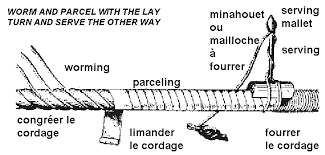
Isn't the serving line supposed to lay in the groves between the threads of the rope? I think I have some terms mixed up. What is "Parceling?" That is really quite a machine. Hope you can make us a video to show how it works. Norgale
 
Isn't the serving line supposed to lay in the groves between the threads of the rope? I think I have some terms mixed up. What is "Parceling?" That is really quite a machine. Hope you can make us a video to show how it works. Norgale
Yes the terms and procedures are similar.

Most modelers don’t parcel or worm rope, because it is covered by the serving.

Serving is different to seizing but the serving machine can be used to do both.

IMG_0677.png
 
An amazing device, and the samples look superb.

As an aside, including a rule in the photo would help appreciate the scale of the work, as that close up looks remarkably like a full size example.

If those are test samples I'm looking forward to seeing the production examples

Jim
 
An amazing device, and the samples look superb.

As an aside, including a rule in the photo would help appreciate the scale of the work, as that close up looks remarkably like a full size example.

If those are test samples I'm looking forward to seeing the production examples

Jim
Thanks for the compliment, Jim. The diameters are mentioned in the text. The last one is 0.9mm diameter.
 
CNC SEIZING
Seizing shrouds and stays to deadeyes was what prompted me to look for a better method than manually winding thread, particularly with my ageing eyesight. The CNC machine which I made does the serving easily, quickly and very neatly.
But seizing right up to a 5mm diameter deadeye was another kettle of fish.
For start, the seizing-serving thread hole feeding onto the rope was in the middle of the bobbin carrier, almost 40mm away from any deadeye, so the feeding hole had to be relocated to the very edge of the bobbin carrier. I had already decided to make the top plate of the bobbin carrier from metal, and to position the thread bobbin vertically to save space. So I redesigned the bobbin carrier, and made a new one, with a metal top, with a thread hole right at the edge of the plate, as well as a hole in the middle of the plate.
The next issue was working out a method of holding the deadeye, 5mm diameter and 3mm thick, with the deadeye edge protruding. A couple of trial designs which were failures. Then one which worked!
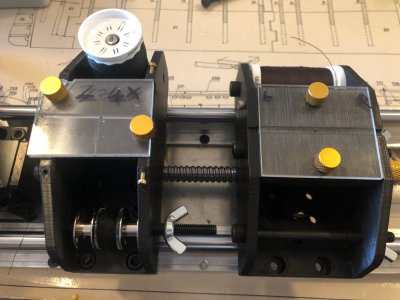
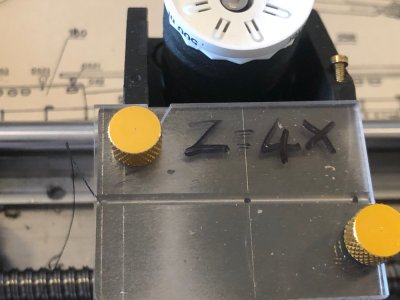
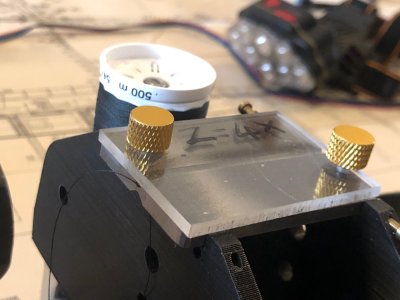
photo 1 The first bobbin carrier (right) and the redesigned one (left). Both have central thread delivery holes, but the new one has one on the left edge also. Note that the metal top plate groove is much smoother. Less tendency to fluff up the thread. The 3 small bobbins are just stored there, out of the way. (but might be used for worming.)
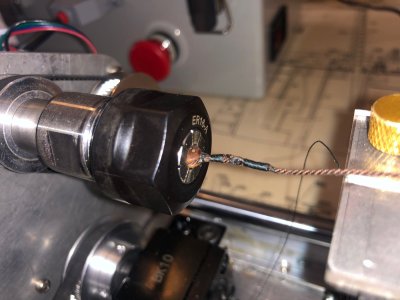
photo 2 Using an ER collet to hold the deadeye. Showing the first satisfactory seizing of a 0.8mm rope. Further improvements in mind.
photo 3 Magnified view of the deadeye. I used that one as a test piece because of the inaccurate drilling. not a great photo.
photo 4,5 The new top plate design with vertical Gutermann bobbin
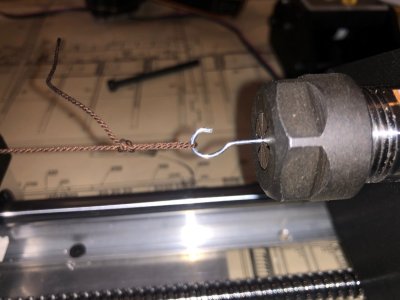
photo 6 where ropes are held on the machine, I use a paper clip bent into a hook, also held in an ER collet.
This was my first attempt to seize a deadeye. Not perfect, but not bad for me.
IMG_5492.JPGIMG_5497.JPGIMG_5493.JPGIMG_5495.JPGIMG_5494.JPG
photo 5 The newer design top plate with the two thread holes, including one on the extreme left edge
IMG_5498.JPG
 
Some amazing accomplishments John. I look forward to more updates on its capabilities and design modifications.
Very impressive.
Will you consider publishing the details of how to replicate this or perhaps a patent is being considered?
 
Some amazing accomplishments John. I look forward to more updates on its capabilities and design modifications.
Very impressive.
Will you consider publishing the details of how to replicate this or perhaps a patent is being considered?
Thankyou Michael. I am blushing.

I will publish details of the build when I am satisfied with the design. Still some mods in mind. Not interested in patent or manufacture. Most of it is made of parts which I purchased from AliExpress, 3D printed some, and I can publish the stl files for anyone who wishes to do the same. Some parts were machined, but only because I had a problem with my 3D printer, now resolved. Even the metal bobbin carrier top plate can be 3D printed, as long as it is carefully smoothed.

The main issue for most potential modelers, as it was for me, will be the electronic wiring. I had expert help for that. I can probably make up some sort of electronic diagram, but it will not be professional standard. I asked my expert friend if he would draw up the circuitry but not sure.

Cost will be an issue for some. The machine hardware cost about $AUD400, and I used about $AUD100 of stuff from my workshop. The electronic components cost about $AUD600-700. The essential software is Mach3 which I purchased years ago. Not sure what it costs now. Probably approx $AUD 300.
(p.s. I checked. Official licensed version from Artsoft is $USD175 $AUD 262. ALiExpress has versions for $AUD2.62!!. My expert friend has tried Mach4, but he tells me that it is more bother than it is worth, and to stick with the older Mach3).

ComponentquantityCost $AUDsuppliercomments
2 Rails, 1 ball screw, 4 bearings 1000x12, end bearings, package deal1145Ebay
PLA bobbin carrier and tailstock, 3D printed. Cost is filament120QidiPrinted 2 carriers and tailstock
Nema 17 stepper motors345Steppersonline
ER16 C16 L100 chucks240Ebay
ER16 collets2 sets60EbayWorkshop stock
Timing gears GT2 6mm 60T38AliE
Timing gears GT2 6mm 20T14AliE
Timing gear GT2 40T 6mm210AliEMachined to 16mm bore
Timing belts GT2 160T28AliEInc spares
Timing belts GT2 200T28AliEInc spares
Stepper motor cables310AliEInc spares
Ethernet cable118AliEInc spare
Aluminium for base 122x500x10mm130Est from workshop supplies
Sundry fasteners20Workshop
TOTAL not including Electronic Controls430= $320 + workshop stock
CNC box with ESS, breakout, stepper drivers, Ethernet cable, MPG.1600-700Made for mini mill
Ball Bearings 16 31 10 (unusual size. a push-bike part)420 AliE
 
Last edited:
The Control Box Components (note: the control box can be switched to other CNC machines using Nema 17 motors. Not suitable for larger Nema sizes)
CONTROLS

ComponentQuantityCost $AUDSupplierComments

Cheaper components available, but best to get good quality from reliable suppliers. Prices include postage and local Oz taxes.
Plastic Box, transparent lid 290x200x145mm150Jaycar?Could use smaller box if Arduino components substituted.
ESS Warp 9, Ethernet Smooth Stepper 1377Homann Designs MelbourneLikely cheaper in US.
Breakout board C25R5-S3746-13145CNC for PC
Stepper driver modules A4988 12v510AliE1 spare
Meanwell power supply RD-65A 12v, 5v,166Ebay
E stop (panic stop switch)115Ebay
On-Off power switch120Ebay240v for AUS. ?elsewhere
Multicolour ribbon cable DB25 female both ends 19.7”121Ebay
Fan 12v, 50mm, with guard113Ebay
CNC MPG (manual pendant control) DB25 connection1125CNC for PC
Aluminium 250x150x3 1 Workshop supplies For shelf.
3mm Standoffs, sundry fasteners and wires 20JaycarSome workshop supplies.
TOTAL 761 (Hmm. More than I had guessed.)
 
Back
Top