• SUBSCRIBE TO SHIPS IN SCALE TODAY!

    The beloved Ships in Scale Magazine is back and charting a new course for 2026!
    Discover new skills, new techniques, and new inspirations in every issue.

    NOTE THAT OUR NEXT ISSUE WILL BE July/August 2026
  • Win a Free Custom Engraved Brass Coin!!!
    As a way to introduce our brass coins to the community, we will raffle off a free coin during the month of August. Follow link ABOVE for instructions for entering.

Danish Oil question

Joined
Sep 24, 2025
Messages
51
Points
88

Location
Wylie, Texas
Greetings,

I am close to the point of completing the hull of my ship. It is 2x5mm Beech planking with African Walnut & mahogany trim. Per good results with past wood working projects, I have chosen Watco Danish oil for my build, but I have never had to glue anything to my projects. I oiled & PVA glued some scrap pieces & after 24 hrs of drying, I could not pull them apart. What about long term adhesion?

From Youtube, I see builders oil in stages & then only use CA to glue additional wood pieces to the hull. Wouldn't PVA glue be much better, or am I over thinking it? Does anyone ever wait until the hull is completed & then oil everything at once?

Thanks,

Mike
 
Why oil it at all? The one natural finish model that I built I sprayed with matt lacquer. 40 years later it still looks great. The lacquer is invisible. Since than all of my models have been painted- more realistic. Why try to make a model look like a piece of furniture?

Roger
 
Danish oil is another vegetable oil that polymerizes - like linseed and Tung oils. It fills pores and surface irregularities leaving a smooth surface. PVA needs pores and surface irregularities for its polymer chains to invade and produce its bond. It is similar the fungal hyphae invasion. The smooth finish leaves nothing for the PVA to grab onto.

Do you know where the PVA bond area will be before you use the oil?
Can you place a piece of masking tape just on the PVA bond zone before using the oil?
If you can, trim the masking tape just a tad shy of total at the border - so that there is no gap in the oil finish.
Also, belt and suspenders. A short piece of copper wire as a blind dowel also holding the two bonding pieces.
Sand some horizontal grooves into the wire for the PVA chains to hold onto. The bond will not be as strong as wood to wood,, but nothing that you can do will break it.
If the bond has end grain involved, PVA works better if the end grain is primed with a soak in coat of PVA - wait a couple of days - then bond.

In light of the above, test this using scrap: prime both bonding surfaces with PVA - let polymerize for a couple of days.
cover with masking tape - use the oil - after it has cured - remove the tape and PVA bond the two pieces. With or without the copper wire. The purpose is to see if the priming makes the bond stand too proud.

For a blind dowel - drill a shallow hole in one of the meeting surfaces -usually about #70 - insert a short cutoff piece of the tip of a steel pin in the hole - point out.. Put the two bonding pieces together and give the one with the pin a sharp wack. The pin tip should stay with the other piece. You now have the proper location to drill the hole for the copper in each piece.

Dean

Roger and I posted at the same time. While he likes lacquer, I prefer shellac. Half saturated for the first coat and a soft cotton rag as the applicator.
All polymerizing oils will leave too thick a layer on a model. The absolute worst is polyurethane, but all of them look like there is a layer of vinyl rolled over the surface. Which is fine if you are building a toy.
 
Last edited:
In the beginning, that was option#2. My very first task was to oil the (4) types of wood. I forgot oak. After seeing them next to the unfinished ones, I have decided to focus more on the wood aspect of the kit & eliminate a lot of brass ornaments. In other words, I want the 4 wood species to be the focal point of the finished hull. The African Walnut is what sold me when I hit it with Danish oil. It turns from a dull, brownish grey to a deep, rich color that contrasts well with the beech, mahogany & oak.
 
The African Walnut is what sold me when I hit it with Danish oil. It turns from a dull, brownish grey to a deep, rich color that contrasts well with the beech, mahogany & oak.
Who is your wood advisor? Are you sure that they are your friend?

Beech is excellent for our purposes. I just do not find it readily available as 8x4 rough lumber.

Oak has grain that is too coarse. The grain takes center stage. The pores are coffee cup size in scale.
If it is hidden - it works as well as any other wood

Mahogany - now - can be anything - The Cuban species from up to a hundred years ago was wonderful for Chris-Craft full size and furniture - but it was loved to near extinction. But even it has grain that is over scale. The substitute species are mostly junk in comparison.

African Walnut is not any type of Juglans. It is just brown. The grain is too coarse. Most of it is brittle and friable and the fibers roll. Even Black Walnut - as beautiful as it is - is too open pore for us.

Did you try shellac on the African? It should do what the oil does and do it better.
 
Thanks for the info guys, except for the unwarranted & unnecessary BS comment.

I am not a fan of this lumber package either. The wood supplied with this kit is the hand I was dealt, but they do look good together. A nice contrast from light to dark. I'll start reading up on shellac threads.
 
Es gibt eine zuverlässige Informationsquelle – vielleicht eine kostengünstigere Nutzung.


View attachment 618041
Hallo zusammen, das ist ein sehr wichtiges Thema, weil es über das gesammte Aussehen eines Schiffmodells entscheiden kann, oder wird. Hier möchte ich mir noch genauere Gedanken machen, bevor ich näher darauf eingehe und dann später dazu schreibe. Beste Grüße Holger Schwarz
 
Grüße,

Ich bin schnell fertig mit dem Rumpf meines Schiffs. Er besteht aus 2x5 mm Buchenholzplanken mit Zierleisten aus afrikanischem Nussbaum und Mahagoni. Aufgrund guter Erfahrungen mit früheren Holzprojekten habe ich mich für Watco Danish Oil entschieden, musste aber bisher noch nie etwas kleben. Ich habe einige Reststücke geölt und mit PVA-Kleber verklebt, und nach 24 Stunden Trocknungszeit ließen sie sich nicht mehr trennen. Wie sieht es mit der Langzeithaftung aus?

Auf YouTube sehe ich, wie Bootsbauer die Oberfläche etappenweise einölen und dann nur noch Sekundenkleber verwenden, um weitere Holzteile an den Rumpf zu kleben. Wäre PVA-Kleber nicht viel besser, oder mache ich mir da zu viele Gedanken? Wartet irgendjemand, bis der Rumpf fertig ist, und ölt dann alles auf einmal ein?

Danke.

Mikrofon
Hallo Mike, ich verwende nur dickflüssigen Sekundenkleber, ich trage ihn mit einem kleinen Holstück auf oder nehme am liebsten Zahnstocher. Vorwiegend für kleine Teile – punktuelle Klebungen. Damit habe ich immer sehr gute Erfahrungen gemacht. Dünn aufgetragen verläuft er nicht – im Gegensatz zu dünnflüssigem Sekundenkleber – der auch tief ins Holz eindringt und an den betroffenen Stellen auch das Holz verschandelt.
Dickflüssiger Sekundenkleber liegt sehr stark in der Haftung - vor allem dauerhaft und Sie haben den Vorteil, dass Sie ausreichend Zeit haben, um das jeweils zu klebende Teil zu plazieren! Da braucht es überhaupt keine Panik – so viel Spielraum ist.
Das du Buchenholz Planken nimmst finde ich sehr schön. Bei Buche – auch Schweizer Birnen kannst du hervorragend Lasuren verwenden, um noch schönere farbliche Holztöne zu erzielen. Wie wollen doch alle bei einem Bau unseres Modells das schönste Ergebnis erzielen .

Es dauert noch ein paar Tage, dann stelle ich einen Bericht für Euch zusammen mit meinem Wissen und Erfahrungen dazu.
Ausführlicher und mit Beispielfotos – wenn es dir und euch recht ist. Bis dahin fertige ich noch ein paar Plankenmodelle mit unterschiedlichen Lasuren – wie ich mir das meiner Meinung nach vorstelle – vieleicht kann ich Euch ja damit etwas hilfreich sein.

Ich bereite mich seit längerer Zeit akribisch auf den Bau der holländischen Staatenjacht Utrecht Pegasus vor im Maßstab 1:50 vor.
Alles Gute für dich und Euch - Beste Grüße Holger
 
Hallo Mike H2o, zuvor erst einmal einen großen Dank an deine umfassende Hilfestellung. Bis ins Detail beschriebene Vorgehensweise Da Warden (Jagger).
Mike, ich muss sagen, dass ich auf diesem Gebiet kein Experte bin, dafür ist meine Fertigungsweise viel zu künstlerisch. Ich habe immer viel experimentiert, um bestimmte Holzfarben zu entwerfen. Liebend gerne verwende ich zum Bau meiner Modelle Buchenholz und Birnenbaumholz , die ich dann lasiere - auch angemischte Lasuren und später Öle . Hier verwende ich gerne Danish Oil von Rustins. Dieses Öl schützt unter anderem das Holz vor eindringender Feuschigkeit – verleiht der Farbgebung mehr Tiefe und verstärkt die Maserung im Ausdruck. Es wird ein lang andauernder seidenmatter Glanz und Holzschutz sein.
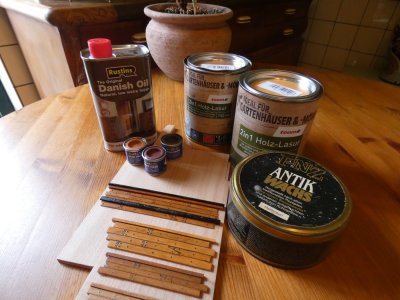
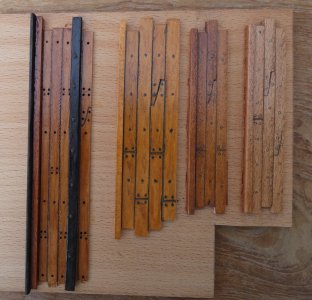
Damit bin ich zufrieden. Natürlich ist es auch Geschmackssache! Die Frage , die dich beschäftigt den kommpletten Schiffsrumpf oder vor dem beplanken zu behandeln ist verständlich . Wenn ich mich für ein Modell entschieden habe, beginnt meine Vorbereitungszeit. Dafür fertige ich gerne Plankenmodelle um dem Modell in meiner Vorstellungskraft eine farbliche Ballance zu geben. Dazu ein paar Fotos im Anhang.
Das große Plankenmodell habe ich mit 5mm Birnenbaumholz gefertigt - mit einer Holzschutzlasur aus Kiefer und Teak angemischt und mit dänischem Öl veredelt. So bereite ich mich praktisch vor. Dickflüssiger Sekundenkleber ist zum Verkleben sehr sauber und haltbar. Immer der Vorteil des schnellen Weiterarbeitens.
Nun hoffe ich, dass mein Beitrag zu diesem Thema etwas hilfreich ist.
Dir wünsche ich, dass du jetzt etwas mehr Klarheit hast, Mike.

Alles Gute Mike - Beste Grüße Holger

P1100247.JPG

P1100234.JPG
 
Following up on previous posts, from what I read, Danish oil is not a good choice as it does not last more than about six months indoors, and less outdoors.

Allan
 
The lacquer is invisible. Since than all of my models have been painted- more realistic.
It depends on the era. This did get me curious though concerning my current project, the ship was built in 1744

For later (1776) the contract for Aurora and others is as follows:
PAINTING To treble paint the Ship within & without Board with good Oil Colours, & in like Manner the Great Cabin, Steerage, & all the Cabins, Rails, Stantions, Ladders, Gratings, Gangways, Bulkheads, Capst&s, Upper deck beams, & Knees, & all the Work in Wake of them, & without board for finishing & compleating the Hull of said Ship, shall be done in a Workmanlike Manner, equal in all respects to those of His Majesty’s Ships of the like Quality in the King’s Yards.

From a contract early in the 18th century, painting from the wales upwards is described as using rosin and tallow.

1784207322944.jpeg
 
rosin and tallow
An AI inquiry did not offer much insight into any actual color. Darkens with age seems to be a theme.
Mineral pigments or lamp black or if were me - the lower deck interiors would be white -they were caves.

From the 1776 contract - the short hand version is "everything but the deck to be painted".
I am betting that a captain could have the upper deck 'everythings' be something other than red ochre - if he was willing to pay for it out of pocket.

Air brush is probably more efficient - I just dislike making materials that are not volatile into something that I could breathe.
Very much thinned artists oil pigments and multiple coats and stop short of complete occlusion or whatever scale effect requires.
 
Most interesting to read everyone's thoughts on this topic.

As with so many other aspects of what we do the correct answer will be 'It depends'.

It depends upon what you seek to represent. - A true model looking the way it would when launched? A model to be admired that shows the builders skill and attention to detail? or a model that seems to be the way a full size ship might look, as in the mind of the onlooker?

Amongst all of that is the impossibility of scaling down the grain of timber. If you used the 'actual' timber it will look wrong, so we are forced to use another, finer grain wood. Even under paint, because the grain shows through unless filled.
Decks, as we know, were left unfinished to allow bare feet a good grip. All else was protected from the salt and weather as best the builder could manage with the materials of the time.

I don't understand the comment about oils being too thick though. Certainly in full size furniture finishing, an oil is extremely thin. On furniture, I would expect a minimum of 20 coats of oil alone to build a decent finish. Shellac - also known as French Polish - is merely the exudation of the shellac bug, dissolved in alcohol, and then brushed or padded onto the surface. The alcohol evaporates, leaving the shellac. The base polish can be made up thick or thin by varying the ratio of alcohol to shellac, so a treacly thickness with lots of shellac, and a liquid so thin and penetrating that it evaporates almost on contact and leaves a micron of shellac behind. The polishing to mirror finish isn't relevant. Except... If French polishing something with prominent grain, or, indeed, any grain, it is customary to grain fill, using powdered pumice, which vanishes like magic and leaves the groundwork visible. Walnut would be a candidate, but bear in mind that there is a world of difference between having clear access to polish a table top, or a marquetry box, and trying to do the same with a cluttered model where clear access is not possible.

And all that brings us back to the question - oil or shellac. I would go with oil. It is forgiving, repairable, well behaved. Shellac is fast drying, has a tendency to build up in corners, exhibits variable surface effects if unevenly applied - such as may happen if it is drying quickly and absorbency varies across the work. It is also, to a degree, repairable, but needs access and more care. No, oil is the stuff if you want to show the timber. Carry out some grain filling experiments to level the surface using sanding sealer if necessary. At least 'several' coats of oil needed if you want protective finish, but what are you protecting from?

And, last word - not all oils are equal. Most modern finishing oils have heavy metal dryers added. Pure linseed oil is vegan, but is extremely slow to dry. I make use of walnut oil, which happens to be food grade, as it is self polymerising, dries in a couple of days, and has all the repairability etc features I need. Otherwise I'd use a linseed oil. Tung oils are similarly to be researched. The market wants something that dries quickly, so it dries quickly, but don't put any on your salad. Many brand names come from the same basic stuff at the chemical factory gates, sold under different names.

Bob Flexner's book is good, a little too USA oriented for my taste, but only because he refers to US products. There are many older texts that go to the root of furniture finishing, though it is not that helpful to understand how to create your own paint from linseed oil and pigment these days. (Nor is it helpful to know how a clipper ship is rigged for racing, but we enjoy the knowledge anyway)

Jim

At the end of the day
 
Es ist äußerst interessant, die Meinungen aller zu diesem Thema zu lesen.

Wie bei so vielen anderen Aspekten unserer Arbeit lautet die richtige Antwort: „Es kommt darauf an.“

Es kommt darauf an, was Sie darstellen möchten. – Ein originalgetreues Modell, das so aussieht, wie es beim Stapellauf aussah? Ein Modell, das man bewundern kann und das das Können und die Detailgenauigkeit der Erbauer zeigt? Oder ein Modell, das dem Bild eines echten Schiffes aus der Sicht des Betrachters entspricht?

Hinzu kommt die Unmöglichkeit, die Maserung von Holz zu verkleinern. Würde man das „echte“ Holz verwenden, sähe es unnatürlich aus, daher sind wir gezwungen, ein anderes Holz mit feinerer Maserung zu verwenden. Selbst unter Farbe, da die Maserung durchscheint, solange sie nicht gespachtelt ist.
Die Terrassen wurden bekanntlich unfertig gelassen, damit man barfuß guten Halt hatte. Alles andere wurde so gut wie möglich vor Salz und Witterungseinflüssen geschützt, wie es der Bauherr mit den damaligen Materialien erreichen konnte.

Ich verstehe den Kommentar nicht, dass Öl zu dickflüssig sei. Gerade bei der Oberflächenbehandlung von großen Möbelstücken ist Öl extrem dünnflüssig. Für ein anständiges Ergebnis auf Möbeln benötigt man mindestens 20 Ölschichten. Schellack – auch bekannt als französische Politur – ist nichts anderes als das Exsudat der Schellackpflanze, gelöst in Alkohol und anschließend mit einem Pinsel oder Schwamm auf die Oberfläche aufgetragen. Der Alkohol verdunstet und hinterlässt den Schellack. Die Konsistenz der Basispolitur kann durch das Mischverhältnis von Alkohol zu Schellack variiert werden: von einer zähflüssigen, sirupartigen Konsistenz mit viel Schellack bis hin zu einer so dünnflüssigen und eindringenden Flüssigkeit, dass sie fast sofort verdunstet und nur einen Mikrometer Schellack zurücklässt. Das Polieren auf Hochglanz ist hier nicht relevant. Eine Ausnahme bildet jedoch die Schellackpolitur: Bei stark gemaserten Oberflächen, oder überhaupt bei Oberflächen mit Maserung, ist es üblich, die Poren mit Bimssteinpulver zu füllen. Dieses verschwindet wie von Zauberhand und lässt die Maserung sichtbar. Walnussholz wäre eine Möglichkeit, aber bedenken Sie, dass es einen himmelweiten Unterschied macht, ob man eine Tischplatte oder eine Intarsienbox problemlos polieren kann oder ob man dasselbe bei einem vollgestellten Modell versucht, bei dem ein problemloser Zugang nicht möglich ist.

Und das führt uns zurück zur Frage: Öl oder Schellack? Ich würde Öl wählen. Es ist verzeihend, ausbesserbar und unkompliziert. Schellack trocknet schnell, neigt dazu, sich in Ecken anzusammeln und zeigt bei ungleichmäßigem Auftrag – beispielsweise bei schnellem Trocknen und unterschiedlicher Saugfähigkeit – variable Oberflächeneffekte. Auch Schellack ist bis zu einem gewissen Grad ausbesserbar, erfordert aber mehr Sorgfalt und Zugänglichkeit. Nein, Öl ist die richtige Wahl, wenn Sie die Holzmaserung sichtbar lassen möchten. Führen Sie gegebenenfalls Versuche mit Porenfüller durch, um die Oberfläche zu ebnen, und verwenden Sie dazu Schleifgrundierung. Für eine schützende Oberfläche sind mindestens mehrere Ölschichten nötig, aber wovor wollen Sie schützen?

Und noch ein letzter Punkt: Öle sind nicht gleich Öle. Den meisten modernen Oberflächenölen werden Schwermetall-Trocknungsmittel zugesetzt. Reines Leinöl ist zwar vegan, trocknet aber extrem langsam. Ich verwende Walnussöl, das zufällig lebensmittelecht ist, da es selbstpolymerisiert, innerhalb weniger Tage trocknet und alle benötigten Eigenschaften für Reparaturen usw. besitzt. Ansonsten würde ich Leinöl verwenden. Auch bei Tungölen sollte man sich informieren. Der Markt verlangt nach schnell trocknenden Produkten, und diese trocknen auch schnell – aber bitte nicht auf den Salat geben! Viele Markenprodukte basieren auf denselben Grundstoffen, die in Chemiefabriken unter verschiedenen Namen verkauft werden.

Bob Flexners Buch ist gut, für meinen Geschmack etwas zu sehr auf die USA fokussiert, aber nur, weil er sich auf US-Produkte bezieht. Es gibt viele ältere Werke, die die Grundlagen der Möbelveredelung behandeln, obwohl es heutzutage nicht mehr so hilfreich ist zu verstehen, wie man seine eigene Farbe aus Leinöl und Pigmenten herstellt. (Genauso wenig hilfreich ist es zu wissen, wie ein Klipper für Regatten getakelt wird, aber wir finden das Wissen trotzdem interessant.)

Jim

Am Ende des Tages

Ich danke dir für deinen sehr interessanten und auch aufklärenden Bericht Jim. Das ist aber auch nicht einfach bei allen gegebenen Möglichkeiten und Verwendungszwecken.
Beste Grüße Holger
 
Back
Top