- Joined
- Sep 1, 2021
- Messages
- 8
- Points
- 3

How do you determine how wide a plank is at each frame? Is there a way other than using proportional dividers?

 |
The beloved Ships in Scale Magazine is back and charting a new course for 2026! Discover new skills, new techniques, and new inspirations in every issue. NOTE THAT OUR NEXT ISSUE WILL BE July/August 2026 |
|
 |
As a way to introduce our brass coins to the community, we will raffle off a free coin during the month of August. Follow link ABOVE for instructions for entering. |
|

Do you do this just for bending with the breadth or also for edge bending so there is no lift to the planks on the hull?Planking should be pre-bent to shape for the best results. I wet the planks and bend them over the barrel of a soldering iron.


You can make this complicated or simplify the process. The easiest is measure up the deepest bulkhead and divide by the nomber of 5mm (?) planks it will take from keel to wale, say 20 planks. That same twenty planks will need to fit at each bulhead and the stem. Measure the length of each bulkhead and divide by your twenty planks. Mark the plank width with a sharp pencil dot...next bulkhead etc...Your dots should of course be at the bulhead distances lengthwise along the plank. You don't need to measure at the stem, when you have joined the dots to get a taper line the taper will extend beyond b'hd 1 to the stem. Planks will need pre bending. They bend downwards so the upper edge of the plank is tapered. If you're building with a 2mm inner and veneer outer (always walnut!) The veneer won't bend, the walnut will splinter. You can get fresh timber, do a 1.5 inner and 1mm outer (Caldercraft and Amati come with these timbers) And get something better that the ubiquitous walnut!! At least cherry!How do you determine how wide a plank is at each frame? Is there a way other than using proportional dividers?
Edge bending can be done but you have to go very slowly, it takes a lot of time, and only works (for me anyway) with some woods. With my usual practice of using 1/16" bass for 1st planking and 1/32" cherry for 2nd planking the planking follows the upward curvatures at the hull ends without the need for prebending.Do you do this just for bending with the breadth or also for edge bending so there is no lift to the planks on the hull?
Allan
I had no problem with hardwoods like Castello, Europeon boxwood and holly so far. I soak it overnight then it bends with the jig fixture in a few seconds. Hot air gun dries it in a minute or two so there is no lift. This has been posted here at SoS in the past, but just in case, for anyone interested in doing planking that looks like it is on an actual ship, the following four part by Passaro explains how to properly plank a hull. It is not difficult even with hard woods. I changed from a hot iron to a hot air gun and it works even better.Edge bending can be done but you have to go very slowly, it takes a lot of time, and only works (for me anyway) with some woods. With my usual practice of using 1/16" bass for 1st planking and 1/32" cherry for 2nd planking the planking follows the upward curvatures at the hull ends without the need for prebending.
The planks curve downwards at the stem. Look along the planks from the stern to see the direction. If you try to plank straight at the belly of the hull where there is the greater curvature the planks will buckle. Also see Chuck Passaro's videos 'Planking the Winchelsea'Edge bending can be done but you have to go very slowly, it takes a lot of time, and only works (for me anyway) with some woods. With my usual practice of using 1/16" bass for 1st planking and 1/32" cherry for 2nd planking the planking follows the upward curvatures at the hull ends without the need for prebending.
In case you haven't seen Chuck's video Alan has posted a link.Edge bending can be done but you have to go very slowly, it takes a lot of time, and only works (for me anyway) with some woods. With my usual practice of using 1/16" bass for 1st planking and 1/32" cherry for 2nd planking the planking follows the upward curvatures at the hull ends without the need for prebending.
Exactly. Before being glued onto the framing they definitely curve downwards as they approach the stem and upwards at the sternpost. When they are attached to the framing they will then curve upward at the stem and sternpost. Also, the garboard should end at the boxing joint rather than carrying forward too far, this is critical. Planking expansion drawings show this clearly. They also show how the planks are about half the breadth at the stem compared to the dead flat area and the lower half of the strakes are wider at the post. No strakes of planking are straight before they are secured to the hull nor after. Lastly, the wales need to taper in thickness at the stem so they seat in the rabbet rather than standing proud of the other planking like they do farther aft.The planks curve downwards at the stem
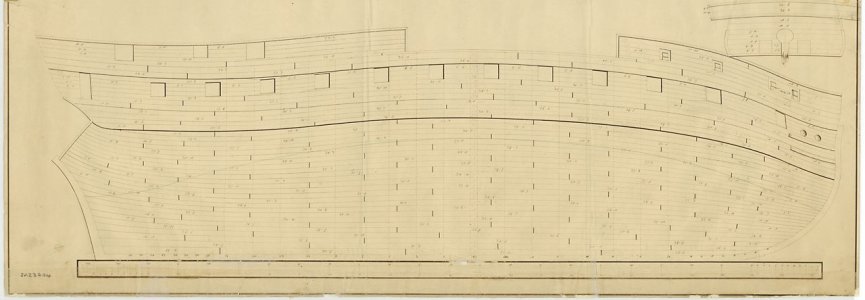
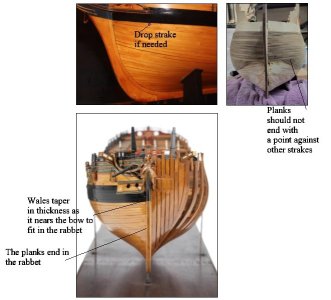
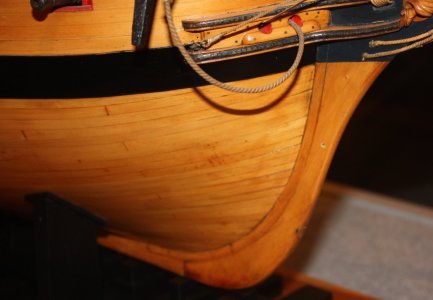
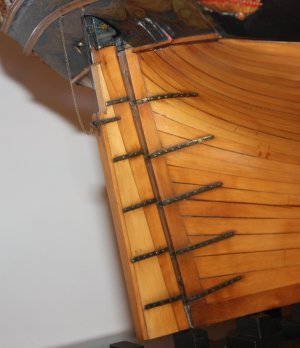
Thanks for posting these Passaro videos. They were excellent. I noted that he was single planking with rather wide 1/4" planks so getting them to lay perfectly flat was essential. My experience is with narrower planks, usually 1/8" to 3/16" and I have not had to edge bend. When double planking at these widths, where the edge of the first planking lies above the desired hull surface at the bow it is just sanded smooth. For the 1/32" second planking I use CA glue at the bow and press it down to get a flush fit.I had no problem with hardwoods like Castello, Europeon boxwood and holly so far. I soak it overnight then it bends with the jig fixture in a few seconds. Hot air gun dries it in a minute or two so there is no lift. This has been posted here at SoS in the past, but just in case, for anyone interested in doing planking that looks like it is on an actual ship, the following four part by Passaro explains how to properly plank a hull. It is not difficult even with hard woods. I changed from a hot iron to a hot air gun and it works even better.
Allan
You still have to edge bend, but it sounds like there is not as much lift. 3/16" is about the equivalent of 10 inch broad planking which is perfect for 1/4" scale. There is lifting in my experience if it is not properly pre-bent in both axes. Best is to spile. To me it would be easier (and cheaper) for the kit makers to supply sheets of wood so we can spile the planking properly. It is not difficult in the least. The little write up by David Antscherl makes it very easy to learn to do. (attached)My experience is with narrower planks, usually 1/8" to 3/16" and I have not had to edge bend.