
• Win a Free Custom Engraved Brass Coin!!!
    As a way to introduce our brass coins to the community, we will raffle off a free coin during the month of August. Follow link ABOVE for instructions for entering.
  • PRE-ORDER SHIPS IN SCALE TODAY!

    The beloved Ships in Scale Magazine is back and charting a new course for 2026!
    Discover new skills, new techniques, and new inspirations in every issue.

    NOTE THAT OUR FIRST ISSUE WILL BE JAN/FEB 2026

Do I need a display case or not?

Joined
Oct 28, 2024
Messages
16
Points
18

Hello Everyone,

I am almost done building a very bog model shop, 42 inches ling and 44 inches tall, Occre Santisima Trinidad, I have a question for you gurus!

Do you have to put the model ship in an airtight case? Or you can get away using a dust blower like those small devices that blow air strongly?

I live in high altitude, it is pretty dry here but we have dust, I guess you have dust everywhere! I like the way model ship looks like alone, not in a display case. Please advice1 I spent 3 years building this, so I want to do what is best and what makes sense!
 
Do you have to put the model ship in an airtight case?
Do not put it in an airtight case for several months or longer as the model and wooden base can give off volatile organic compounds. If there is any residual moisture this would also be trapped, It is often recommended to have some SMALL holes in a few places but fill them with fibrous material or even steel wool to let air in and keep out tiny critters and dust. I was warned that steel wool can rust, but I had one case with steel wool in it for upwards of 20 years no sign of rust.
Allan
 
i have never put a model in a case i leave them out in the open, they have survived for 20 some years. i live where the weather goes from -10 Fahrenheit to a hot and humid 100 degrees. As Allen said do not seal a model in a case the wood still has moisture in it about 8% so it will dry rot over time.
i learned it the hard way i lumbered an apple orchard about 600 board feet of lumber i put in a closed storage unit. when i can back at the end of the summer and opened the door, it smelled like apple cider and the wood rotted. Wood needs air flow.
 
Congratulations on the completion of your OcCre Santisima Trinidad. Now you've arrived at what might be called "the kit builder's painted yourself into a corner moment!" Don't feel bad. It happens to just about everybody. You've invested over seven hundred bucks in a ship model kit and God only knows how many hours building it and the family interior decorator says, "Okay, now that you've finished it, what do you think you are you going to do with that thing?"

Decision One: "What are you going to do with that thing?"

If you have no interest in what happens to it, you don't need a case. If you want to keep it for at least as long as it took you to assemble the kit, you do need a case of some kind. If you have any concern about it getting dusty and covered with sticky cobwebs, a case is imperative.

It is possible to blow dust off a model without damaging it, depending upon how strongly built the model is and how careful the duster is. If the "cleaning lady" takes a feather duster to it, you may as well throw the thing in the trash bin straightaway and spare yourself further grief. Cleaning a model which has been without a case is a restorationist's common task, usually undertaken immediately before a previously cased model is placed in a newly built case, and a very tedious job. Consequently, it's also expensive.

If you have a pet parrot, or even a parakeet, or a cat that can get anywhere near your uncased model, you may as well throw the thing in the trash bin straightaway and spare yourself further grief.

If you can neutralize all of the above risks attendant to the lack of a proper case, you won't need a proper case, but you will find yourself throwing the thin into the trash bin at some point in the not all that far distant future because all of the common environmental factors in the average family home will combine to cause a surprisingly rapid deterioration of the model, causing it to fall apart in various ways.

Many ship model kit builders will explain that it is the building their models that they enjoy and they really have little interest in keeping them once they are completed. They often give their completed models to friends and other worthy recipients of their generosity shortly after completion (and before the dust collecting on them becomes too unsightly.) In this fashion, they avoid the need to worry about casing their models.

Deciding what you are going to do with your finished model kit will determine whether you model needs a case or not.

Decision Two: If your model needs a case, what kind of case does it need?

Any model worth keeping requires a proper case. You will find long threads in this forum containing protracted discussions about what standards apply to high-quality scale ship models and there are those modelers who are quite adamant that "there are no rules in scale ship modeling." Here, as well, I am sure there will be those who will offer their "internet testimony" that they've never put any of their models and a case and just go over them with the vacuum cleaner brush once a year with no problems at all. You can listen to them if you wish or you can listen to the science explained by the curatorial experts: at least read the section on model cases at https://thenrg.org/resource/articles/materials-in-ship-models. This article will explain the reasons you do not want an "air-tight" case for your model, and how to allow for proper ventilation inside your case.

You will also have to decide between glass and plastic for your cases panes. Plastic materials such as Plexiglas(tm) and a variety of acrylics have the advantage of light weight, but a number of disadvantages related to archival considerations (see the article.) "Archival plastics" now exist, but at present are substantially more expensive than glasses. Glass has the advantage of significantly lower price (in most cases,) and the option of UV-shielded versions made for picture framing, with the drawbacks of significantly greater weight and the risk of breakage.

Size matters:

While I don't belong to the "anything goes club," I do believe in a modeler's exercising a certain degree of artistic license. Therefore, since your case is going to have a bit more room all around, so that the case frame doesn't distract the viewer's attention away from the model itself, it will be up to you to decide the dimensions of your model's case. Your mileage may vary and you will have to use your own "eye" to determine how much volume your model's case requires. The best size will be determined by an aesthetic balance between the size of the model and the thickness of the case framing. The dimensioning of your model's case is as important as the framing of any other work of fine art. Doing it well can make a mediocre model look better. Doing it poorly can make a great model look mediocre.

Once you have determined how large your case has to be, it may be advisable to take a tape measure and some cardboard and make a mock-up of how much space your cased model will require. Don't forget, also, that a model the size of yours will require some sort of table or stand, as well. It may well be discovered that you've built a model that is simply too big to put anywhere in your home short of a divorce, which may cause you to reconsider keeping the model or, alternately, becoming one of those kit modelers who focus on the process of building alone without any intention of every keeping the models they build. :(

Weight matters:

An important word of caution: cases weigh a lot and are difficult to handle, especially cases glazed with glass. I'm not exaggerating. I presently have in my shop for some minor repairs a model the size of yours. (Memo to self: Never agree to work on a model that "only" needs anything.) It is a very fine model and entirely deserving of the high-quality custom walnut stand and case in which it is displayed. The problem is that in order to lift the simple "upside down open box" style glass glazed case off the stand to make the model accessible for servicing, it takes four and preferably six strong people to carefully lift the case off the model! But wait! There's more! The stand is about three feet high, and the case is about four feet high, and the model is about three and a half feet high, so, in order to lift the case off the model requires a total of more than ten and a half feet, floor to ceiling to get the case off the model! This means that in a room with an eight-foot ceiling, we have to remove the base of the case from the stand with the model in the case, put it on the floor, and then remove the case box from the case base to access the model! And, all this has to be done with the utmost of care not to allow the (loose) model to tip in its cradle or the heavy glass case box to touch the model at any point in these evolutions which would almost certainly damage the model itself. (Which is why it now requires repairs in the first place!

So, the moral of the story is that with models the size of yours, it is highly advisable that the case box framing be designed with a provision for opening a side of the model case so that the model, which is securely fastened on a separate base, can be slid out of the side of the case box for service access. This brings us to the last consideration:

Cost matters:

As usual, if you build a case yourself, the cost can be reduced considerably. I expect that anyone who can complete a wooden ship model should have the ability to design and build a case themselves, if they are so inclined. Suitable wood and glass or clear acrylic sheet is available everywhere. The glass or clear acrylic sheet is still surprisingly costly, but far less than from the commercial ship model case suppliers. (I buy picture frame glass cut to size from a picture framing store or glazier's shop.) There are articles in ship modeling books with plans for various case designs. It's basically an exercise in cutting exact angles and lengths and assembling them at right angles to each other. You can do it.

If you don't want to tackle building your own case, based on my experience, a commercially sourced very basic acrylic-glazed simple box case alone would cost you somewhere north of a thousand dollars USD, plus shipping and handling and shipping something that big is going to cost a pretty penny. (E.g., see:
http://www.woodenmodelships.com/case.shtml) Unfortunately, no "off the shelf" commercial cases are available for models the size of yours, nor will the mail-order retailers ship glass (the preferred and less expensive option, IMHO,) and your model requires a custom designed and built case with provision for "side-loading access" as described. I expect your best bet will be to find a local cabinet making shop to build you what you need. The cost of that is dependent upon local market prices, but I'm guessing you will have to invest more than fifteen hundred USD for that, but it would be considerably less than anything you had to pay to ship.

In summary:

I realize the above is probably now what you wanted to hear, but over the years, I've come to conclude that most decently done ship models that were worth building are worth exhibiting in a proper case, just as most fine art paintings are worth putting in a frame. There's nothing I know of, short of doing it yourself, to prevent the average cost of the average case for the average model to be greater than the model it contains. (And doing it yourself is a lot cheaper than buying a kit, as well!) That just seems to always be the way it goes. The sad thing about cases is that we all tend to underestimate the size and visual "impact" of a model once it is properly cased. At least, I know I always do. A model always seems to become so much bigger when it's finally in its case, but it also always seems to become so much better in a case as well.

There was a time when only a certain class of people with houses full of large rooms had any interest in having ship models in their homes. Now, ship models have wider appeal, but there are fewer and fewer people who live in houses where a three- or four-foot-long ship model in a suitable case will fit without chasing everybody out of the room. I sometimes think that they've already manufactured more 1:48 and even 1:96 scale 18th century warship model kits than there is space to put them when they're all assembled. :oops: This is probably why "the smaller the scale the higher the auction price" seems to be the order of the day on the fine art high-quality scale ship model collector's market.
 
Last edited:
i learned it the hard way i lumbered an apple orchard about 600 board feet of lumber i put in a closed storage unit. when i can back at the end of the summer and opened the door, it smelled like apple cider and the wood rotted. Wood needs air flow.

Interesting. Apple wood doesn't have as high a sugar content as some other hardwoods. (E.g., maple.)
 
I have run the numbers but not had to actually do any of it myself.
The numbers say:
If you wish to keep the model for any period of time, it needs protection from dust and arachnids.
If foods are fried, tobacco is combusted it must be in an atmosphere separated from that.
The interior needs to breath - wet finger something like a complete turnover q24h.
Glass wool is inert so it can filter the lower inlet openings.
Every type of glass that meets the recommended requirements is heavy as hell and expensive.
Any plastic sheets that meet the recommended requirements while not as heavy are expensive.
I checked on line for cost and weight for glass that is as thin as is available. Not heavy, not expensive, not safe because it is easy to break and the shards would probably substitute for daggers. You pays your money and you takes your chances.

While you weigh your options, you can always go quick and dirty. Do something that lets you put off doing something perm for as long as you wish to procrastinate: Cobble together a box frame using something like small PVC water pipe and place a clear plastic bag over it. When you wish to see the model or do a formal showing, remove the plastic and then the frame and put it back when the show is over.
 
I have run the numbers but not had to actually do any of it myself.
The numbers say:
If you wish to keep the model for any period of time, it needs protection from dust and arachnids.
If foods are fried, tobacco is combusted it must be in an atmosphere separated from that.
The interior needs to breath - wet finger something like a complete turnover q24h.
Glass wool is inert so it can filter the lower inlet openings.
Every type of glass that meets the recommended requirements is heavy as hell and expensive.
Any plastic sheets that meet the recommended requirements while not as heavy are expensive.
I checked on line for cost and weight for glass that is as thin as is available. Not heavy, not expensive, not safe because it is easy to break and the shards would probably substitute for daggers. You pays your money and you takes your chances.

While you weigh your options, you can always go quick and dirty. Do something that lets you put off doing something perm for as long as you wish to procrastinate: Cobble together a box frame using something like small PVC water pipe and place a clear plastic bag over it. When you wish to see the model or do a formal showing, remove the plastic and then the frame and put it back when the show is over.

I save those really thin plastic bags the cleaners put over dry cleaning you pick up and which, apparently, little kids love to play with, if the warnings all over them are any indication. I just drape them over the uncased model and use light clamps to "clothespin" it all together. It's light enough that a framework isn't needed. Care is required not to get the plastic bag snagged on a yard or such, of course, but it seems that's less likely to do damage than whacking something with the frame when putting it on or taking it off.

I've found that standard picture frame glass, which can be obtained with UV-shielding (to keep pictures from fading) is about as cheap as anything else. It's a perfect fit for the average table saw kerf, so ripping the frame stock is easy.
 
Hello Everyone,

I am almost done building a very bog model shop, 42 inches ling and 44 inches tall, Occre Santisima Trinidad, I have a question for you gurus!

Do you have to put the model ship in an airtight case? Or you can get away using a dust blower like those small devices that blow air strongly?

I live in high altitude, it is pretty dry here but we have dust, I guess you have dust everywhere! I like the way model ship looks like alone, not in a display case. Please advice1 I spent 3 years building this, so I want to do what is best and what makes sense!

I can't add any more to what Bob Cleek said, except to reinforce the basics. A model can get dust and dirt all over it in a year or two, and removing it is VERY difficult and time consuming. Dust dulls the colors and clings to rigging. My last model has been under plexiglas for the past 5 years, and it still looks like new! If you are building a ship as grand as the Santisima Trinidad, it's worth protecting with a good case. It should not be air tight, but nearly so, such that changes in humidity will allow the model to breathe. Trapped humidity warps wood. Buying a case is very expensive, but you can make one for a lot less money. Plexiglas is light, real glass is very heavy and can be broken if you have kids.

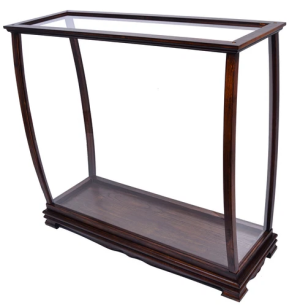
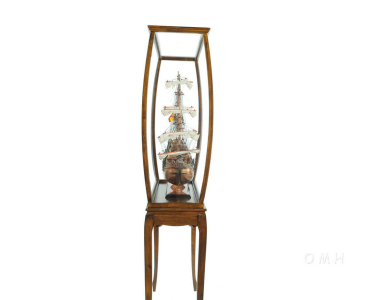
I really want make this style case on top of long, Queen Anne style legs. Can thin plexiglass bend enough to make the front/rear panels?
1772597690443.png 1772597921711.png
 
Last edited:
I really want make this style case on top of long, Queen Anne style legs. Can thin plexiglass bend enough to make the front/rear panels?
I saw that picture and thought, "Wow! That's beautiful." My next thought was what it would take to make it and I realized it would be a real challenge to build. If the top and sides are flat and only the front and back are curved, it's less challenging and it appears that's how it's been done. I expect acrylic sheet will bend to that radius fairly easily and, if not, a plastics fabrication shop (e.g., a Tap Plastics store, see: https://www.tapplastics.com/?msclki...tm_term=tap plastics&utm_content=tap plastics ) should be able to do it with heat.
 
I saw that picture and thought, "Wow! That's beautiful." My next thought was what it would take to make it and I realized it would be a real challenge to build. If the top and sides are flat and only the front and back are curved, it's less challenging and it appears that's how it's been done. I expect acrylic sheet will bend to that radius fairly easily and, if not, a plastics fabrication shop (e.g., a Tap Plastics store, see: https://www.tapplastics.com/?msclkid=43b3316d8fda1557e08058c58176450d&utm_source=bing&utm_medium=cpc&utm_campaign=ECI - Trademark - TAP Plastics [CONV]&utm_term=tap plastics&utm_content=tap plastics ) should be able to do it with heat.
I like how the case is shaped to surround the yards without taking up as much space at the top and bottom, and allows the viewer to get just a bit closer than a rectangular case would. They make those cases in China an sell them on eBay for $1200 for a large one. However, our models typically require a custom sized case to fit properly, and the cost of a large case for the model I'm currently working on is far too high. I could make it it for less, although slotting the curved vertical edge pieced to accept the bent plexiglas using the router table will be a challenge. Thanks for the link to the plastics vendor!
 
Back
Top