




.
Almost 7 mm. Sandpaper alone won't do.
Please...

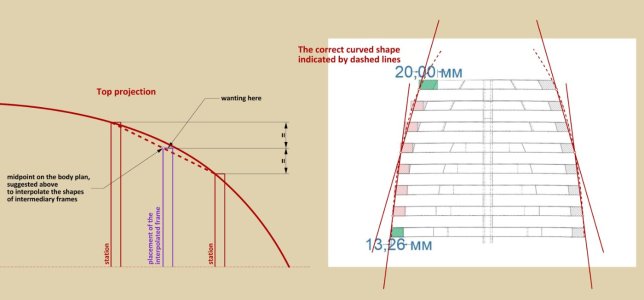
While bevelling is a closely related issue, my explanations actually concerned something else. I will try to demonstrate this again. Below are two graphics, yours and mine. I supplemented your graphic with the resulting contours of the frames interpolated using the simplified method, which ignores guide lines such as waterlines and diagonals. My graphic, on the other hand, has been supplemented in such a way that it also takes into account the thickness of the frames, which requires the application of bevelling. In this way, both graphics become equivalent in this respect.
The point is that using a simplified method of interpolating frames, such as the one obtained by using the “blend” command in CorelDraw, you will not get the result you just showed, but a different one, which I have marked with continuous, straight red lines in your graphic. And no amount of bevelling can fix this incorrect effect of straight hull segments (in the longitudinal direction), a bit like: ‘I've shortened it twice and it's still too short’. And, the greater the curvature of the hull, the greater must be the deviation from the correctly curved shape of the hull.
.

