
• Win a Free Custom Engraved Brass Coin!!!
    As a way to introduce our brass coins to the community, we will raffle off a free coin during the month of August. Follow link ABOVE for instructions for entering.
  • PRE-ORDER SHIPS IN SCALE TODAY!

    The beloved Ships in Scale Magazine is back and charting a new course for 2026!
    Discover new skills, new techniques, and new inspirations in every issue.

    NOTE THAT OUR FIRST ISSUE WILL BE JAN/FEB 2026

Drafting Frames Based on Old Plans

Joined
Jan 26, 2026
Messages
5
Points
3

I have in mind drawing each individual frame for HMS Lenox. Based on great book by Richard Endsor - "The Restoration Warship". Great publication, which I bought years ago in Portsmouth Dockyards.

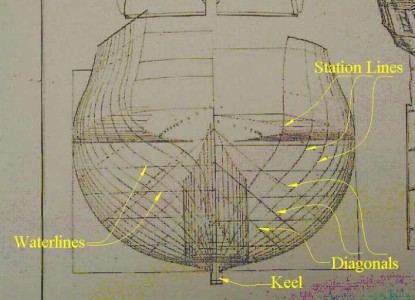
Anyway, plans included in the book are great but what I am missing are waterlines. I have station lines, side plan, but no waterlines.
Station lines show around 20 bulkheads, which is mor that enouch for POB.
I would like to draw all the frames in between, let's say 40 or 50 depending on the hull.

As I said, I do not have waterlines drawing. How can I start here? Old way with pencil and paper - no CAD.

Has anyone done that?
1770054186476.png
 
My first build in the 80's, I put carbon paper under the drawing and traced the frames....slow and tedious.

Now, with a home copier. Make copies and cut out the frames. They can be glued with elmers rubber glue (link below), right on your frame blanks.

Rubber Cement on Amazon ....cheaper at Walmart or a craft store.

From there, you can use a jigsaw or drum sander to shape each frame.

Good luck and have fun!
 
Brad, you beat me to it. :) The station lines in the body plan are usually enough for POB so copy, cut, paste and sawing them out is quick and easy I would add that while gluing works well it is a pain in the neck to get rid of the residue.. I have gone to printing onto label paper, then cut, peel and stick on the plywood. There is little if any residue to worry about on the bulkheads.
Allan
 
Last edited:
I learned how to do it 63 years ago in Naval Architecture 101 at the University of Michigan. I’ve been doing it to build models ever since, No CAD.

First, you need the spacing of the various body plan sections. From the little bit of the drawing that appears on the right hand edge of your post, you have a profile (aka sheer) view that should provide this information.

You’re going to draw a top (aka half breadth view). Begins by drawing a centerline, and a parallel line offset by the half breadth of the keel. Now construct vertical lines (perpendicular to the centerline) upward from the centerline at each body plan location shown on the sheer plan. Length is unimportant; make them plenty long.

Now select a waterline and measure the distance from the centerline as shown on the body plan. It’s helpful to use strips of paper called “tick strips” to record this information. Plot each distance measured for the waterline on it’s respective body plan section vertical line that you drew above.

Now the fun part. You need to draw a smooth (aka fair) curve through the plotted points. Naval Architects have specialized tools for doing this, but you’ll have to improvise. Buy the largest French Curve that you can find, and rip a flexible wooden strip. Spruce is ideal, and maybe 3mm x3mm. It needs to be longer than the plan view that you are drawing. Start by springing the wooden strip through the points that you have plotted. In the absence of special drafting weights you can secure it with fine nails. Draw the waterline. For sharp curves at the bow and stern you can use the French curve.

This is the basic system don’t hesitate to ask questions.

Roger
 
Now select a waterline and measure the distance from the centerline as shown on the body plan. It’s helpful to use strips of paper called “tick strips” to record this information. Plot each distance measured for the waterline on it’s respective body plan section vertical line that you drew above.
Hi Roger,
I remember the days of drafting as part of in naval architecture studies, but this seems like a lot of unnecessary work for a POB build. Is there any advantage over just copying and cutting the station lines from the body plan as described above? This is assuming the copies are to scale, which is not a big deal to check if a small known scale is attached or drawn on the plans before making the copies. Worst case is the drawings are 1:96 and the builder wants to go 1:48. In this case it is just a matter of going to a copy service store and tell them the scale you want.
Allan
 
That’s up to the guy who asked the question. He asked how to plot waterlines. I told him how I would do it. I agree, it would seem that there is adequate information on the body plan view to cut out the various POB bulkheads.

Roger
 
Anyway, plans included in the book are great but what I am missing are waterlines. I have station lines, side plan, but no waterlines.
Station lines show around 20 bulkheads, which is mor that enouch for POB.

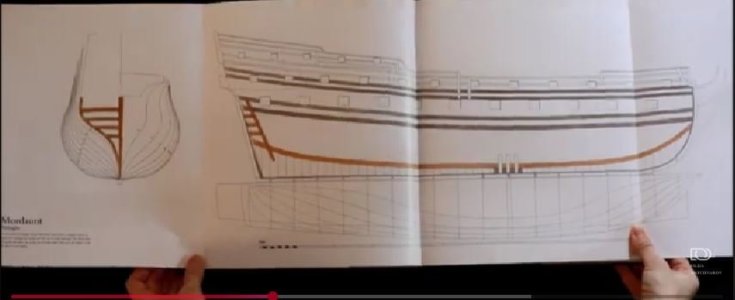
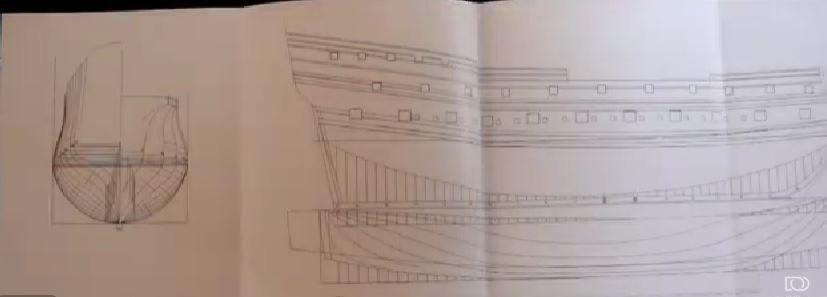
there are waterlines in the book


Capture book1.JPG
book3.JPG
 
Last edited:
i might have the wrong book by Richard Endsor the title is not what the video shows there are 2 different books

Capture vid.JPG
 
Last edited:
I remember the days of drafting as part of in naval architecture studies, but this seems like a lot of unnecessary work for a POB build. Is there any advantage over just copying and cutting the station lines from the body plan as described above?

You'd need to develop the "looking down" waterline curves if you were building a solid hull model built up of lifts. Otherwise, the body shape stations on the plan are all you'd need. One issue with using these old lines drawings is to be clear whether they are drawn to the inside or outside of the planking,. Sometimes the scale of the drawings and the scantlings are such that plank thickness can be ignored as negligible, by adjustments will then have to be made as required in the thickness of the keel and the rabbeting so everything comes together there in the ends.
 
Last edited:
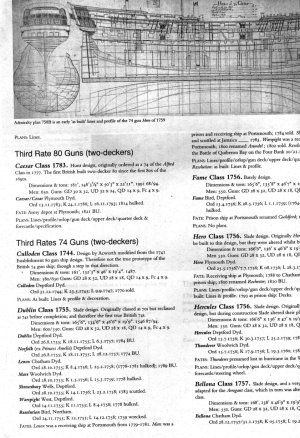
i checked David Lyon Sailing Navy List
there are no drawing for the Lenox as close to what you can get is the Dublin class 3 rate 74 gun ships where the Lenox is listed.
plans are as follow lines/profile/orlop/gun deck/upper deck/quarter and forecastle

so i would suggest you order the plans at least you will have waterlines to start with

lenox.jpg
 
.​
I have in mind drawing each individual frame for HMS Lenox [...] but what I am missing are waterlines [...].
[...]
I would like to draw all the frames in between, let's say 40 or 50 depending on the hull.


Waterlines are not particularly relevant to achieving your primary goal of multiplying the frames. Diagonals are much better for this purpose, as they yield a better, more even distribution of coordination points along the length of the frame contours, and being bent only in one direction are easier to form than waterlines. In fact, waterlines normally only serve a verification function, unless you also want to calculate (manually) the volume of the hull.

In addition to the diagonals that are on the base drawing (if there are any at all), you can also add as many more diagonals as you want, based on the contours of the existing frames. Overall, this is a trivially easy and fairly reliable method without resorting to old design methods, but quite tedious for such a large number of frames.

All other things, such as the type of paper and brand of pencil, are up to you, but I would advise you to stay focused on this task, because any inaccuracy or shortcut can come back to haunt you many times over and in a painful way. Besides, by following this procedure, you also have a chance to verify the accuracy of your base plan.

.​
 
Back
Top