- Joined
- Feb 12, 2024
- Messages
- 20
- Points
- 48

Ahoy there! What´s up, Doc?

Sirs, Ladies, Lads,
we need your support and attention, pls.!
Some time ago, @The BItter End and me, we noticed a very strange feature on US Frigate Constitutions bow:

This is part of a photo of Constitution hauled on the ways in ca. 1875 at the Philadelphia Navy Yard [Courtesy Naval History & Heritage Command Detachment Boston]. As you see, the planks above the water line were stripped, we can see her densely set frames. Below the waterline the planks seem still to be in place. We also seem to see two water lines - a brighter one below a darker, thinner one. Both seem to at least show traces of the coppering. And then there seems to be a "triangle" on top of the upper waterline. This seems to be just because the planks of the underwater body of course "raise" a bit on top of the waterline, following their curvature along the hull. We also see no traces of coppering on those short ends of the planks.
And in the corner of the stem and those underwater body planks we see this strange "filling", marked with the orange circle - which I at first considered to be a "fairing piece" - a component to smoothen the flow of the water and to generate a more laminar flow along that edge.
I had that impression as the part seems to stop at the waterline level (or maybe where the wave at the bow may need it?) .. presumed to be not needed up there as there is no water to guide, right?
On the other hand:
why does such a flow improving feature then stop just in the middle of the underwater body and doesn´t run down to the start of the keel?
Haiko @The BItter End noted: maybe there is none above the waterline as that "thing" seems to sit on top of the hulls planks - and as the planks are not existing on top it had to be taken away there too ?
Well, yes ! Why didn´t I think about THAT ?
If we assume it may have been going further up, there would be a chance that this is in fact a feature intended to solve a completely different problem.
So we were starting to look if we can see "something" in other representations - and there they are - even if being a bit smaller :
Here in a photo of the ship done 27. May 1858 - "the first known photo" of Constitution:

[Courtesy USS Constitution Museum, Boston]
We can see 2 lines beside her cutwater .. therefore there is not just a "corner" but a "thing" in that corner !
W.A.K. Martin - a painter obviously having done some research on the ship and proposing an often referred sketch of the ship in 1797 (which is not true, as it is just the interpretation of Martin done by him in 1852 - and as he was born in 1816 he most likely never saw the ship in 1797 or even in 1812.

This digitalized photo is owned by the MIT - and the text says, that Martin reconstructed the ships based on the Doughty Drawing of 1794.
What we can see is that he tried to represent the Doughty drawing - as we see

You see 2 lines in the corner between the stem or cutwater and the ships planks, right? Martin was a good observer - and his "mistakes" were due to his observations on the real ship.
There is another evidence for the existence of something "filling" that corner. Lets see on one of our ships sistership: US Frigate President:

This is a representation of Antoine Roux "US Frigate in a Gale off Marseille" - the bow decor indicates that this most likely was USS President.
If you look closely, you will notice below that wash cant (that vertical planks in a "triangle" below the lower cheek) that there is something "filling" the corner between planks and cutwater - going down into the water. And its also visible in his other paintings of President.
In conclusion we may say:
the ship had - at least in between 1852 and 1875 - "something" visible in that corner between the cutwater and the ships planks.
What might that "something" be?
One idea may be that it is something doing the more or less same job as the Wash Cant was doing a bit further up: maybe this IS a fairing piece which was added to reduce the power of waves smashing into that corner. That could by the way be an explanation for the fact, that its not going down to the keel - as the waves smashing against the hull are only working OUTSIDE the water - and in case of riding waves it would be needed only a certain distance below the normal water line.
An argument against this thesis: the photo of 1875 shows a relatively wide "filling piece". Also what´s shown in the Roux painting may work as a "wave deflector" - guiding the energy sideways and protecting the hulls structure from those smashing impacts. But other drawings showing a much smaller element - seemingly not really matching the expected task.
Well, we have also another thesis to offer:
As we know: the ship for sure had head pumps - "deck water wash pumps" being placed in the head and used for the sailors and their cloths washing. We know that the ship had seats of ease there .. they are mentioned in papers - and we can see at least their theoretical position in a deck plan done by Charles Ware in 1820 for the Frigate United States:

This is a cut out of that deck plan - and "A" is revered to "Wash Deck Pumps"

This is an interpretation of United States head assembly. And as the "A" is positioned at those diamond shaped contours - and as they look (beside the diamond shape) like the wells or drip pans of other pumps (on Gun Deck level) in the same drawing, I assumed the pump (marked green) standing IN that pan / well.
The triangle shaped black thing in the corner of the head rail with the ships hull might be cisterns - either used for flushing the officers "round houses" a deck below and/or for flushing the sanitary facilities in the head (to be discussed later in this chapter).
Its unclear if there are more seats of ease below the ships bow sprit, as Constitution (and comparable sized ships) is shown with those in the modern depictions concerning the head:
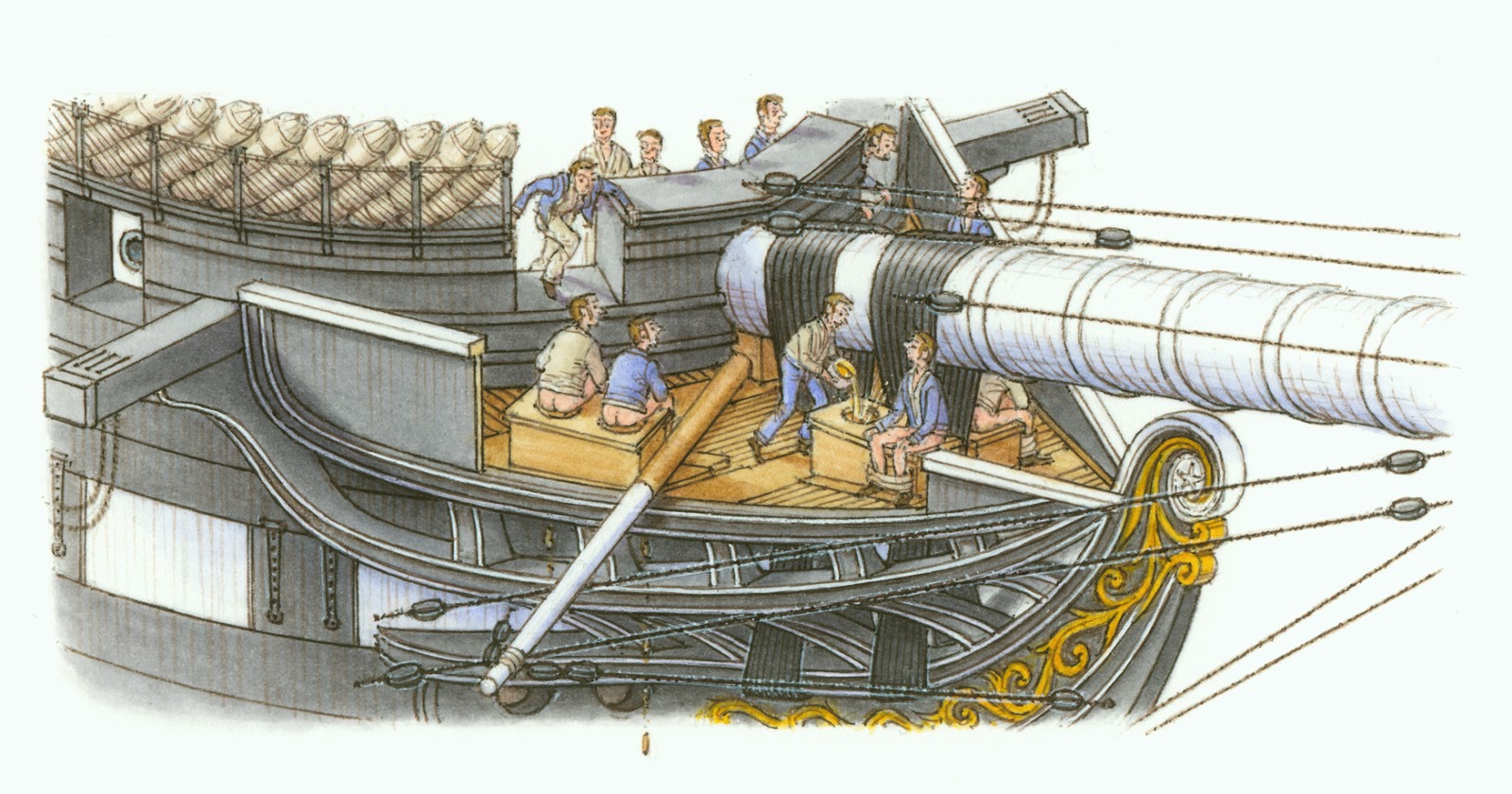
[Head Lines - USS Constitution Museum]
The modern depiction does show neither urinals or head pumps. But the pumps for sure existed in the ships early years. The sailors needed water there, the head pumps are mentioned in many logs.
Those pumps were in need of pipes going downwards to the sea water level. And where would they be placed? Would one drill holes into the hull? Or wouldn´t they just being fixed into that corner of the cutwater with the ships planking?
I assume that black round "hole" in the Ware drawing above is a cutout for the pumps pipe - as it is exactly where the pipe would have to be to be protected in that corner.
But if there would be a pipe running down at the bow - in that corner between cutwater and the bows planking: wouldn´t those pipes not needed to be protected vs. debris in the sea, maritime growth or even ice? A plank outside added would be a reasonable feature doing that!
There is evidence that such a design was known and used in those years:

This drawing was found by a fellow modelist in the Ship-of-Scale forum. You can find the digitalized original in the NMM collection: https://www.rmg.co.uk/collections/objects/rmgc-object-59543
It shows the head of HMS Leander (1848).

Inside the marked circle you can see a diagonal "board" protecting the pipe in its corner between hull and stem. The dotted line below the blue connection indicates that this plank is below that blue connection.
I admit: this shows flushing pipe - the pipe bringing flush-water down to the sea. Beside the fact that it shows a pipe in that corner it is interesting to think about the possibility that or big frigate might have had a flush-water system too !!
But let´s jump back and let us summarize:
Water for regular flushing the sanitation?
Another thought - going a bit further:
maybe the Ware drawing shows only ONE opening in the heads floor for water coming up from the sea level as the other side may have been a pipe going downwards - for flush-water. If the ship had a system to flush the (possible) urinals and the seats of ease - as HMS Leander shows - the downwards going pipe would start below the heads gratings - and therefore would not be visible in Ware´s layout.
So we propose another thesis:
the big American Frigates might have had a flushing system for their sanitary equipment in the bow.
This is again only a thesis - and its likelihood is again not a zero - but I admit: as there is never ever something like a regular flushing (like once an hour?) mentioned by the sailors or the officials, there is absolutely no proof that the ships had a system like that in the head - and the likelihood may be even less that they had it in her early phase. It might be that the cisterns (if those black triangles in the heads corners ARE cisterns) were used to flush the "in-gun-deck officers round houses" of the United States (and also in USS Constitution where those are also mentioned for several years). It is well understood that at least in some captain galleries cisterns for flushing the captains toilet in the galleries existed:

John Hearle's Fire and Wash Engine Pump as fitted to Caledonia (1808) | Royal Museums Greenwich
you may read the remark for "L" (the horizontal line going to the left side and then leading up to the stern of the ship) "pipes to supply the cisterns of the water closet on the stern.
You might argue that things like this must have been documented somewhere or described in a text - and as this obviously is not the case we can not assume they existed.
... but you also have to admit: in those years a lot of either completely self-evident things or things not to be spoken about were not described at all. And also in those years things were not standardized as in our days. The shipwrights were kept free to produce the needed ships and equipment in their common known way - and only the very important features were defined - even without drawings - by the written specification of the government - details to be done in expected manner. Sanitary features might not have seen as important, nor as adequate topic of conversation for a gentlemen - so that these things might not have reached written papers.
The result:
we can only guess here .. based on very little provided information - keeping the likelihood very vage above zero ...
Nevertheless:
that there was a plank or wooden piece filling that corner between cutwater and planks for me seems likely enough to show it in a model.
My question now:
Do you have evidence for for those "fairing pieces" in any other ship ? .. do you know a better or correct name for them?
Sirs, Ladies, Lads,
we need your support and attention, pls.!
Some time ago, @The BItter End and me, we noticed a very strange feature on US Frigate Constitutions bow:
This is part of a photo of Constitution hauled on the ways in ca. 1875 at the Philadelphia Navy Yard [Courtesy Naval History & Heritage Command Detachment Boston]. As you see, the planks above the water line were stripped, we can see her densely set frames. Below the waterline the planks seem still to be in place. We also seem to see two water lines - a brighter one below a darker, thinner one. Both seem to at least show traces of the coppering. And then there seems to be a "triangle" on top of the upper waterline. This seems to be just because the planks of the underwater body of course "raise" a bit on top of the waterline, following their curvature along the hull. We also see no traces of coppering on those short ends of the planks.
And in the corner of the stem and those underwater body planks we see this strange "filling", marked with the orange circle - which I at first considered to be a "fairing piece" - a component to smoothen the flow of the water and to generate a more laminar flow along that edge.
I had that impression as the part seems to stop at the waterline level (or maybe where the wave at the bow may need it?) .. presumed to be not needed up there as there is no water to guide, right?
On the other hand:
why does such a flow improving feature then stop just in the middle of the underwater body and doesn´t run down to the start of the keel?
Haiko @The BItter End noted: maybe there is none above the waterline as that "thing" seems to sit on top of the hulls planks - and as the planks are not existing on top it had to be taken away there too ?
Well, yes ! Why didn´t I think about THAT ?
If we assume it may have been going further up, there would be a chance that this is in fact a feature intended to solve a completely different problem.
So we were starting to look if we can see "something" in other representations - and there they are - even if being a bit smaller :
Here in a photo of the ship done 27. May 1858 - "the first known photo" of Constitution:
[Courtesy USS Constitution Museum, Boston]
We can see 2 lines beside her cutwater .. therefore there is not just a "corner" but a "thing" in that corner !
W.A.K. Martin - a painter obviously having done some research on the ship and proposing an often referred sketch of the ship in 1797 (which is not true, as it is just the interpretation of Martin done by him in 1852 - and as he was born in 1816 he most likely never saw the ship in 1797 or even in 1812.
This digitalized photo is owned by the MIT - and the text says, that Martin reconstructed the ships based on the Doughty Drawing of 1794.
What we can see is that he tried to represent the Doughty drawing - as we see
- the gallery and their decor,
- the intended taffrail,
- the open head,
- the 7 gun ports on spar deck in the quarterdeck equally distributed between the gun deck ports,
- the open waist
- ...
- the "16th" port on gun deck level on the bow - the bridle port - which was existing (having the same size as the gun ports) in 1852 - but which was cut in the ships bow by Capt. Bainbridge after he took command in 1813 - and which was only later "adjusted to match the gun ports" - therefore most likely was smaller than the gun ports in 1813 - and of course which was NOT yet in the ship in 1797 - nor in Doughty´s plan.
- the boring black and white paint scheme
- the gun port lids (which are of course in dispute - the fact that they were able to be taken out does not necessarily mean that they couldn´t have been placed in "hinged" position)
- ...
You see 2 lines in the corner between the stem or cutwater and the ships planks, right? Martin was a good observer - and his "mistakes" were due to his observations on the real ship.
There is another evidence for the existence of something "filling" that corner. Lets see on one of our ships sistership: US Frigate President:
This is a representation of Antoine Roux "US Frigate in a Gale off Marseille" - the bow decor indicates that this most likely was USS President.
If you look closely, you will notice below that wash cant (that vertical planks in a "triangle" below the lower cheek) that there is something "filling" the corner between planks and cutwater - going down into the water. And its also visible in his other paintings of President.
In conclusion we may say:
the ship had - at least in between 1852 and 1875 - "something" visible in that corner between the cutwater and the ships planks.
What might that "something" be?
One idea may be that it is something doing the more or less same job as the Wash Cant was doing a bit further up: maybe this IS a fairing piece which was added to reduce the power of waves smashing into that corner. That could by the way be an explanation for the fact, that its not going down to the keel - as the waves smashing against the hull are only working OUTSIDE the water - and in case of riding waves it would be needed only a certain distance below the normal water line.
An argument against this thesis: the photo of 1875 shows a relatively wide "filling piece". Also what´s shown in the Roux painting may work as a "wave deflector" - guiding the energy sideways and protecting the hulls structure from those smashing impacts. But other drawings showing a much smaller element - seemingly not really matching the expected task.
Well, we have also another thesis to offer:
As we know: the ship for sure had head pumps - "deck water wash pumps" being placed in the head and used for the sailors and their cloths washing. We know that the ship had seats of ease there .. they are mentioned in papers - and we can see at least their theoretical position in a deck plan done by Charles Ware in 1820 for the Frigate United States:
This is a cut out of that deck plan - and "A" is revered to "Wash Deck Pumps"
This is an interpretation of United States head assembly. And as the "A" is positioned at those diamond shaped contours - and as they look (beside the diamond shape) like the wells or drip pans of other pumps (on Gun Deck level) in the same drawing, I assumed the pump (marked green) standing IN that pan / well.
The triangle shaped black thing in the corner of the head rail with the ships hull might be cisterns - either used for flushing the officers "round houses" a deck below and/or for flushing the sanitary facilities in the head (to be discussed later in this chapter).
Its unclear if there are more seats of ease below the ships bow sprit, as Constitution (and comparable sized ships) is shown with those in the modern depictions concerning the head:
[Head Lines - USS Constitution Museum]
The modern depiction does show neither urinals or head pumps. But the pumps for sure existed in the ships early years. The sailors needed water there, the head pumps are mentioned in many logs.
Those pumps were in need of pipes going downwards to the sea water level. And where would they be placed? Would one drill holes into the hull? Or wouldn´t they just being fixed into that corner of the cutwater with the ships planking?
I assume that black round "hole" in the Ware drawing above is a cutout for the pumps pipe - as it is exactly where the pipe would have to be to be protected in that corner.
But if there would be a pipe running down at the bow - in that corner between cutwater and the bows planking: wouldn´t those pipes not needed to be protected vs. debris in the sea, maritime growth or even ice? A plank outside added would be a reasonable feature doing that!
There is evidence that such a design was known and used in those years:
This drawing was found by a fellow modelist in the Ship-of-Scale forum. You can find the digitalized original in the NMM collection: https://www.rmg.co.uk/collections/objects/rmgc-object-59543
It shows the head of HMS Leander (1848).
Scale: 1:48. Plan showing a plan and starboard side elevation of the head to be fitted to Leander (1848), a large 50-gun Frigate. The plan illustrates the arrangement for directing the effluent from the heads/toilets in the bows. A copy was sent to Sheerness Dockyard on 19 October 1849.
Signed by William Rice [Assistant? to Master Shipwright]
Inside the marked circle you can see a diagonal "board" protecting the pipe in its corner between hull and stem. The dotted line below the blue connection indicates that this plank is below that blue connection.
I admit: this shows flushing pipe - the pipe bringing flush-water down to the sea. Beside the fact that it shows a pipe in that corner it is interesting to think about the possibility that or big frigate might have had a flush-water system too !!
But let´s jump back and let us summarize:
- the protecting plank or "fairing piece" as I called it in the beginning can be seen in 1852 - 1875 at least.
- as the ship HAD head pumps we can assume that pipes had been there from the beginning
- placing them in the corner between stem and planks seems reasonable
- to assume that they would have been unprotected doesn´t seem plausible
but - there is no proof available so far - we can only state a certain likelihood - bigger than zero
Water for regular flushing the sanitation?
Another thought - going a bit further:
maybe the Ware drawing shows only ONE opening in the heads floor for water coming up from the sea level as the other side may have been a pipe going downwards - for flush-water. If the ship had a system to flush the (possible) urinals and the seats of ease - as HMS Leander shows - the downwards going pipe would start below the heads gratings - and therefore would not be visible in Ware´s layout.
So we propose another thesis:
the big American Frigates might have had a flushing system for their sanitary equipment in the bow.
This is again only a thesis - and its likelihood is again not a zero - but I admit: as there is never ever something like a regular flushing (like once an hour?) mentioned by the sailors or the officials, there is absolutely no proof that the ships had a system like that in the head - and the likelihood may be even less that they had it in her early phase. It might be that the cisterns (if those black triangles in the heads corners ARE cisterns) were used to flush the "in-gun-deck officers round houses" of the United States (and also in USS Constitution where those are also mentioned for several years). It is well understood that at least in some captain galleries cisterns for flushing the captains toilet in the galleries existed:
John Hearle's Fire and Wash Engine Pump as fitted to Caledonia (1808) | Royal Museums Greenwich
you may read the remark for "L" (the horizontal line going to the left side and then leading up to the stern of the ship) "pipes to supply the cisterns of the water closet on the stern.
You might argue that things like this must have been documented somewhere or described in a text - and as this obviously is not the case we can not assume they existed.
... but you also have to admit: in those years a lot of either completely self-evident things or things not to be spoken about were not described at all. And also in those years things were not standardized as in our days. The shipwrights were kept free to produce the needed ships and equipment in their common known way - and only the very important features were defined - even without drawings - by the written specification of the government - details to be done in expected manner. Sanitary features might not have seen as important, nor as adequate topic of conversation for a gentlemen - so that these things might not have reached written papers.
The result:
we can only guess here .. based on very little provided information - keeping the likelihood very vage above zero ...
Nevertheless:
that there was a plank or wooden piece filling that corner between cutwater and planks for me seems likely enough to show it in a model.
My question now:
Do you have evidence for for those "fairing pieces" in any other ship ? .. do you know a better or correct name for them?
Last edited: