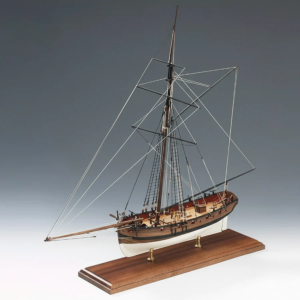
If you are bringing some modeling and wood crafting skill to the table, the 1:64 Lady Nelson by Amati has you building all the major features of an advanced ship like a larger frigate in a smaller vessel that uses good quality hardwood and doesn't come out looking like a toy. You get to perform quality hull and deck planking and simple, basic rigging for both fore-aft sails and square sails. A model like this will hone your skills for the next, grander project.
If you are a rank beginner with less experience with tools, then a basic kit like Artesania Latina's 1:90 scale 15th century galleon San Francisco II may be to your liking. This was based on an actual historical ship. The instructions are more descriptive, aimed at beginners, but the model features are less like professional models due to the types of wood used, the generic parts like cannons and fittings used on many other kits, and simplicity of the fittings. However, there is much more to do on this model because there is more planking and deck work, and you do more rigging AND also sail work. This one is a favorite for beginners.
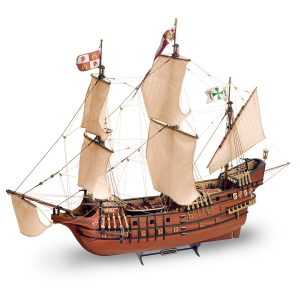
Bear in mind that the time period selected and type of ship largely is determined by your preference, so that is where you start shopping for a model. Then, you choose one that suits your skill level. One that has great instructions with illustrations in color like SF II is a model you can't go wrong with. The Lady Nelson, even though it is a fictional ship, is a generic 18th century English cutter with details and design which are more historically accurate and finer, quality hardwood which makes the model appear more professional (e.g. walnut or cherry hull planks intead of mahogany or cheap basswood).
There are many other kits out there which other builders will point you to for various reasons and from personal experience. Some have great instuctions, many not so much. Most of them will not teach you the how-to's when it comes to planking and basic wood shaping and parts fabrication. That comes from tutorial books you purchase seperately, or articles members here can provide in electronic format, such as those below. You will find that researching and reading take up more time than building on your first ship. Best advice: the most important part of building model sailing ships is having patience. . . and lots of it!