
• SUBSCRIBE TO SHIPS IN SCALE TODAY!

    The beloved Ships in Scale Magazine is back and charting a new course for 2026!
    Discover new skills, new techniques, and new inspirations in every issue.

    NOTE THAT OUR NEXT ISSUE WILL BE July/August 2026
  • Win a Free Custom Engraved Brass Coin!!!
    As a way to introduce our brass coins to the community, we will raffle off a free coin during the month of August. Follow link ABOVE for instructions for entering.

General Observation re Masts (HMS Bounty 1:48)

Joined
Mar 24, 2025
Messages
22
Points
48

Location
Sydney
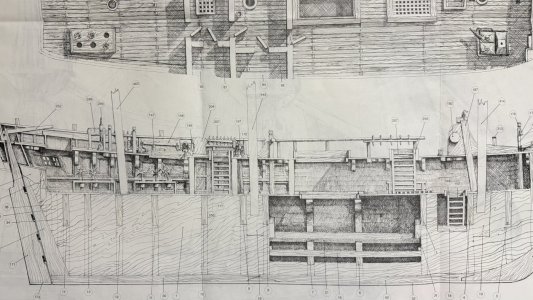
I've just finished my lower deck and about to add the upper deck. No mention in the instructions but the masts on the scale plans definitely have a lean. Especially the mizzenmast. It and the mainmast tilt back and the foremast tilts forward. I must have looked at the ship (and others like it) hundreds of times and I would have sworn ships masts were perpendicular to the keel. I've cut out a template with the angles so I can match the plan.
A4A44560-6300-411A-9E7F-E647A38AAEF5_1_102_a.jpeg

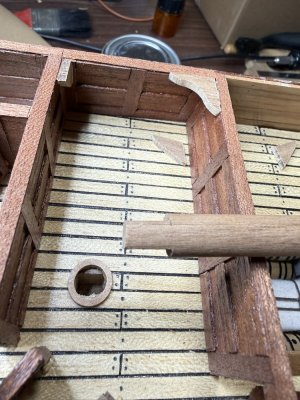
Another thing that wasn't mentioned in the instructions but was pretty self evident was that the foremast and mainmast needed to be notched to fit into keyhole created in the ships framework. Once in, everything else mounted to them better be lined up properly as there wont be any adjusting.

CF56C39F-661A-45E2-BC20-D7E1685CCC58_1_102_o.jpeg
 
So, a couple of things here.
First, the rake of the masts could be moved. Not a lot, but it could be moved and adjusted.
Second, through the history of ships, the ideas of mast rake changed and as a result, as time went along, the masts rake was designed differently to make up for this change in philosophy.
In addition, different types of ships were designed with different rakes.
 
Along with Jeff's great response, for the mizzen and foremast once locked in place in their respective steps it was a major effort to change the rake, but it could be done. The main mast on the the other hand, at least for English navy ships, were more easily adjusted as the step was not bolted in place, but rather, could slide within the well space. It was held down by the weight of the mast and adjusted with wedges along the keel.
Allan

1783069428612.jpeg
 
I did it just to take pictures Jeff. Even with just deck beams and no deck planking, it will likely never be seen. I guess it was really just one of those "I want to see if I can do it and see what it will look like" kind of things. Had never done it before and may never do it again.
Allan
 
I would have sworn ships masts were perpendicular to the keel.
Seldom was that the case and, if I had to guess, it was a coincidence when it happened. In fact, on vessels with more than one mast, they are often set at different rakes. The rakes of keels vary and the rakes of masts vary. I can't think of any obvious relationship between the two. Fair winds!
 
Adjusting the rake of the mast was and still is a way to change a ship or boat’s performance. Think of the hull as a lever or child’s teeter totter. There is an imaginary point along the longitudinal axis of the ship’s hull called The Center of Lateral Resistance. The location of this point is determined by the underwater shape of the hull.

The sails exert forces on the hull; necessary to propel the ship. Forces exerted on the hull forward of the Center of Lateral Resistance pivot the hull away from the wind. Forces exerted on the hull aft of the Center of Lateral Resistance pivot the hull into the wind.

Ideally the vessel should have a slight weather helm. Forces on the hull should be giving the hull a slight nudge into the wind. If the vessel has an undesirable strong weather helm or worse a Lee helm shifting the rig fore or aft can correct it. This is done by increasing or decreasing the rake of one or more masts. Where the mast passes through each deck, the hole is oversized with the mast secured by wedges, The standing rigging is adjusted to change the rake and the wedges in the mast holes adjusted accordingly.

In a boat with a pivoting centerboard the Center of Lateral Resistance can be changed by simply moving the board.

Roger
 
Back
Top