
-

Win a Free Custom Engraved Brass Coin!!!
As a way to introduce our brass coins to the community, we will raffle off a free coin during the month of August. Follow link ABOVE for instructions for entering. -

SUBSCRIBE TO SHIPS IN SCALE TODAY!
The beloved Ships in Scale Magazine is back and charting a new course for 2026!
Discover new skills, new techniques, and new inspirations in every issue.
NOTE THAT OUR NEXT ISSUE WILL BE MARCH/APRIL 2026
- Home
- Forums
- Welcome to Ships of Scale Forum
- Beginners Corner - How to Get Started
- Basic Tools Needed
You are using an out of date browser. It may not display this or other websites correctly.
You should upgrade or use an alternative browser.
You should upgrade or use an alternative browser.


Here are my own glue recommendations:
All wooden parts are glued using various brands of PVA wood glue. For non-wood components, I primarily use CA glue (see photo). The reasoning is fairly straightforward: different tasks require different adhesives, each with its own holding strength, viscosity, and working time. Below is the list of glues I use most often and where they work best.
PVA / Wood Glues

All wooden parts are glued using various brands of PVA wood glue. For non-wood components, I primarily use CA glue (see photo). The reasoning is fairly straightforward: different tasks require different adhesives, each with its own holding strength, viscosity, and working time. Below is the list of glues I use most often and where they work best.
PVA / Wood Glues
- Lineco Neutral pH Adhesive
Very thin; dries fast and clean without clogging. Excess glue is best removed before it fully cures, as it leaves a transparent film. Recommended for the finishing planking layer. Light handling is possible after about 1 hour of drying time. - Titebond I, II, III
Excellent strength with a slower drying time, allowing for longer assembly and adjustment. Ideal for structural components such as bulkheads and framing. Full cure in approximately 24 hours. - Elmer’s Wood Glue Max
Ideal for the first layer of planking and tight joints; also well suited for framing. Bonds extremely strong. Contains real wood fibers, which helps with staining. Dries fast and clean. - Moment Stolyar Super PVA
An excellent all-purpose wood glue brought to me from Russia. Dries fast and clean and produces a strong bond. - Ponal (found mostly in Europe), I use it occasionally because it is hard to obtain in the USA.
- M5T
My go-to CA. Extremely thin—almost water-like. Penetrates joints and holes easily, bonds very strongly, and cures in seconds. Importantly, it does not clog as it dries. Best used for photo-etched parts. Note: glued parts cannot be blackened, and wood bonded with CA will not accept stain. - M1100G
Essentially, the thicker-viscosity sibling to M5T. Equally reliable, just suited to applications where gap control is needed. - ZAP CA
Needs little introduction and is widely used among modelers worldwide. This version is very thin and fast-curing, but the bond strength is moderate, and it can leave white residue as it dries. - Rapid Fuse CA
I use this as a utility glue. It has a thick viscosity and is useful for temporary joints, as parts can be separated without damage if needed.


Most of us use a PVA glue (including myself). I like Titebond.
Sometimes people (including myself) use CA.
Some use the UV curing glues and others like the basic white glues.
Some love epoxy.
Part of it depends on what you are gluing and what it's going to be used for.
LOL I never hit reply to post this...
Sometimes people (including myself) use CA.
Some use the UV curing glues and others like the basic white glues.
Some love epoxy.
Part of it depends on what you are gluing and what it's going to be used for.
LOL I never hit reply to post this...
For CA glues, You will most commonly find Zap glues and also glues from Bob Smith Industries.Most of us use a PVA glue (including myself). I like Titebond.
Sometimes people (including myself) use CA.
Some use the UV curing glues and others like the basic white glues.
Some love epoxy.
Part of it depends on what you are gluing and what it's going to be used for.
LOL I never hit reply to post this...
Both are available in different viscosities. Thinner dries the fastest, but needs a perfect joint. The thicker it is, the longer it takes to dry (still not a long time) but the larger gap it will fill. Here are pictures of both the Zap lines and the Bob Smith industries glues. You will often fine the Bob Smith industries glues with different 3rd party labels.



I use ca primarily,,Bob Smith Industries, in three viscosities.. I then coat the inside of the planked hull with titebond 2 ..never had a problem with separation...just my opinion.. if I'm not in a hurry(?) , I use Titebond Quick and Thick.
- Joined
- Jun 29, 2024
- Messages
- 1,645
- Points
- 488

Three glues:
Titebond II: or any other PVA glue for wood-wood or wood-paper joints.
Wood- metal: Duco Original Formula in conjunction with a mechanical fastener.
Metal-metal: soldered or in some cases, JB Weld Original Formula Epoxy.
Roger
Titebond II: or any other PVA glue for wood-wood or wood-paper joints.
Wood- metal: Duco Original Formula in conjunction with a mechanical fastener.
Metal-metal: soldered or in some cases, JB Weld Original Formula Epoxy.
Roger
Good stuff here Roger..I'm stuck on this topic
Thank you for the info. Been modeling plastic sailing ships from the beginning of time. It would be difficult to build a wood model in an apartment in Brooklyn NY. So at 88 years old I decided to try a wood sailing ship. My plastic ships were all highly detailed as to the rigging etc.Here are my own glue recommendations:
All wooden parts are glued using various brands of PVA wood glue. For non-wood components, I primarily use CA glue (see photo). The reasoning is fairly straightforward: different tasks require different adhesives, each with its own holding strength, viscosity, and working time. Below is the list of glues I use most often and where they work best.
PVA / Wood Glues
CA (Cyanoacrylate) Glues
- Lineco Neutral pH Adhesive
Very thin; dries fast and clean without clogging. Excess glue is best removed before it fully cures, as it leaves a transparent film. Recommended for the finishing planking layer. Light handling is possible after about 1 hour of drying time.- Titebond I, II, III
Excellent strength with a slower drying time, allowing for longer assembly and adjustment. Ideal for structural components such as bulkheads and framing. Full cure in approximately 24 hours.- Elmer’s Wood Glue Max
Ideal for the first layer of planking and tight joints; also well suited for framing. Bonds extremely strong. Contains real wood fibers, which helps with staining. Dries fast and clean.- Moment Stolyar Super PVA
An excellent all-purpose wood glue brought to me from Russia. Dries fast and clean and produces a strong bond.- Ponal (found mostly in Europe), I use it occasionally because it is hard to obtain in the USA.
- M5T
My go-to CA. Extremely thin—almost water-like. Penetrates joints and holes easily, bonds very strongly, and cures in seconds. Importantly, it does not clog as it dries. Best used for photo-etched parts. Note: glued parts cannot be blackened, and wood bonded with CA will not accept stain.- M1100G
Essentially, the thicker-viscosity sibling to M5T. Equally reliable, just suited to applications where gap control is needed.- ZAP CA
Needs little introduction and is widely used among modelers worldwide. This version is very thin and fast-curing, but the bond strength is moderate, and it can leave white residue as it dries.- Rapid Fuse CA
I use this as a utility glue. It has a thick viscosity and is useful for temporary joints, as parts can be separated without damage if needed.
I am building my models in an apartment in Brooklyn, NYThank you for the info. Been modeling plastic sailing ships from the beginning of time. It would be difficult to build a wood model in an apartment in Brooklyn NY. So at 88 years old I decided to try a wood sailing ship. My plastic ships were all highly detailed as to the rigging etc.


Good time for modeling today with at least 8 inches of snow in Brooklyn so far today. To both you and Clipper, have fun, stay safe.I am building my models in an apartment in Brooklyn, NY
Allan
Only...4 rooms... lucky you!The Brooklyn apartment was only 4 rooms
The adhesives I consider acceptable for use on a model include Roger's three "usual suspects" above, with some reservations, and some additions:
Titebond II (or equivalent PVA) for wood-wood or wood-paper and paper-paper (reversible with difficulty using heat and/or isopropyl alcohol.) Frankly, of all the adhesives I still on models, I consider PVA to be the least acceptable.
Duco Original Formula nitro-cellulose adhesive for all purposes only with a mechanical fastener. Reversible with acetone.
Polystyrene plastic (e.g. Styrofoam) dissolved in acetone only with mechanical fastener - (equivalent to Duco Original Formula.) Reversible with acetone.
Clear shellac in a range of viscosities ("cuts") for all purposes, thin for sealing and for gluing paper-wood, thick for wood-wood but used as an adhesive only with a mechanical fastener. Easily reversible with alcohol.
Paraloid B-72 thermoplastic resin for all purposes except metal to wood, unless a mechanical fastener is used. (Used in a wide range of viscosities: thin as a finish coating through thick for adhesive.) Easily reversible with acetone. Full disclosure: I have not used B-72 as yet but expect I will be using a lot of it in the future. In recent years, B-72 has become the "go-to" sealer and adhesive for professional fine art conservators, restorers, archaeologists, and just about anybody else in the business of putting lots of little pieces back together. (See: https://en.wikipedia.org/wiki/Paraloid_B-72)
Liquid hide and fish glues for wood-wood, wood-paper. I avoid these because I find synthetic adhesives more agreeable to use, but they could be preferred for restoration work on antique models at times. (Reversable with hot water.)
CAVEATS:
I only use epoxy resin adhesives when absolutely necessary because as a practical matter they are not reversible. Examples of acceptable uses would be repairing a pinned broken spar, assembling small metal to wood subassemblies, or laminating lifts for a solid hull.)
I never use cyanoacrylate adhesives ("Superglue") on models for the same reasons they are rejected as unacceptable by most all top-tier museum curation and restoration shops that now ban the stuff for a variety of reasons including, but not limited to a lack of easy reversal, poor shear strength, and archival uncertainties.
I have four overarching considerations when picking an adhesive for any particular purpose on a model, in order of importance with the most important first:
1. Is it reversible and if so, how easily?
2. What are its archival properties? How long will it last? Will it discolor over time? Does it have acidic properties that are detrimental to the model? Is it compatible with prior or subsequent finish coatings?
3. How good is its holding power for the given application?
4. How convenient is its "workability?" Does it dry too slowly, or too fast, or just right? Is its viscosity correct, or better yet, can its viscosity be easily adjusted? Does it require clamping or not?
With the exception of "the new kid on the block," Paraloid B-72, my above choices have been confirmed over the years by experience and keeping a close watch on the "state of the art best practices" of professionals in the fields of conservation and restoration. I am convinced without any doubt that the single most important quality of an adhesive used on a ship model is its reversibility. It isn't just that the builder may make a mistake that he wants to correct, but also, and perhaps more frequently, if (or when) the model suffers damage the repair of which requires deconstruction the damage can be repaired without further damaging the model.
I'm keenly aware there are those who will say, "I could care less how long the glue with which I build my models lasts as long as it outlasts me." I agree with them. If that's how they feel, there's probably no reason why their models need to last any longer than they do.
Titebond II (or equivalent PVA) for wood-wood or wood-paper and paper-paper (reversible with difficulty using heat and/or isopropyl alcohol.) Frankly, of all the adhesives I still on models, I consider PVA to be the least acceptable.
Duco Original Formula nitro-cellulose adhesive for all purposes only with a mechanical fastener. Reversible with acetone.
Polystyrene plastic (e.g. Styrofoam) dissolved in acetone only with mechanical fastener - (equivalent to Duco Original Formula.) Reversible with acetone.
Clear shellac in a range of viscosities ("cuts") for all purposes, thin for sealing and for gluing paper-wood, thick for wood-wood but used as an adhesive only with a mechanical fastener. Easily reversible with alcohol.
Paraloid B-72 thermoplastic resin for all purposes except metal to wood, unless a mechanical fastener is used. (Used in a wide range of viscosities: thin as a finish coating through thick for adhesive.) Easily reversible with acetone. Full disclosure: I have not used B-72 as yet but expect I will be using a lot of it in the future. In recent years, B-72 has become the "go-to" sealer and adhesive for professional fine art conservators, restorers, archaeologists, and just about anybody else in the business of putting lots of little pieces back together. (See: https://en.wikipedia.org/wiki/Paraloid_B-72)
Liquid hide and fish glues for wood-wood, wood-paper. I avoid these because I find synthetic adhesives more agreeable to use, but they could be preferred for restoration work on antique models at times. (Reversable with hot water.)
CAVEATS:
I only use epoxy resin adhesives when absolutely necessary because as a practical matter they are not reversible. Examples of acceptable uses would be repairing a pinned broken spar, assembling small metal to wood subassemblies, or laminating lifts for a solid hull.)
I never use cyanoacrylate adhesives ("Superglue") on models for the same reasons they are rejected as unacceptable by most all top-tier museum curation and restoration shops that now ban the stuff for a variety of reasons including, but not limited to a lack of easy reversal, poor shear strength, and archival uncertainties.
I have four overarching considerations when picking an adhesive for any particular purpose on a model, in order of importance with the most important first:
1. Is it reversible and if so, how easily?
2. What are its archival properties? How long will it last? Will it discolor over time? Does it have acidic properties that are detrimental to the model? Is it compatible with prior or subsequent finish coatings?
3. How good is its holding power for the given application?
4. How convenient is its "workability?" Does it dry too slowly, or too fast, or just right? Is its viscosity correct, or better yet, can its viscosity be easily adjusted? Does it require clamping or not?
With the exception of "the new kid on the block," Paraloid B-72, my above choices have been confirmed over the years by experience and keeping a close watch on the "state of the art best practices" of professionals in the fields of conservation and restoration. I am convinced without any doubt that the single most important quality of an adhesive used on a ship model is its reversibility. It isn't just that the builder may make a mistake that he wants to correct, but also, and perhaps more frequently, if (or when) the model suffers damage the repair of which requires deconstruction the damage can be repaired without further damaging the model.
I'm keenly aware there are those who will say, "I could care less how long the glue with which I build my models lasts as long as it outlasts me." I agree with them. If that's how they feel, there's probably no reason why their models need to last any longer than they do.
Last edited:

4 rooms! Luxury! We used to dream of living in 4 rooms. All 20 of us lived in a septic tank, but we were happy.Only...4 rooms... lucky you!
You tell kids stuff like that today and they won't believe you!


I have looked for a simple, readily available hobby PVA glue. Several years ago and a half dozen models I found and settled on Aleenes Quick Dry Tacky Glue, premium all-purpose adhesive, quick drying and fast tacking. I especially like the fast tacking nature. I have no idea about the reversibility. I have not had to tackle that in my models. I have several bottles of the Aleenes hobby glue on my bench. Totally satisfied.

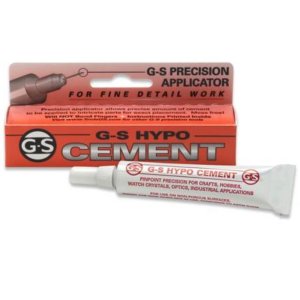
Lots of good advice here. For PVA I use builders indoor glue--strong and odourless. As far as CA, I agree with the concerns above. Plus many of us are allergic to it. The alternative as mentioned above is epoxy. I've found GS Hypo excellent for gluing metal to wood. It's glue used by jewelers so you know it's strong. It's inexpensive but not always widely available. See picture. Good luck.


Not that I am an experienced ship builder, but my 2 cents anyway.
I use two types of PVA where PVA can be used -
I started with Helmar Craft & Hobby PVA that I had in the cupboard for years before I decided on this hobby, and that is very strong and reasonably quick but not too quick to grab.
I used it for all the structural work like bulkheads, balsa infills, and replacing plywood keel edges with walnut strips. I did not use any clamps, just pressing for a while.
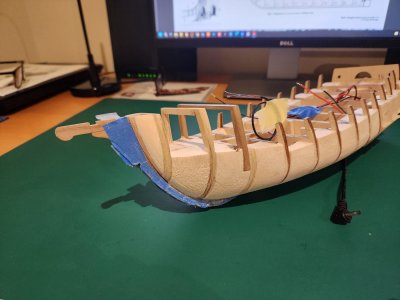
Then I heard about the Titebond Quick & Thick, so I decided to use it for the first planking.
I don't find it to be very quick compared to the Helmar glue - it allows plenty of time to position pieces if needed, but on the other hand, it does not take too long to make a safe grab when clamps can't be used. It does not run when put on vertical surfaces.
It is too thick to pour, so it has to be squeezed into the small plastic bottles that I use to dispense it.
I have two bottles with different size holes, and they have to be kept upside down otherwise it takes too long for the glue to run into the nozzle.
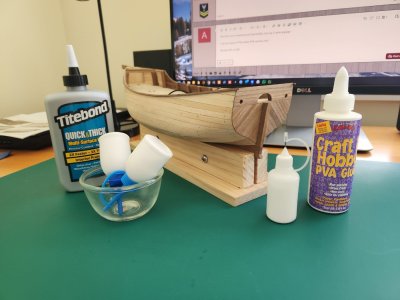
For the 2nd planking which is only 3.8 mm wide and cleanliness is important, I use the Helmar thinner glue, because I can use the bottle with metal tip that allows smaller and more precise drops of glue.
Happy gluing !
I use two types of PVA where PVA can be used -
I started with Helmar Craft & Hobby PVA that I had in the cupboard for years before I decided on this hobby, and that is very strong and reasonably quick but not too quick to grab.
I used it for all the structural work like bulkheads, balsa infills, and replacing plywood keel edges with walnut strips. I did not use any clamps, just pressing for a while.
Then I heard about the Titebond Quick & Thick, so I decided to use it for the first planking.
I don't find it to be very quick compared to the Helmar glue - it allows plenty of time to position pieces if needed, but on the other hand, it does not take too long to make a safe grab when clamps can't be used. It does not run when put on vertical surfaces.
It is too thick to pour, so it has to be squeezed into the small plastic bottles that I use to dispense it.
I have two bottles with different size holes, and they have to be kept upside down otherwise it takes too long for the glue to run into the nozzle.
For the 2nd planking which is only 3.8 mm wide and cleanliness is important, I use the Helmar thinner glue, because I can use the bottle with metal tip that allows smaller and more precise drops of glue.
Happy gluing !