
• Win a Free Custom Engraved Brass Coin!!!
    As a way to introduce our brass coins to the community, we will raffle off a free coin during the month of August. Follow link ABOVE for instructions for entering.
  • PRE-ORDER SHIPS IN SCALE TODAY!

    The beloved Ships in Scale Magazine is back and charting a new course for 2026!
    Discover new skills, new techniques, and new inspirations in every issue.

    NOTE THAT OUR FIRST ISSUE WILL BE JAN/FEB 2026

Gluing Brass parts together

Joined
Nov 16, 2025
Messages
8
Points
3

I am new to model ship building, and I am building the Norwegian Sailing Pram by Model Expo - the second in a series of three ships. I am trying to attach the gudgeons and pintels for the rudder. I have glued on the small brass tubes on the pad. I have also the pintels onto the brass pintel straps. However, whenever some pressure is applied, it seems, the parts come off the straps. I have had to re-glue one gudgeon onto the pad twice, and both pintels to the pintel straps once. I let the glued parts dry at least overnight before manipulating them. At first I was using Gorilla Super Glue, but I thought maybe the I needed a thicker glue; so, I am not using Loctite Super Glue. I just do not understand what I may be doing wrong. Does anyone have any suggestions on gluing these brass parts together, especially as they will be under some degree of pressure once mounted?

Many thanks for any suggestions.

 
I do a lot of miniature metalwork; all brass. For assembling parts:

First choice- lead free acid free solder. This is soft solder applied with an electric soldering iron and liquid flux. I don’t own or use an expensive soldering station; just an ordinary conical tipped soldering iron. Soldering is an essential modeling skill.

Second choice- JB Weld Original Formula Epoxy.

Third choice- Duco cement.

Each has its own use.

Roger
 
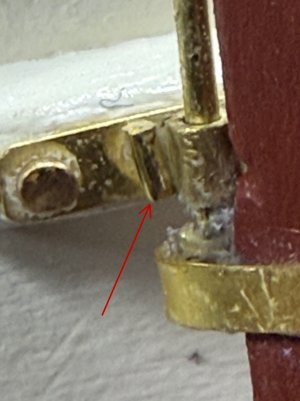
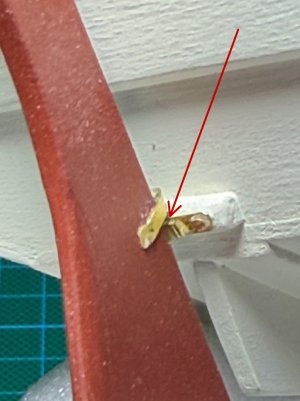
In incidently that is what I was doing yesterday also on the Pram, as per the instructions I too used CA glue. They did stick well but I do not like the result as it is messy. In fact yesterday evening I was researching soldering and started to order flux, soldering iron etc. What I did do yesterday which seemed to have helped is to cut small pieces off a brass nail and placed them directly adjacent to the pipe to add strength by increasing the contact surface. I have taken some photos to help explain.

IMG_2770.jpeg

IMG_2768.jpeg
 
Yup, soldering for brass parts, and paste is the best. Can get lower temperature paste (180'C) as used for SMD and hot air gun. Do not need to silver solder UNLESS there is major stress on parts, like brass rings onto mast bands for rigging r/c yachts etc.

Kim
 
Last edited:
Yuri,
all my brass, pintles, hinges, eyerings/bolts, chain and others are all blackened, especially after soldering, as there were very, very few items of brass on a period ship. I've not encountered ordinary yellow solder but there is a gold paste solder, check jewellery website like Cooksongold.
Even bronze guns, close up, look more black than bronze, and certainly not bright brass colour.

Kim
 
I don't know much about the solder game myself. Let's say you're working with pieces you plan to chemically blacken, can you use brass wire for soldering the pieces together?
 
I don't know much about the solder game myself. Let's say you're working with pieces you plan to chemically blacken, can you use brass wire for soldering the pieces together?
Not really. Brass melts at about 1700F. Solder melts at about 400F. If you heated the brass wire it would probably cause the brass parts you want to secure to melt or change their shape.
 
Back
Top