Thank you Alan. I am not aware of the types of flags or ensigns that should be flown. I appreciate your information.

 |
The beloved Ships in Scale Magazine is back and charting a new course for 2026! Discover new skills, new techniques, and new inspirations in every issue. NOTE THAT OUR NEXT ISSUE WILL BE July/August 2026 |
|
 |
As a way to introduce our brass coins to the community, we will raffle off a free coin during the month of August. Follow link ABOVE for instructions for entering. |
|
We are all in a learning mode, no matter how long we have been at it. This kind of mistake by AL seems to be due to lack of research which is common on AL kits. But, a little research is not so hard to do with the internet that we have today, for anyone that enjoys doing it. A hobby is to be fun, and research can be part of the fun and satisfaction for some folks but it can be a chore for others. With your family story I suspect you have already had some fun with the research. The link above is quite detailed for British vessels' flags and pennants as well.Thank you Alan. I am not aware of the types of flags or ensigns that should be flown
![20260616_095725[1].jpg](https://shipsofscale.com/sosforums/data/attachments/596/596157-ea049a8acd4470de13236a82d1f6b914.jpg?hash=fz3StLIcrp "20260616_095725[1].jpg")
Hello Alan,We are all in a learning mode, no matter how long we have been at it. This kind of mistake by AL seems to be due to lack of research which is common on AL kits. But, a little research is not so hard to do with the internet that we have today, for anyone that enjoys doing it. A hobby is to be fun, and research can be part of the fun and satisfaction for some folks but it can be a chore for others. With your family story I suspect you have already had some fun with the research. The link above is quite detailed for British vessels' flags and pennants as well.
Allan
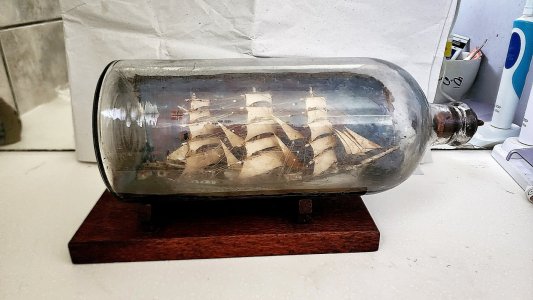
Thank you Allan, It may be the Margit as the bottle was found in Australia.I did a quick search three masted Norwegian commercial vessels that sank in the 19th or early 20th centuries and found two.
- Pronto (1895): A wooden barque built in 1892 in Norway. It ran ashore and wrecked at Porth-Post (Cornwall) on April 21, 1895, while on passage from Mauritius to Garston, England, with a cargo of sugar. [1]
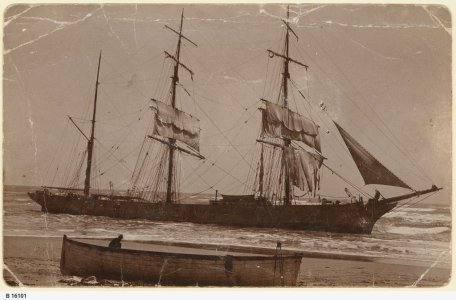
- Margit (1911): A three-masted steel barque built in 1891. After departing Victor Harbor, Australia, the vessel ran aground on the shores of the Coorong on November 10, 1911, and eventually succumbed to the seas due to what an inquiry deemed careless navigation. [1]
Barque "Margit" on the Coorong beach, 34 miles north of Kingston. The wrecked vessel was from Norway with a cargo of wheat bound for England. She ran aground on sand on November 10, 1911. All hands were savedI did a quick search three masted Norwegian commercial vessels that sank in the 19th or early 20th centuries and found two.
- Pronto (1895): A wooden barque built in 1892 in Norway. It ran ashore and wrecked at Porth-Post (Cornwall) on April 21, 1895, while on passage from Mauritius to Garston, England, with a cargo of sugar. [1]
- Margit (1911): A three-masted steel barque built in 1891. After departing Victor Harbor, Australia, the vessel ran aground on the shores of the Coorong on November 10, 1911, and eventually succumbed to the seas due to what an inquiry deemed careless navigation. [1]
Thank you Allan, It may be the Margit as the bottle was found in Australia.

I've read that too, but also read that during certain periods all non-naval ships used the red ensign. And I'm confused as to how ships knew if the flagged ship was part of the Red Ensign (along with White and Blue), or a ship without a squadron, or if I'm correct, a non-naval vessel. I found this very confusing.Like most vessels of the Royal Navy in the 18th century, Supply would have flown the red ensign ( "Red Duster"). While the Royal Navy used the squadron color system (red, white, and blue), the red ensign was to be used for all naval squadrons that were not operating as part of the White or Blue divisions
Me too.I found this very confusing.
 And if a ship changed squadrons, so did the flag.
That part, I understand. If a ship flew the blue ensign, you knew what it was. And if it flew the white ensign, you knew as well. But if it was the red, it could be the Admiral of the fleet, or a ship in that group, or a ship from a different group, or any old cargo ship at all???Me too.
And that, ladies and gentlemen, is why my Granado remains flag-less.The more I research this the more questions that are raised. The ensigns were the large flags flown aft. Flags were smaller and flown from the mizen, main, and fore mastheads. Before 1864 from what I could find your comment is correct, except that the head of a squadron flew an additional flag. The ship carrying a fleet commander (like an Admiral, Vice-Admiral, or Rear-Admiral) flew an additional personal command flag on a specific masthead to distinguish her from the rest of the fleet. The article goes into detail including the following comment:
Originally there were three naval squadrons - the Red, White and Blue - they took these colours from those of the Union Jack. Because the Red Ensigns of England and Scotland had already been established as merchant flags, a Red Ensign with the Union in the canton became the merchant flag of Great Britain upon Union in 1707. This led to potential confusion - was that ship a merchantman or a naval ship?
Also found the following: From AI so beware.
Admirals flew their flags from the mainmast, Vice-Admirals from the foremast, and Rear-Admirals from the mizzenmast.
And to add to the confusion looking at the flags and ensigns flown on Victory at Trafalgar she flew the ensign, two St. Georges flags and two Union Jacks as well as Nelson's flag. I am sure some member here can explain this more simply and accurately. I never realized what a complex thing this could be, and we have not even thrown in pennants!
- Red Squadron: Admirals flew a plain red flag, with Vice- and Rear-Admirals adding one or two white balls to the upper-left canton, respectively.
- White Squadron: Admirals used a St. George's Cross on a white field, with Vice- and Rear-Admirals adding one or two blue balls.
- Blue Squadron: Admirals flew a plain blue flag, with Vice- and Rear-Admirals adding one or two white balls.
- Commodores: Used colored broad pennants based on their squadron.
Allan

A list of them:What are the rankings? I suddenly have two stripes. Is there a list somewhere of the various ranks and how they are achieved?


Hi Peter,A list of them:
There must also be a list of rankings …….Trophies
You can earn trophies by carrying out different actions. This page shows a list of the trophies that are available.shipsofscale.com
Regards, Peter
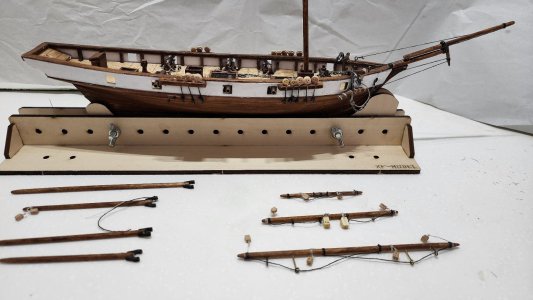
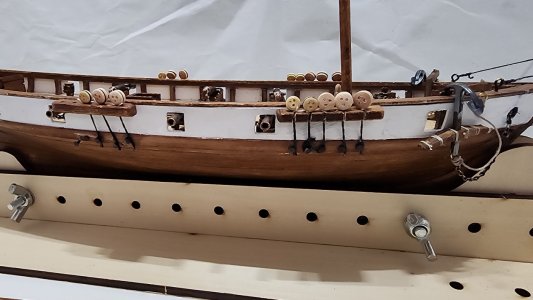

Nice work Furry! Keep it going smoothly. No rush! Magic MikeWork progressing slowly on my Halcon model. next step is to sort out rigging for masts. I have realised that I need more 5mm deadeyes. Sourcing these is not easy as postage costs from a lot of sites to North Queensland, Australia is prohibitive.View attachment 615279
View attachment 615280
Thank you Mike,Nice work Furry! Keep it going smoothly. No rush! Magic Mike