
• Win a Free Custom Engraved Brass Coin!!!
    As a way to introduce our brass coins to the community, we will raffle off a free coin during the month of August. Follow link ABOVE for instructions for entering.
  • PRE-ORDER SHIPS IN SCALE TODAY!

    The beloved Ships in Scale Magazine is back and charting a new course for 2026!
    Discover new skills, new techniques, and new inspirations in every issue.

    NOTE THAT OUR FIRST ISSUE WILL BE JAN/FEB 2026

Harold Hahn

Dave Stevens (Lumberyard)

Sponsor: dlumberyard
Sponsor
Joined
Dec 1, 2016
Messages
6,420
Points
728

This is not a one room school house you would see in rural America circa 1860s this is a school with a number of classrooms where different lectures take place as well as building projects

we presented Howard Chapelle now we will present to you the life and times of artist Harold Hahn. I was given Harolds personal Library when he passed away and i was a student of Harold for many years. This classroom will start with an article and progress into an open discussion and a Q&A from here there will be a build using the Hahn method then a build modified version. Yes we talk the talk and walk the walk.
Like all artists who put themselves in the public eye and open themselves to critique and sometimes harsh criticism, it is the case of Harold Hahn. Some say he is the root of evil and some say he is the light from above. Harold had a strong dislike for commercial mass-produced ship kits, and he was not shy in saying so. There was a small group which included Howard Chapelle, Robert Bruckshaw, August Crabtree, Harold Hahn and the directors of the NRG. The ruling class.
 
Last edited:

before the lecture begins here is a list of links to Harold Hahns work


part 1 Harold Hahn the artist

In this article i will explore the work of Harold Hahn and the impact he had on the hobby of model ship building. His ideas molded a generation of model builders and those inspired by his work carried his work forward into the new generation.

All the images you will see are from the Cleveland Museum of art as well from the estate of Harold Hahn. They are shown here with the permission of the museum and the estate. Harold never stopped working, he was a prolific artist every wall in his house hung paintings and sketches, model ships are on display in his house as well as the homes of his children and piles and piles of water colors, drawings, prints, sketches and etchings. Many times i sat and went through his work as he told their story of where and why he created the piece. My father was a portrait artist and photographer later to become a lithographer i followed in his foot steps and pursued a career as a commercial artist. With my back round in art meeting Harold Hahn a bond was formed as kindred spirits as the young artist and the master. Harold was a well educated and refined man his intellect would shine and you could feel his passion of art.

The question of art versus craft. The division between the two is not easy to define without writing a dissertation. Art can be the expression of an idea through craft, and more recently still, art can even just be an idea. Craft on the other hand is often the creation of object through a learned skill. Evidence of this is found in the history of guilds and trades in the renaissance through the journeyman process found even now in trades like carpentry. The museum does not define these things specifically, but collects objects which are examples of both historically. In other words an art museum defines art as a natural talent where as a craft is the result of a learned skill. An artist can pick up a brush or pen and ink or for that matter whatever medium chosen and without prior training will create a work of art. This is not to say an artist can't go through school or training and improve on the raw natural talent. What makes an item a craft is the result of a craftsman going through the process from apprentice to master craftsman or a journeyman learning the craft through a well-defined set of rules and instructions.

What is going on when an artist takes a craft and raises it to a level of fine art? As defined above the artist redefines the craft through self-expression. In the case of Harold Hahn, he was a well-established and award-winning artist long before he built his first model ship. Self-expression comes into play when Harold Hahn took the craft of model ship building which is a learned skill and adds an element of sculpture and expression. We can accomplish the craft of model ship building through learning and training but no matter how hard some of us try we can never accomplish the level of sculpture achieved by the natural talent of Hahn, this is the dividing line between art and craft.


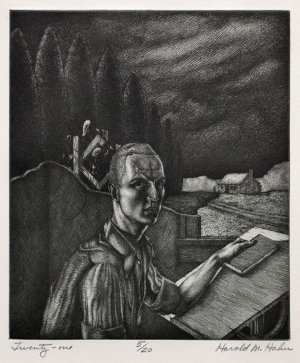
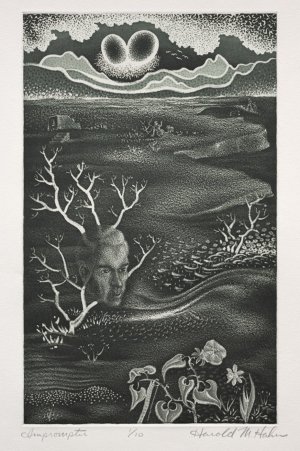
The first piece is a self portrait dated 1942
Twenty-one (Self-Portrait), 1942. Harold Maxwell Hahn (American, 1920-) Etching; The
Cleveland Museum of Art, Gift of The Print Club of Cleveland 1942.311

1942.hahn.jpg

As an artists medium Harold first learned Linoleum cutting then engraving on end grain blocks of Boxwood. Following he learned the different approaches to working on polished copper plates: drypoint, engraving, line etching, soft ground etching, and other aquatint techniques. All of the methods for producing pictures represented direct application of the artists creative efforts and special skills. At the time i met Harold i was working in a print shop specializing in limited edition art prints and learning how to do etchings. The etchings done by Harold should not be confused with commercially printed reproductions of an artists work. The mechanically produced offset lithographs are "copies" of the original artists work, however they are reproductions of the actual etching and lack the detail of the original prints made direct from the copper plates.

The process of creating and printing a line etching begins with a polished copper plate. This plate is heated and a ball of hard ground wax is touched to the hot plate to deposit enough wax on the surface so it can be rolled out into a smooth coating. Next the plate is passed over a candle flame until the warm wax is impregnated with the smoke to produce a uniformly blackened surface. The design is then traced onto the plate, bearing in mind that when the image is printed, the image will be reversed. The picture is cut on the grounded plate with a sharp point that cuts into the hard wax to expose the copper.

The contrast between the blackened wax and the bright copper color produces a well defined negative image. After drawing all the lines that will be the heaviest in the picture, the plate is submerged in a diluted solution of hydrochloric acid. The time the plate is left to etch in the acid is determined by the skill and experience of the artist. After the first etching the next pronounced lines are scribed in the wax and the plate is once again etched. This process is repeated from the heaviest lines to the finest lines. Some drawings will require as many as six acid etchings ranging from two minutes to two hours. When the final etching is done, the wax is cleaned from the copper plate and a test print is made. In most cases the cycles of etching may have to be done three of more times until the finished result is achieved.

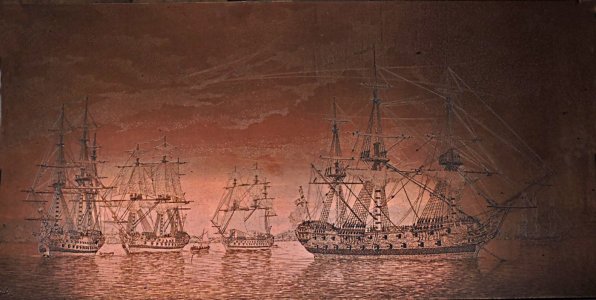
Looking at the bottom of the prints you will see numbers for example 5/20 the top number is the number of the print and the bottom number is the amount of prints made. Lower the numbers the higher the value of the print. To assure the value of a print the artist will destroy the original copper plate so no more prints can be made. This is the only surviving original copper plate. private collection


copper etching a1.jpg
 
In almost all Hahn prints there will be a building which suggests Harold's interest in structure and architecture. Realizing the path of the starving artist was not for him he went to school at Case Western University school of applied science where he enrolled in the engineering curriculum resulting in a career as an engineer and not as an artist.

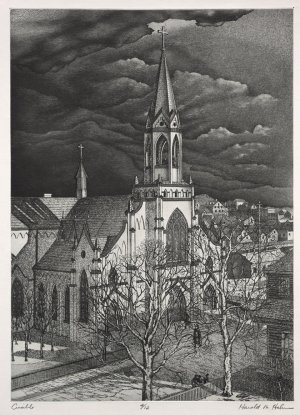
Crucible 1942
etching and aquatint
gift of the print club of Cleveland 1942
Cleveland museum of Art collection

1942.312 (1).jpg
 
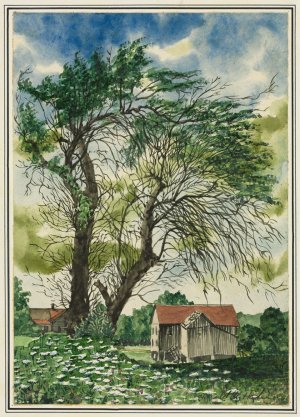
Harold not only worked with B&W etchings he also worked in water colors and oils

watercolor
Cleveland Art museum

1947.134.jpg

Nancy Hahn
in the Hahn estate


3270.jpg

Although structures appear in many of his works Harold did dabble in the abstract, however in the back round it looks like steps and some sort of structure.

1948.87.jpg
 
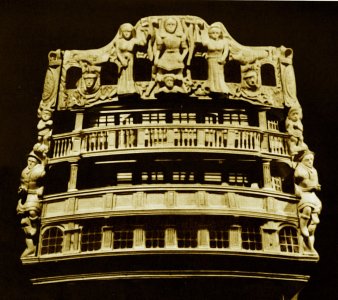
Of all the visits to Harold i never seen any examples of sculpture, this all changed when he directed his attention to model ship building. In this genre he was able to combine all his artistic talent of painting, design and the discovery of sculpture into one endeavor call it artist turned engineer or engineer turned artist.

39.jpg

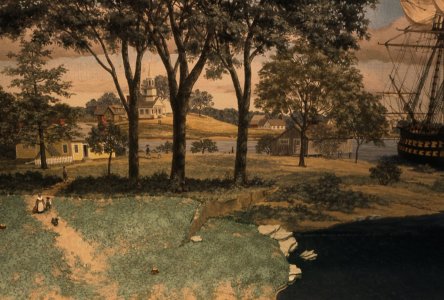
Hahn's colonial period resulted in the diorama, a book the Colonial Schooner and sets of modeling plans. His work so far was well received and well respected. When crossing the line from artist to craftsman it becomes a learned skill and there are rules to follow, and things are done certain ways, this is where self expression of the artist takes a back seat to learned skills and a system of doing things. It was this second phase when the artist turned shipwright that the critics began to creep out of the woodwork and criticize his work from where he placed gun ports, their size, how he framed his models, the use of little people in the models, interpretation of the carved work and anything no matter how trivial was questioned, some was justified some just nit picking. Some comments come down to the arm chair experts those who sit down and read an article or two maybe even a book on a subject and consider themselves experts, then there are those who will quote information and apply it willy-nilly. One example of this is when i read a post i don't remember when or where but the post read Hahn's framing of his models were all wrong because he did not taper the frames. The information is correct, British ship did taper frame futtocks they got smaller as they reached the top timbers, problem is a number Hahn's ship were American built and in North America frames were not tapered, framing was almost a solid wall of timber from keel to caprail.
 
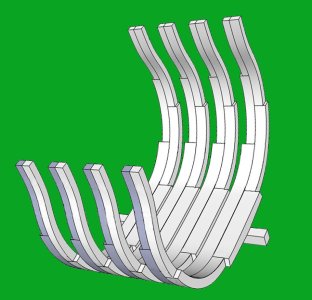
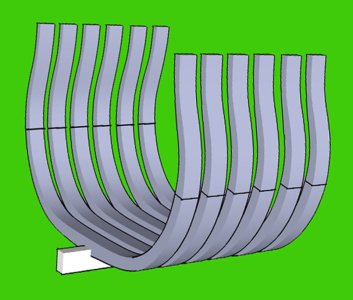
This graphic shows the British system of reducing the sided dimension of the futtocks perhaps to reduce weight in the upper hull.

tapered frames3.jpg


the North American system was to build almost a solid wall of timber and using lighter weight wood for the upper futtocks to reduce weight.

single frames2.jpg


Two major events set Harold's model building into motion one was the Boston museum of art and the other was Robert Bruckshaw


Taken directly from his Memoirs and in Harold’s own words. “The Boston Museum of fine arts really hit me hard. I found ship models in cases located in the halls of the museum. The thing that bowled me over, and forced me to reassess my intent in ship modeling was a gallery devoted to a collection of British Admiralty models. I had been patting myself on the back for being quite a fine model builder after the few opportunities I had had to see other noted people’s work. Suddenly it was revealed to me that I hadn’t even reached first base. The exquisite workmanship and detailing that I saw in the complicated Admiralty models had me eating humble pie
.
 
Last edited:
Before we take a look at the models and drawings of Harold Hahn it might be worth it to understand who Hahn's muse was, who inspired him and advised him? It was Robert Bruckshaw who built models for the Smithsonian under the guidance of Howard Chapelle.

bob.jpgbob2.jpg
 
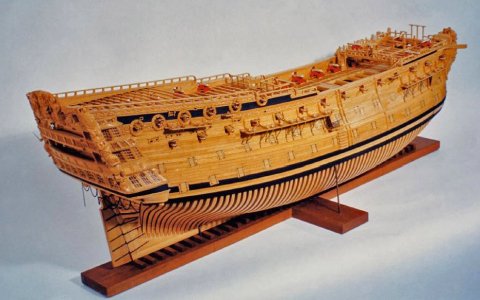
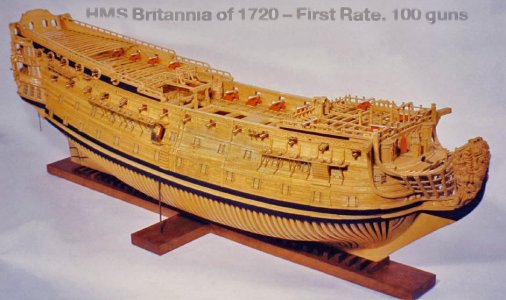
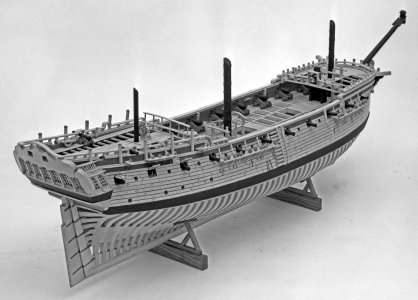
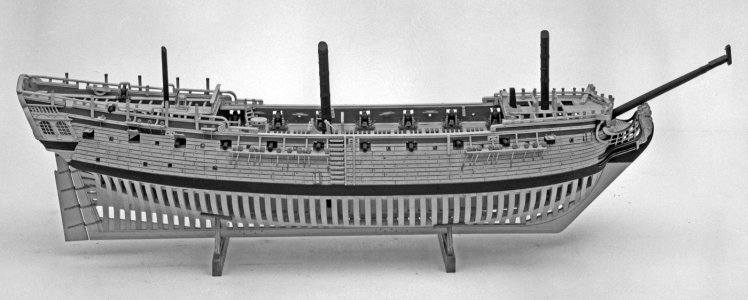
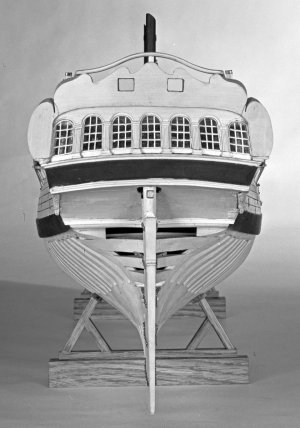
As Bob said, "Why build an admiralty model?" for years, I have had a model of the HMS victory of 1776, sitting on the mantel, and then on a shelf. The most dominating feature of that model is the tallow colored bottom of the hull. Eons ago when i modeled the USS Preston and the USS Texas the red bottoms of their hulls, except for the brass screws and rudder tended to block out any view of the superstructure. On an admiralty model the absence of the planking on the bottom half of the hull diminishes its bulky appearance and the open bottom is broken up by the spacing of the frames. The upper portion of the hull is separated from these frames by black wales. The open decks lead into the airy appearance of the rigging, giving the whole model a delicate balanced influence. You can focus on the topgallant or a truck without a white hull blinding you. An admiralty model is more pleasing to the eye.
Robert Bruckshaw

If it looks like a duck and quacks like a duck, it must be a duck. If it looks like a duck but clucks like a chicken then it must be a chicken in a duck disguise. Same applies to Bruckshaw's admiralty models they look like an admiralty model and built like an admiralty model thus they are an admiralty model. Hahn's models look like an admiralty model but not built like an admiralty model thus they are not an admiralty model they just look like one.

We can expand the definition of Admiralty model to include any model with the lower hull left open exposing any system of framing. What if one side of the hull is fully planked and one side left open is this a half admiralty model? Rather than try and squeeze different configurations of a model into the admiralty style let's keep it simple and stick to the rules bob set down.

Keep in mind Bob was building one off, one-of-a-kind models for museum display they were never meant to be reproduced. On the other hand, Harold was thinking modeling plans and a building system if followed correctly most anyone can reproduce the model.

Just to build an admiralty model is very difficult let alone trying to fit it into a fool proof building system. Oh yes, a talented artist with an engineer's mind set.
 
Back
Top