- Joined
- Dec 12, 2020
- Messages
- 158
- Points
- 88

Harriet Lane, 1:96 scale from Model Shipways
A seemingly simple model, yet riddled with flaws.
The plans are worse than those for the 3/32" scale version.
The hull planking is extremely thin; you can see light through it. The bulkheads come in two halves that are difficult to align and contain errors.
The hull needs to be reinforced with a different type of wood to assemble them correctly and avoid wearing them down during sanding.
Billing Boats uses this system, but with two halves—each the same thickness as the false keel—that align perfectly once the bulkheads are assembled.
The paddle wheels consist only of halves that must be glued to the housing; consequently, they do not rotate and, in fact, crumble between your fingers—they are incredibly fragile due to the way the wood was cut.
Paper is used to clad the smokestack, which would otherwise be a crude-looking solid wood cylinder.
The yardarms are flat and must be shaped with a file—something I had never seen before.
There is no deck planking—at least not in the plans—but there is a hideous line running along the centerline.
The underwater hull section should be clad in copper plating; in the kit, it comes painted maroon.
It also lacks metal deck guides for rotating the cannons.
Finally, the instructions are abysmal: a booklet with very small, unclear photos.
The display stand is dreadful.
Very expensive for what you get.
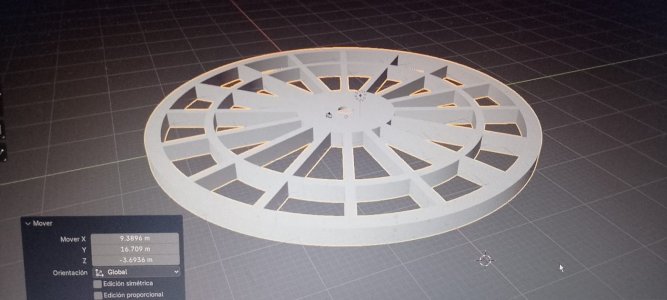
I fabricated these wheels out of resin.
Sketch measurements in meters.
You will need at least 4 of these.
A seemingly simple model, yet riddled with flaws.
The plans are worse than those for the 3/32" scale version.
The hull planking is extremely thin; you can see light through it. The bulkheads come in two halves that are difficult to align and contain errors.
The hull needs to be reinforced with a different type of wood to assemble them correctly and avoid wearing them down during sanding.
Billing Boats uses this system, but with two halves—each the same thickness as the false keel—that align perfectly once the bulkheads are assembled.
The paddle wheels consist only of halves that must be glued to the housing; consequently, they do not rotate and, in fact, crumble between your fingers—they are incredibly fragile due to the way the wood was cut.
Paper is used to clad the smokestack, which would otherwise be a crude-looking solid wood cylinder.
The yardarms are flat and must be shaped with a file—something I had never seen before.
There is no deck planking—at least not in the plans—but there is a hideous line running along the centerline.
The underwater hull section should be clad in copper plating; in the kit, it comes painted maroon.
It also lacks metal deck guides for rotating the cannons.
Finally, the instructions are abysmal: a booklet with very small, unclear photos.
The display stand is dreadful.
Very expensive for what you get.
I fabricated these wheels out of resin.
Sketch measurements in meters.
You will need at least 4 of these.