


Hazel was (is?) used in many rural crafts to make items such as hurdles, coracles, thatching pins and dowsing rods. Usually the staves are used in the round or split lengthways.
I wondered what the wood was like and as I have a hazel tree in the garden I decided to find out.
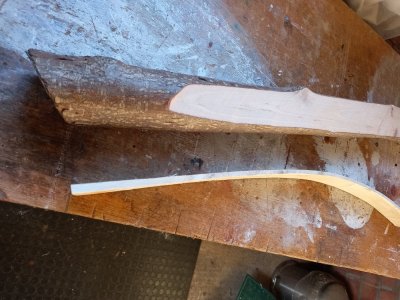
First I took a stave I cut some years ago for a plant support and sawed a billet lengthways. |The wood was white, very close grained and hard - which surprised ne for a relatively fast growing tree. (photo 1 upper)
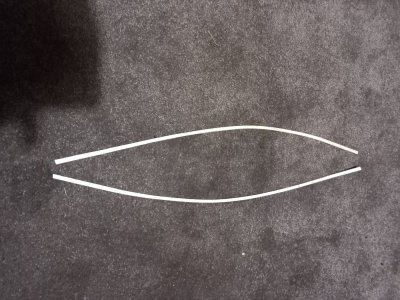
I then cut a fresh stave from which I extracted a plank 5mm thick. While green I clamped it into an arbitrary curve. After a week I found that it had retained its shape. (photo 1 lower) From this piece I cut a couple of ship planking strips 2mm thick. Photo 2. These were very flexible and, after soaking, even more so - including edge bending.
From a search of this forum I see that I am not the first to discover these properties and the potential of the wood. When PSM eventually get round to sending my next kit I may try using it.
Making dowsing rods for water divining is not a requirement in an English winter.
I wondered what the wood was like and as I have a hazel tree in the garden I decided to find out.
First I took a stave I cut some years ago for a plant support and sawed a billet lengthways. |The wood was white, very close grained and hard - which surprised ne for a relatively fast growing tree. (photo 1 upper)
I then cut a fresh stave from which I extracted a plank 5mm thick. While green I clamped it into an arbitrary curve. After a week I found that it had retained its shape. (photo 1 lower) From this piece I cut a couple of ship planking strips 2mm thick. Photo 2. These were very flexible and, after soaking, even more so - including edge bending.
From a search of this forum I see that I am not the first to discover these properties and the potential of the wood. When PSM eventually get round to sending my next kit I may try using it.
Making dowsing rods for water divining is not a requirement in an English winter.