• Win a Free Custom Engraved Brass Coin!!!
    As a way to introduce our brass coins to the community, we will raffle off a free coin during the month of August. Follow link ABOVE for instructions for entering.
  • PRE-ORDER SHIPS IN SCALE TODAY!

    The beloved Ships in Scale Magazine is back and charting a new course for 2026!
    Discover new skills, new techniques, and new inspirations in every issue.

    NOTE THAT OUR FIRST ISSUE WILL BE JAN/FEB 2026

Hello I need help!

Boxwood is NOT good for long, narrow applications, as it tends to "wander" as it ages. Longridge's "Victory" had many examples of this. Boxwood is very hard, and is best used for carvings ,blocks . etc.
Hello.
Are you referring specifically to planking and/or masts and spars? Historically it's considered one of the best timbers for planking, Both European and Castelo (or lemonwood as an equivalent in the US)
Looking at NMM contemporary models most, or at least a large proportion are planked with 'English' box.
I plan to use it on my next hull instead of pear.
 
Alaskan cedar is a good substitute if the buxus is hard to find and/or too expensive. I agree with Bob that Castelo is a great wood for planking and even carving and turning.

Lemonwood? Got to give that a try if I ever run out of Castelo.

Allan
 
Thank you for responding to my post I did look into Model exp's 3 part learners series. But I got basswood a while back and am wondering If I should make a scratch build the only hard part has been researching something to make. I've found the Royal museum of Greenwich https://www.rmg.co.uk/collections/ to be an good site for Information and one to one examples of every thing ships. I recently got more supplies like a zona saw and some clips but I have most of the other supplies except any thing fancy like a bandsaw.

And Go Red sox!
It looks like a fairly simple kit is the best direction. I usually recommend a revenue cutter, English or American instead of a ship's boat, then you have something that makes a better display, and they won't cost much. Either way, things like planking are a skill you must learn. Most of us have planked numerous ships and are skilled to varying levels.
Kits are cheap, learn the basics, the pitfalls and your strengths and weaknesses before you go scratch. You might even be able to scratch a second build depending on how you get on. But...it's doubtful I'm afraid. You seem to want to charge like a bull at a gate. With scale building this approach won't work, patience is essential here!
BTW, you mention a bandsaw, very few of us uses one (although I'm one of them) most find a table saw more suitable.
You say you got basswood (planks or thicker sheets?) You can keep this in a stock of timber, it's useful for internal work but it's not a good finishing timber (nor in my view is walnut or mahogany) Again, more research and preparation required.
 
Alaskan cedar is a good substitute if the buxus is hard to find and/or too expensive. I agree with Bob that Castelo is a great wood for planking and even carving and turning.

Lemonwood? Got to give that a try if I ever run out of Castelo.

Allan
It's intensely irritating that we can't get any of this stuff in the UK. We used to be covered in forests but if I want any timber like you have available we have to import it, even Swiss pear! I get my supplies from Estonia but now that we're not in Europe postage has shot up. (it should be normal when the EU evaporates and punitive policies stop whipping us for naughty Brexit!!)
Oh...Psst, I hear that somebody over here is selling cherry, but I don't believe that for a moment!!
 
Ditto to what's been said about wood and tools. I would add that there is a silver lining to the clouds that have been mentioned. First and foremost, you will be able to save a remarkable amount of money on woods if you equip yourself to mill your own modeling wood. This will, however, occasion considerable initial costs, but that cost will be quickly amortized over the course of a couple of serious modeling projects and such tools are always highly marketable should you abandon ship modeling and no longer have a need for them. The basic equipment consists of a circular saw (table or hand-held,) bandsaw, a modeler's table saw, and a thickness sander. These four tools should equip you to mill any modeling wood you wish from a tree trunk or branch or larger piece of dimensioned lumber.

Not only does milling your own modeling stock save a lot of money, but perhaps even more importantly it frees you from the limitations of dimensioned stock. If you go to the hardware store or hobby shop. you can purchase dimensioned stock in increments of a half, a quarter, an eighth, and maybe a sixteenth of an inch. But what do you do when your scale model ends up requiring all sorts of oddball sizes of timber? (And trust me, it will. They all do.) Basically, you're stuck. And you'll see that this is one limitation of kit models which must be designed to minimize the need for the skills required to fit pieces closely in an unlimited variety of dimensions.

Circular saw (e.g. "Skilsaw"): This tool allows you to cut wood to small size suitable for modeling work raw stock. (2"x2"x24' billets, or thereabouts.) You can also use it to rip deep ripping kerfs the length of small logs and split the logs along the grain using wedges driven into the kerfs. This splitting technique also has the advantage of getting out long stock with little or no grain runout over its entire length.

Bandsaw: A 14" bandsaw is great and there are scads of decent ones for sale used for around $150-250 USD. A bench top 12" bandsaw will also do the job for less money but won't have stock size the capacity of the 14" model. The bandsaw is handy for resawing thin sheet stock.

Modeler's table saw: This one will cost you but will be worth every penny. IMHO, there is only one modeler's table saw on the market that is worth the money and is so much better that all the competition around that it makes sense saving up for it. That is the Byrnes Model Machines table saw. (Get the sliding table accessory and you'll be glad you did.) I'm not sure of the current pricing for the basic saw, as they're just going back into production after Jim Byrnes' sad passing. I expect they may run somewhere around $500 plus shipping. There are very few for sale used. A Byrnes saw is one of those, "You can have it if you can pry it out of my cold dead hands." kind of things. (No need for a chop saw. The "Jimsaw" will cut exact miters perfectly. The "Jimsaw" will also rip all the strip wood you could possibly ever want in any dimension you want. Accuracy is one-thousandth of an inch. See: https://byrnesmodelmachines.com/tablesaw5.html (Call them on the phone to inquire about availability at present.) There are other small saws on the market, but even the best of them aren't comparable to the Byrnes table saw in terms of both overall quality and "bank for your buck," even if they are a bit less expensive. Note: While others who don't know better may disagree, there are a number of "micro-power tools" coming on the market recently from Chinese manufacturers, primarily "micro-saws" and drill presses and (ahem... ) so-called milling machines. These may look attractive. Most feature slick CNC machining, but from all appearances and reviews they are practically toys, lacking sufficient power and capacity for their price points.
If the micro table saw is too pricy for your pocketbook at present (and it is admittedly a major purchase... although less costly than most fancy ship model kits,) you can rip stock for modeling on a standard 8" or 10" table saw using a fine-toothed finishing blade. This was the method used by Harold Hahn and other master modelers fifty years ago before the smaller saws became commercially available. The only drawback to this is that a fair amount of wood is wasted when turned into sawdust by the wider kerf cut by the thicker saw blades. Getting out thin planking stock, you can turn half or even more of your stock into sawdust when the saw blade is thicker than the planking stock! That said, all wood is expensive, but we use relatively little of it. So long as one steers clear of expensive exotic species, good quality modeling wood can be had and milling with a wide blade without breaking the bank. This is especially so if you are getting your own bigger pieces from raw wood from the town tree dump or recycled old furniture for free or next to it.

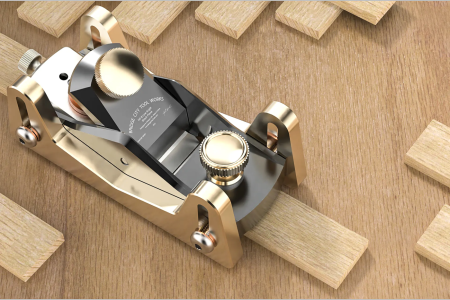
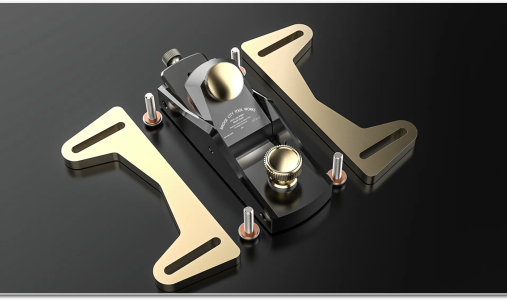
Modeler's thickness sander: Not absolutely essential, but very, very handy for surfacing down thinner wide pieces of modeling wood into sheets. These can also be shop made, but considering what is available from Byrnes, I can't imagine anybody would want any of the other alternative method of getting the job done. I'm guessing these will be running around $400 USD. See: https://byrnesmodelmachines.com/sander5.html Thickness sanders are one modeling power tool that many have made themselves with claimed success. You may want to consider that if you wish. Another option is to hand-plane strip stock to a desired thickness. Bridge City Toolworks makes a sweet modeler's block plane with an attachment for planing stock to exact thickness. It doubles as a regular modeler's block plane which is a tool you'll become attached to rather quickly once you get used to using it and sharpening its iron. Oddly, a lot of people today have litle familiarity with hand planes and instead end up sanding everything to shape which is really not the easiest or most accurate way of doing the job. See: https://bridgecitytools.com/products/hp-8-mini-block-plane This bit of "jewelry" lists for around $130 USD, but is seemingly perpetually discounted, at the moment to $129 USD. I got mine on sale from their website recently for $79 USD. Other less expensive modeler's planes are available, of course, but without the "adjustable skids" attachments for planing to exact uniform thicknesses. Wait for a good sale price and treat yourself!
1767313827400.png
1767313871712.png

These power tools aren't required for scratch building. The same results, albeit with much greater efforts can be realized with hand tools and dimensioned stock from the hobby shop or mail order modeling supply sites, but, in my experience and that of others, these tools pay for themselves rather quickly over time. The modeler's table saw and the thickness sander will probably set you back around a grand, but you can always defer those purchases in the manner described above. You don't have to buy all these tools at once! Aside from the Byrnes Model Machines tools, which are now a "great investment," because Jim Byrnes' passing occasioned a hiatus in the production runs (now reportedly resolved and they're back in production, but you have to phone them to get in line for one,) Used Byrnes saws were at one point selling on eBay for around $1,200 USD! At the moment, I don't think there's a Byrnes machine out there that the owner couldn't easily sell in a hot minute for more than they paid for it. That's about the best recommendation I've ever seen for a product. I know the total cost is daunting, but $1,000 is what a fancy decent kit would cost you, plus the aftermarket upgrades if you wanted to do it up right. These tools enable the modeler to build as many models as he wants not only more easily, but at practically no materials costs at all if he's a capable scrounger.

Any serious craftsman will tell you, always buy the best tool you can afford because the most expensive tools are the ones you have to buy more than once. A good tool that lasts more than a lifetime is a tool that will always hold some, if not all, of its value on the resale market and in some instances will bring several times over its initial cost as time goes on.
 
There are exceptions, but in general scratch tends to get tool heavy. It is possible to get neck deep in tool and material expenses. It would be unfortunate to have spent significant sums of money on something that is abandoned. Nothing about this is anything like an investment.
It is wise to consider anything spent as sunk cost. It is prudent to go in slowly, in small increments, Lots of reading.

As I mentioned in the post above, if one judiciously buys good tools, one can enjoy them and sell them for a reasonable return if they ever find they no longer have a use for them. Moreover, if one keeps an eye out, there are many quite remarkable bargains to be had on used tools in the online classifieds and auction sites. This is especially true of stationary power tools on the local sites. They weigh too much to justify the cost of shipping and there's often not enough profit to be made in moving and storing them, so something like a table saw, band saw, or jig saw can often be had for a couple of hundred bucks at most and, on occasion, even for free, just because somebody wants it out of their garage.

My analysis, however, presumes that one considering the question of tools is sufficiently serious about making a commitment to the pursuit that it is more likely than not that they will get lots of use and enjoyment out of them. It's never wise to overdo it when equipping oneself for an adverture without being sure you'll stay with it or not. On the other hand, I will continue to maintain that if one were to spend $1,500 USD on a fancy ship model kit and got a quarter of the way into it and gave up, they'd take a much greater loss trying to sell that half-finished Victory or Sovereign of the Seas to anybody than they would selling quality used tools!

I can't agree more that this hobby is as much about the acquisition of subject matter knowledge as it is about building models, and perhaps even more so. If anybody asks me, "What are the most essential tools I need for ship modeling?" I always answer, "A research library. Start building one right away and budget to $25 or $50 USD a month on average for used modeling books. After a while you'll have an invaluable resource." It's the library that is the best indicator of a modeler's seriousness. Unfortunately, there is a wide range of quality in the books available, but the silver lining is that there are more of the "classics" on the used market at low prices, so they're easy to come by. Books can get expensive, too, but the essential basics aren't going to max out anybody's credit card. Like good tools, good books can often be sold when no longer needed and can even appreciate considerably if they go out of print while they remain in demand.
 
Last edited:
I got basswood a while back and am wondering If I should make a scratch build the only hard part has been researching something to make. I've found the Royal museum of Greenwich https://www.rmg.co.uk/collections/ to be an good site for Information and one to one examples of every thing ships.
No question that the RMG is a goldmine of subject matter for Napoleonic Era ship models, and then some, but little of it comes with any sort of instruction or commentary. Allan is correct that a simple subject is the wisest first choice. The first thing a scratch builder needs to learn if they don't know already is how a boat or ship is built. How to create an object made up of graceful curves from straight sticks of wood is something that it takes a lot of people some time to wrap their head around.

You might consider looking to the available books on building full-size smaller craft. There are many around and most are reasonably priced. In the small craft range, you don't even need to worry much about scaling. often you can just use whole, half, or quarter inches for feet and you're good to go. A number of great books to take a look at are any of those by John Gardiner, former curator of small craft at Mystic Seaport Museum. See: https://www.bing.com/shop?q=john+ga...-40&sk=&cvid=CAE0012973E440908927BD250ED32BC7

Gardiner's books, variously titled Building Classic Small Craft, Building Classic Small Craft, Volume 2, Small Craft You Can Build, and so on, are full of various small craft with lines drawings, tables of offsets, and full instructions for building them Similarly, there are many now somewhat dated books full of classic boats and yachts that can be built by amateurs. These books will be by John Atkin and William Atkin, frequently found in the MotorBoating Magazine Ideal Series volumes on homebuilt boats. Howard Chapelle's classic books, Boatbuilding and Yacht Planning and Design lay out the basics of construction and design and provide excellent plans. For more ambitious projects, L.Francis Herreshoff's Sensible Cruising Designs has a good number of simple through quite large and famous plans of yachts he designed with full insructions on how to build them, these being reprints from his articles in The Rudder magazine around the time of the Second World War and thereafter. Most of these books are readily available on the online used market for very reasonable prices. Chapelle's books, especially, should be in every ship modeler's reference library for the sake of their lofting and construction instructions, if nothing else.
 
Hello fellow newbie and Sox fan! I can't say I have anywhere near the experience of many of the gentlemen here have have, but I can share some reflectings of my own stumbling around in this hobby. I agree with many others in that ships are not to be taken lightly if you haven't worked with them in the past. But, if you're stubborn, passionate, and thorough, you'll figure it out.

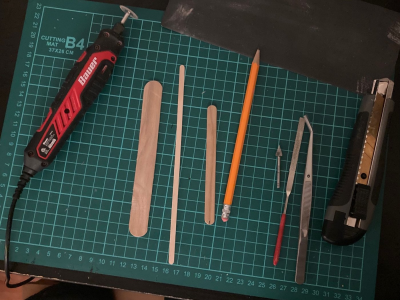
I started with a popcicle stick and dream. Well, perhaps that's an exaggeration, but not much of one. Below were my starter tools and though I've expanded my arsenal a bit since, it's still reserved to small, inexpensive hand tools.

1767328282129.png

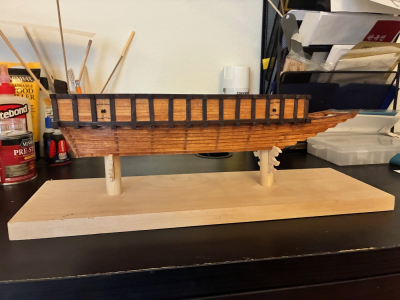
I'm a year into this hobby now, and am still currently working on my first build. I've made more mistakes than I can count, had to start over, made more mistakes, but don't they say failure is the best teacher? And this is where I'm at now.
1767328500952.png
It is perfect? Hell no! Is it half as good as the builds that appear here daily? I wish. Am I close to done? I tell myself I am every week. I joke around about how I'm doing all the time, but ultimately, I'm actually quite proud of what I've been able to achieve so far for a first build and the bare minimum of tools. Even the wood I'm using is cheap basswood from Hobby Lobby, but, hey, I make it work for my budget.

My point is, when you're not sure where to start, just jump in and start building. You'll make mistakes, but you'll learn more from them. But the most important thing I can say is this: choose a ship you love. I cannot emphasize that enough. A ship you're passionate about because, at the end of the day when you want to take everything you've done and chuck it in the trash, that love and passion will be what keeps you going. Anything, from a dingy, a ancient Greek galley, or even an advanced ship-of-the-line. And while you build, research! Youtube has been a great friend when it came to things framing or how to properly shape planks. Articles, books and photos will help you learn more about the ships. And yes, the forums themselves do help as there's always helpful techniques to learn from them.

Forgive my ramblings, but I look forward to seeing on whatever you choose to be your first build!

 
Last edited:
I can’t seem to get the Love function to work, but I love this post.

Kits have always been expensive for me and once I had the means to buy them I realized I didn’t need them. I started building models using basic hand tools and scrap lumber. Unlike your nicely built Korean Warship my initial efforts resulted in some awful models, long since consigned to the trash. But I persevered, and can now produce work that at least satisfies me.

Beginners would do well to learn from your post.

Roger
 
Views on Plank-on-Frame Models Volume 1 and 2 Harold A. Underhill as a useful starting point?

These should be on every modeler's bookshelf. Get both volumes. Somewhat dated in some respects, particularly regarding "modern" kit engineering, e.g.: "plank on bulkhead," etc., but it addresses the basics very well. Anything written by Harold Underhill is worth grabbing. The same goes for Charles Davis. (Davis' books have been reissued by Dover in quality paperback format.) (Shipbuilder's Assistant, etc.) These guys were writing at a time when it was expected that a gentleman had some a priori knowledge of wood and metalworking, but they are entirely applicable for today, especially if you don't want to go down the "power tool rabbit hole" right out of the gate. These guys were building great models using the simplest of hand tools, but, of course, they assumed the average guy knew how to sharpen a pocketknife!

See:

I also consider The Techniques of Ship Modeling, by Gerald Wingrove to be a valuable basic reference work.

See: https://www.bing.com/shop/productpage?q=techniques+of+ship+modeling&filters=scenario:"17"+gType:"12"+gId:"272438835991"+gIdHash:"0"+gGlobalOfferIds:"272438835991"+AucContextGuid:"0"+GroupEntityId:"272438835991"+NonSponsoredOffer:"True"&productpage=true&FORM=SHPPDP&browse=true

Shop around online for these books used. They are frequently available for less than ten bucks each.
 
Hello fellow newbie and Sox fan! I can't say I have anywhere near the experience of many of the gentlemen here have have, but I can share some reflectings of my own stumbling around in this hobby. I agree with many others in that ships are not to be taken lightly if you haven't worked with them in the past. But, if you're stubborn, passionate, and thorough, you'll figure it out.

I started with a popcicle stick and dream. Well, perhaps that's an exaggeration, but not much of one. Below were my starter tools and though I've expanded my arsenal a bit since, it's still reserved to small, inexpensive hand tools.

View attachment 567771

I'm a year into this hobby now, and am still currently working on my first build. I've made more mistakes than I can count, had to start over, made more mistakes, but don't they say failure is the best teacher? And this is where I'm at now.
View attachment 567772
It is perfect? Hell no! Is it half as good as the builds that appear here daily? I wish. Am I close to done? I tell myself I am every week. I joke around about how I'm doing all the time, but ultimately, I'm actually quite proud of what I've been able to achieve so far for a first build and the bare minimum of tools. Even the wood I'm using is cheap basswood from Hobby Lobby, but, hey, I make it work for my budget.

My point is, when you're not sure where to start, just jump in and start building. You'll make mistakes, but you'll learn more from them. But the most important thing I can say is this: choose a ship you love. I cannot emphasize that enough. A ship you're passionate about because, at the end of the day when you want to take everything you've done and chuck it in the trash, that love and passion will be what keeps you going. Anything, from a dingy, a ancient Greek galley, or even an advanced ship-of-the-line. And while you build, research! Youtube has been a great friend when it came to things framing or how to properly shape planks. Articles, books and photos will help you learn more about the ships. And yes, the forums themselves do help as there's always helpful techniques to learn from them.

Forgive my ramblings, but I look forward to seeing on whatever you choose to be your first build!

I have that exact dermal tool.
 
These should be on every modeler's bookshelf. Get both volumes. Somewhat dated in some respects, particularly regarding "modern" kit engineering, e.g.: "plank on bulkhead," etc., but it addresses the basics very well. Anything written by Harold Underhill is worth grabbing. The same goes for Charles Davis. (Davis' books have been reissued by Dover in quality paperback format.) (Shipbuilder's Assistant, etc.) These guys were writing at a time when it was expected that a gentleman had some a priori knowledge of wood and metalworking, but they are entirely applicable for today, especially if you don't want to go down the "power tool rabbit hole" right out of the gate. These guys were building great models using the simplest of hand tools, but, of course, they assumed the average guy knew how to sharpen a pocketknife!

See:

I also consider The Techniques of Ship Modeling, by Gerald Wingrove to be a valuable basic reference work.

See: https://www.bing.com/shop/productpage?q=techniques+of+ship+modeling&filters=scenario:"17"+gType:"12"+gId:"272438835991"+gIdHash:"0"+gGlobalOfferIds:"272438835991"+AucContextGuid:"0"+GroupEntityId:"272438835991"+NonSponsoredOffer:"True"&productpage=true&FORM=SHPPDP&browse=true

Shop around online for these books used. They are frequently available for less than ten bucks each.
Thank you for the book suggestion I'll have to pick this one up.
 
Just remembered another helpful book……

Ship Modelling from Scratch by Edwin B. Leaf

Good basic starting point…hence useful for me as a wanderer in the desert of knowledge!
 
Back
Top