

• Win a Free Custom Engraved Brass Coin!!!
    As a way to introduce our brass coins to the community, we will raffle off a free coin during the month of August. Follow link ABOVE for instructions for entering.
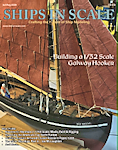
  • PRE-ORDER SHIPS IN SCALE TODAY!

    The beloved Ships in Scale Magazine is back and charting a new course for 2026!
    Discover new skills, new techniques, and new inspirations in every issue.

    NOTE THAT OUR FIRST ISSUE WILL BE JAN/FEB 2026

Help with a museum restoration. Can anyone identify this model?

I agree, Mystic is in a class by itself, although I believe that the Chesapeake Bay Maritime is a close second. I spent 12 years involved volunteering for a preserved historic ship here in the Duluth Harbor. Like most of these historic vessels she suffers from the “bucket list” problem. People passing through town pay a few dollars to visit her, take the guided tour and have no reason to ever visit again. As a result, she never collects enough revenue for serious maintenance.

Mystic is entirely different. There’s always something new to see. For one thing they have an active ship yard busy repairing large wooden vessels. They recently completed repair of the replica of the Mayflower for Plimouth Plantation and are now supposed to be working on the yacht Coronet. The New England Village at Mystic is tastefully done and nicely explains the various trades that supported the regional maritime economy. They have recently added an art museum. When we last visited in 2019 they were hosting a major J.M. Turner Exhibit.

In days when I was better able to travel my wife and I enjoyed visiting Great Britain. Unfortunately we never made it to Bucklers Hard. If it operates on the same principal as Mystic, it would certainly be worth a visit.

Roger
 
Further investigation of the model shows the rigging damage is probably due to rodents. Mice probably, by what they have left behind…..I have by the way also had problems with rats eating the wiring in my campervan, but that is not an issue for this forum.
 
Gerald Wingrove, mentioned above, was responsible for a huge scale model of Bucklers Hard in its heyday that is a prime exhibit in the museum. The detail of the period shipyard and two vessels under construction on the slips has to be seen to be believed. There is incredible detail of all the wood storage and seasoning of the oak trees from the New Forest needed in the period .There is a rather poor picture of it on his website. It can only be appreciated by a visit to the museum.
 
I've been following this thread and have enjoyed all the commentary and seeing how some of it applied to my experiences. I like the depth of your approach, however I have to take exception to ganging Mystic with other museums, historical or otherwise. It's almost as if you had never been there. Let me say this before more chime in on it. Mystic Seaport is presented by serious curators and sailors. I posted one or two pictures from there in my bit on 1/4" scale Elsie. I saw people making masts for sailing ships, I saw a wood shop with two giant thickness planers. I saw boats and ships ready to go sailing tied up at their. docks. There are a few descriptive or demonstrative displays, but the main effort is that it is an historic working seaport. They were just finishing up getting Mayflower 2 ready to sail. after rebuilding the transom and other tasks. I turned to their extensive library for copies of prints and articles when I was digitizing plans for a racing sloop that I had been making half models of for sale in Florida. It may have a theme, but it is by no means a commercial theme park. No rides, no Jesus on the half-shell.

I wasn't intending any criticism of Mystic Seaport. I've been very familiar with Mystic Seaport for decades and follow its activities closely. Yes, I've been there. In fact, I'm more familiar with what Mystic does with its "full scale ship exhibits" than I am with what the more "model centric" maritime museums of the world do with their scale model ship exhibits. While ship modeling has always been an artistic outlet for me, and becoming increasingly so in my retirement years, most of my younger life, both professionally and recreationally, involved the preservation, repair, and care of classic yachts and historic working watercraft, albeit on the West Coast where I grew up with a father in the transpacific maritime shipping business. My wife's family has a compound on the Cape in Truro, but I've rarely been back there, so my exposure to Mystic Seaport, and the Nantucket and New Bedford whaling museums has been as a visitor, rather than a participant.

My reference to Mystic and Buckler's hard as "historic theme parks" emphasized their "historic" character, rather than their "theme park" aspect as that term is also used to describe places like Disneyland! To that list of "historic theme parks" I would add places like the Henry Ford Museum and Greenfield Village in Dearborn, Michigan, Jamestown and Colonial Williamsburg in Virginia, and Columbia, in the California Gold Country. In checking further, I see that many of these institutions refer to themselves as "living-history museums," so... "My bad!"

My point with reference to this particular model for which the museum had no documentation whatsoever and which was not of a quality or apparent provenance justifying any apparent curatorial interest, was simply that the museum should not be marked down for possessing such a model because these "living-history museums" have a much broader focus than the "old fashioned ship model museums" which exhibited large collections of fine art and/or historically important high-quality scale ship models. Ship models in such broad subject matter living-history museums must compete for attention with all the other broad subject matter such museums address. Buckler's Hard has a relatively small museum which features Gerald Wingrove's famous panoramic model of the Buckler's Hard shipyard, but I don't believe it is known beyond that as an old-fashioned maritime museum full of high-quality scale ship models.

In recent times, many maritime museums have transitioned to "interactive" educational exhibits and away from mere passive "artifact displays" more akin to what is still seen with paintings in fine arts museums. I was fortunate to be able to visit a number of these museums before their modification, both in the U.S. and in Europe at the Royal Museum, Greenwich, the Royal Science Museum in London, the Rijksmuseum and the Scheepvaartmuseum in Amsterdam. It was a special joy to be able to spend unlimited time studying large numbers of their models in "happier times" before push-button video loops and "audio guides" elbowed ship models out of scarce exhibit space. From the perspective of a ship modeler and maritime history wonk, these "modernized" maritime museums are almost as if the Rijksmuseum said regarding its Rembrandts or the Van Gogh Museum said regarding its Van Goghs, "We really don't need to hang all of them on the wall. Two or three are enough to get the message across." :(
 
I wasn't intending any criticism of Mystic Seaport. I've been very familiar with Mystic Seaport for decades and follow its activities closely. Yes, I've been there. In fact, I'm more familiar with what Mystic does with its "full scale ship exhibits" than I am with what the more "model centric" maritime museums of the world do with their scale model ship exhibits. While ship modeling has always been an artistic outlet for me, and becoming increasingly so in my retirement years, most of my younger life, both professionally and recreationally, involved the preservation, repair, and care of classic yachts and historic working watercraft, albeit on the West Coast where I grew up with a father in the transpacific maritime shipping business. My wife's family has a compound on the Cape in Truro, but I've rarely been back there, so my exposure to Mystic Seaport, and the Nantucket and New Bedford whaling museums has been as a visitor, rather than a participant.

My reference to Mystic and Buckler's hard as "historic theme parks" emphasized their "historic" character, rather than their "theme park" aspect as that term is also used to describe places like Disneyland! To that list of "historic theme parks" I would add places like the Henry Ford Museum and Greenfield Village in Dearborn, Michigan, Jamestown and Colonial Williamsburg in Virginia, and Columbia, in the California Gold Country. In checking further, I see that many of these institutions refer to themselves as "living-history museums," so... "My bad!"

My point with reference to this particular model for which the museum had no documentation whatsoever and which was not of a quality or apparent provenance justifying any apparent curatorial interest, was simply that the museum should not be marked down for possessing such a model because these "living-history museums" have a much broader focus than the "old fashioned ship model museums" which exhibited large collections of fine art and/or historically important high-quality scale ship models. Ship models in such broad subject matter living-history museums must compete for attention with all the other broad subject matter such museums address. Buckler's Hard has a relatively small museum which features Gerald Wingrove's famous panoramic model of the Buckler's Hard shipyard, but I don't believe it is known beyond that as an old-fashioned maritime museum full of high-quality scale ship models.

In recent times, many maritime museums have transitioned to "interactive" educational exhibits and away from mere passive "artifact displays" more akin to what is still seen with paintings in fine arts museums. I was fortunate to be able to visit a number of these museums before their modification, both in the U.S. and in Europe at the Royal Museum, Greenwich, the Royal Science Museum in London, the Rijksmuseum and the Scheepvaartmuseum in Amsterdam. It was a special joy to be able to spend unlimited time studying large numbers of their models in "happier times" before push-button video loops and "audio guides" elbowed ship models out of scarce exhibit space. From the perspective of a ship modeler and maritime history wonk, these "modernized" maritime museums are almost as if the Rijksmuseum said regarding its Rembrandts or the Van Gogh Museum said regarding its Van Goghs, "We really don't need to hang all of them on the wall. Two or three are enough to get the message across." :(
I am so glad you said all that.
 
Back
Top
