




Vanguard Models kit
Unboxing
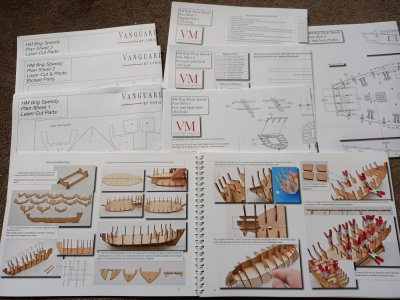
The instructions are clear and comprehensive. A 79 page booklet provides detailed, coloured pictures of all stages of the build with adjacent captions in English. This is easier than having the pictures in one place and instructions on a multi language sheet elsewhere. I don't know what provision is made for those speaking French, German, American etc.
Sheets providing plans of the model and its rigging are also included.
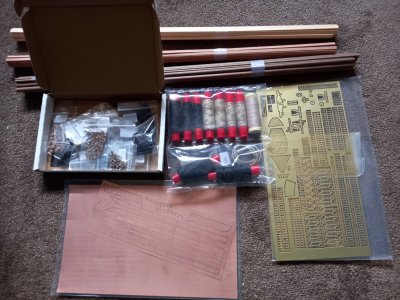
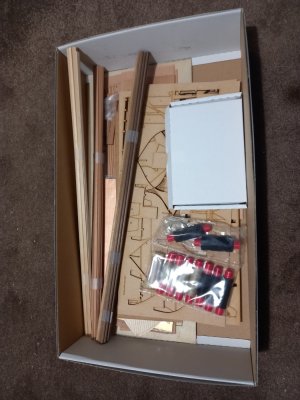
There are bundles of two stage planking strips (5x1mm lime; 0.8x4mm cherry) and spar dowels (mainly walnut) but no other strips
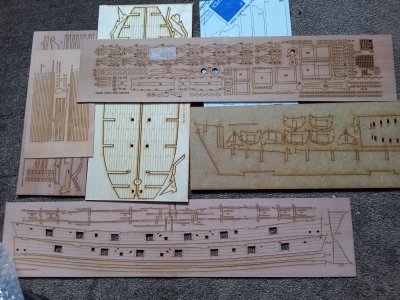
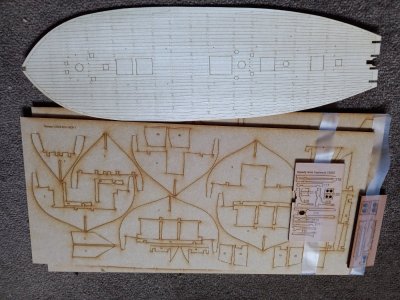
The keel and bulkheads are on laser cut MDF board. This is not nice to work with. Although it is all hidden in the final model it still needs to be processed: shaping the bulkhead edges and removing the laser burn to improve adhesion. MDF dust is carcinogenic.
The deck sheets are pre-printed with planking seams and nails. There are debates elsewhere on the forum about the acceptability of this alternative to user planking. The plywood bulwarks are also presented with marked planking.
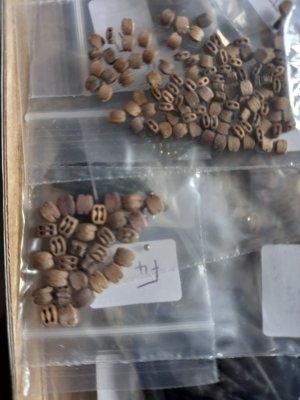
The fittings are all in well labelled bags. I opted for the £40 higher priced version which has nicely shaped rigging blocks. Cannons and anchors are plastic (mmm!); rigging thread looks to be from the Amati stable which is OK. BUT: the ratline thread is white and the instructions describe making it black with ink! Why not supply black thread?
Most of the wooden fittings (eg cross trees, cannon carriages, gratings, pin rails, bitts) are on laser cut sheets of pearwood. This is a pinkish colour and most, it seems, are intended to be painted black. Unpainted walnut would have been better - I don't like painting wood.
A Real downer: belaying pins, eyebolts, deadeye hounds and many other fiddly bits are on sheets of photo-etched brass, These 2D representations of 3D items are really naff. All will need painting. Painting brass with simple paints is not very satisfactory; primer and top coat are really needed to achieve adhesion. Where the vaunted historical accuracy here?
A trivial point: the box appears to be generic - perhaps for a smaller model. The bundles of dowels and primary planking will only fit at an angle. The box is unnecessarily deep and the contents were bulked out with copious bubble wrap.
Apart from the hull planking this seems to be a wooden Revell kit (but pricier) requiring assembly rather than building. I don't think painting and putting ready-cut bits together will be very rewarding.
Unboxing
The instructions are clear and comprehensive. A 79 page booklet provides detailed, coloured pictures of all stages of the build with adjacent captions in English. This is easier than having the pictures in one place and instructions on a multi language sheet elsewhere. I don't know what provision is made for those speaking French, German, American etc.
Sheets providing plans of the model and its rigging are also included.
There are bundles of two stage planking strips (5x1mm lime; 0.8x4mm cherry) and spar dowels (mainly walnut) but no other strips
The keel and bulkheads are on laser cut MDF board. This is not nice to work with. Although it is all hidden in the final model it still needs to be processed: shaping the bulkhead edges and removing the laser burn to improve adhesion. MDF dust is carcinogenic.
The deck sheets are pre-printed with planking seams and nails. There are debates elsewhere on the forum about the acceptability of this alternative to user planking. The plywood bulwarks are also presented with marked planking.
The fittings are all in well labelled bags. I opted for the £40 higher priced version which has nicely shaped rigging blocks. Cannons and anchors are plastic (mmm!); rigging thread looks to be from the Amati stable which is OK. BUT: the ratline thread is white and the instructions describe making it black with ink! Why not supply black thread?
Most of the wooden fittings (eg cross trees, cannon carriages, gratings, pin rails, bitts) are on laser cut sheets of pearwood. This is a pinkish colour and most, it seems, are intended to be painted black. Unpainted walnut would have been better - I don't like painting wood.
A Real downer: belaying pins, eyebolts, deadeye hounds and many other fiddly bits are on sheets of photo-etched brass, These 2D representations of 3D items are really naff. All will need painting. Painting brass with simple paints is not very satisfactory; primer and top coat are really needed to achieve adhesion. Where the vaunted historical accuracy here?
A trivial point: the box appears to be generic - perhaps for a smaller model. The bundles of dowels and primary planking will only fit at an angle. The box is unnecessarily deep and the contents were bulked out with copious bubble wrap.
Apart from the hull planking this seems to be a wooden Revell kit (but pricier) requiring assembly rather than building. I don't think painting and putting ready-cut bits together will be very rewarding.


