


- Joined
- Aug 14, 2018
- Messages
- 924
- Points
- 403
First a short history of HMS Agamemnon
HMS Agamemnon (1906)
HMS Agamemnon was the Royal Navy's last and most powerful pre-dreadnought battleships. Designed by Sir Philip Watts, Director of Naval Construction, under the 1904-05 Naval Estimates, she and her sister ship Lord Nelson represented the final development of the mixed-calibre battleship.
The Lord Nelson class emerged from studies into long-range naval gunnery conducted by Watts and senior naval officers after the turn of the century. The design placed greater emphasis on heavy intermediate guns, carrying ten 9.2-inch guns in addition to the traditional four 12-inch main guns. This gave the class the heaviest secondary armament ever fitted to a British battleship.
Agamemnon was ordered under the 1904-05 Estimates and laid down at William Beardmore's new Dalmuir shipyard on 15 May 1905. Launched on 23 June 1906, her completion was delayed by labour disputes and by the Admiralty's decision to divert some of her 12-inch guns to accelerate construction of the revolutionary HMS Dreadnought. She finally commissioned on 25 June 1908 at a cost of approximately £1.65 million.
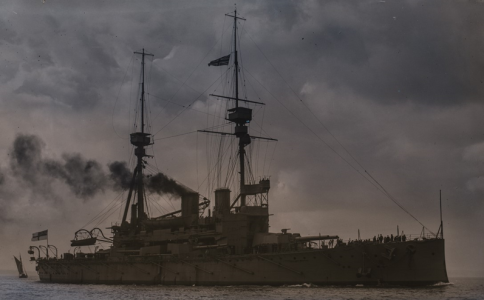
By the time Agamemnon entered service, HMS Dreadnought had already transformed naval warfare with her all-big-gun armament and turbine propulsion. Although exceptionally powerful for her time, Agamemnon belonged to a generation whose dominance had ended before she even joined the fleet.
Up to the First World War she served with the Home Fleet and later the Channel Fleet. Apart from one embarrassing moment in February 1911 when she grazed an uncharted rock in the harbour at Ferrol in Spain and damaged her hull, her pre-war service was uneventful.
When war broke out in August 1914, Agamemnon initially helped protect the passage of the British Expeditionary Force to France. In February 1915 she was ordered to the Mediterranean to participate in the Allied attempt to force the Dardanelles and capture Constantinople.
She joined the opening bombardment of the Ottoman forts on 19 February 1915, becoming one of the principal British battleships engaged in the operation. Working close to shore under heavy enemy fire, she repeatedly attacked the fortifications guarding the entrance to the straits.
On 25 February 1915 she suffered some of the heaviest punishment experienced by any ship in the campaign. Ottoman shore batteries struck her repeatedly during a concentrated engagement, causing casualties and damage to her upperworks, though her armour prevented serious structural harm.
During the great naval assault of 18 March 1915, Agamemnon was again heavily engaged as Allied battleships attempted to force the Narrows. The attack ultimately failed due to mines and accurate Turkish gunfire, leading the Allies to abandon a purely naval solution.
For the remainder of the Gallipoli campaign, Agamemnon provided gunfire support to Allied troops ashore, bombarding trenches, artillery positions and strongpoints around Cape Helles and other sectors of the battlefield. No other Royal Navy battleship spent so much time under fire or expended so much munitions as her during the campaign.
During her service in the eastern Mediterranean, Agamemnon wore one of the Royal Navy's more unusual wartime camouflage schemes. Photographs from the Gallipoli period show irregular light and dark patches painted across her funnels, superstructure and upperworks, the intent was to break up her outline against the hazy backdrop of sea and coastline. Thus, making the ship harder for enemy observers and artillery spotters to identify and range accurately while operating close inshore.
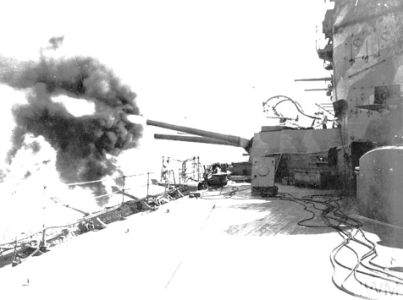
Photographic evidence also indicates that by the time she carried this pattern she had already lost the upper section of her mainmast because of damage sustained during the campaign, giving her a noticeably altered profile from her peacetime appearance.
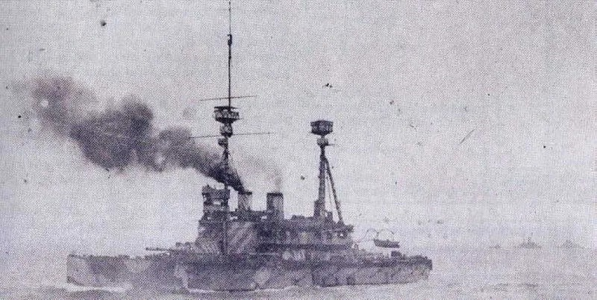
After the evacuation of Gallipoli, Agamemnon remained in the eastern Mediterranean, helping to contain the German battlecruiser Goeben and the cruiser Breslau while supporting Allied operations around Salonika. On the night of 5 May 1916, the German Army Zeppelin LZ 85 carried out a bombing raid against Allied positions at Salonika. As the airship attempted to return to base, it came under anti-aircraft fire from Allied ships, including Agamemnon. The Zeppelin was damaged and forced down near the mouth of the River Vardar, where it crashed and was destroyed. Agamemnon was officially credited as the vessel responsible for bringing down the airship. The destruction of LZ 85 was one of the rare occasions on which a Zeppelin was successfully brought down by naval anti-aircraft fire.
Agamemnon achieved lasting historical significance on 30 October 1918 when Ottoman representatives boarded her while she lay at anchor off Lemnos. There they signed the Armistice of Mudros, ending Ottoman participation in the First World War and effectively concluding the naval struggle in the eastern Mediterranean.
After returning to Britain in 1919, Agamemnon escaped immediate scrapping and was selected for conversion into a radio-controlled target ship. Entering this role in 1921, she became the largest warships in the world to be operated remotely by wireless control. Her steering and machinery were controlled from another vessel, enabling live gunnery trials without exposing a full crew to danger.
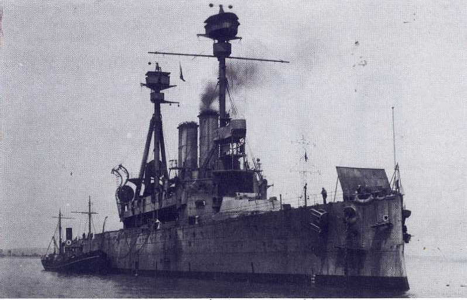
For five years she served as a valuable target for testing naval weapons and fire control systems, contributing to the development of the next generation of Royal Navy battleships.
Agamemnon was sold for scrap in January 1927. At the time of her disposal, she was the last pre-dreadnought battleship still serving in the Royal Navy.
At 1/96 scale Agamemnon’s hull is 1.46 meters long and looks massive compared to the Hobby Boss 1/350 effort, daunting! So where to start?
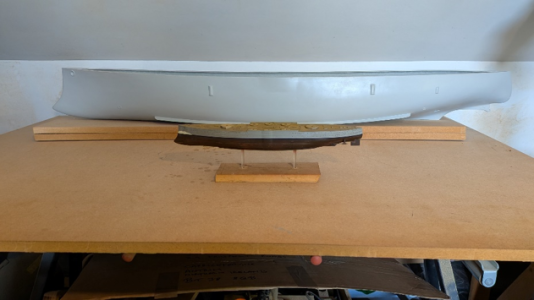
The hull from Fleetscale is a good one, but it is absent of almost all detail, except bilge keel and six trash chutes! These chutes are not in the same place as in my 1908 pics so will have to go.
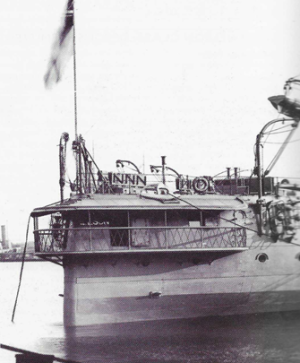 The standout feature of a WW1 Capital Ship’s hull is the stern gallery (handy for the Admiral to splash his boots), as in this pic of Agamemnon’s sister Lord Nelson. Fortunately, like Lord Nelson, Agamemnon’s is quite plane so that is where I have started. I like the idea of using brass for this, so I tried that first. I used a sheet of 0.4mm brass for the floor and rail,0.4 mm tube for the fence and 1mm nickel silver rod for the uprights. Here are some pics of how I got on so far.
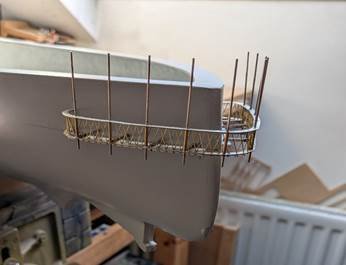
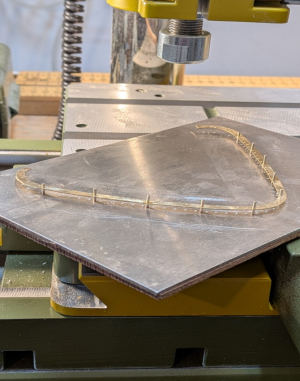
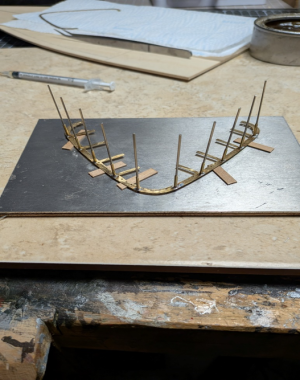
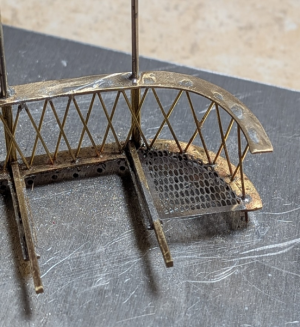
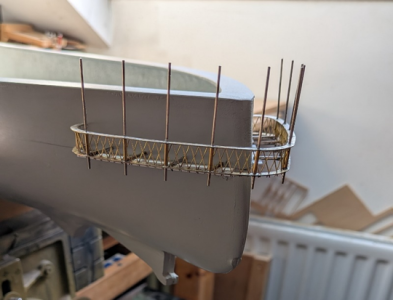
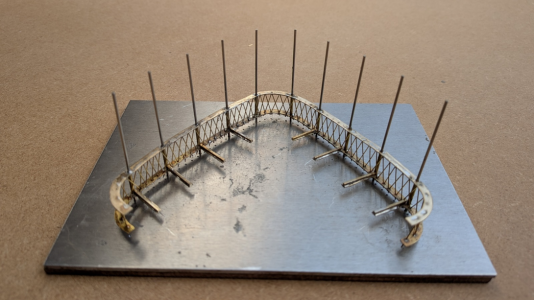
Where the balcony is in this trial sitting is as per JH plans but looks a bit low to me so I will leave the gallery for now until I do some work on the hull. To get a feel for working in 1/96 scale I have also started work on the ship’s boats, starting with the two 50-foot pinnaces I have finished one as a picket boat, the other as an Admiral’s barge as Agamemnon carried in 1908.
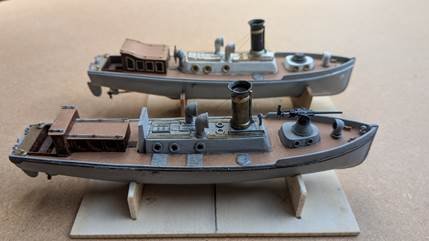
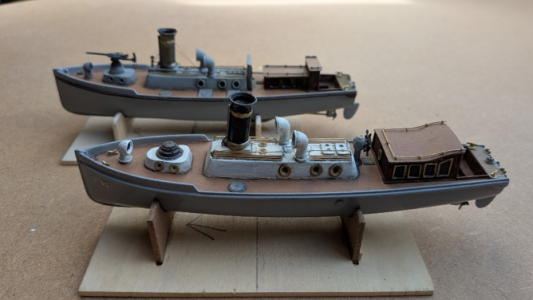
They where made from some cast resin blanks and while not exactly 3D printed, they turned out ok. This build will take me a very long time, but now I have started it is full steam ahead.
Wish me luck, JJ..
HMS Agamemnon (1906)
HMS Agamemnon was the Royal Navy's last and most powerful pre-dreadnought battleships. Designed by Sir Philip Watts, Director of Naval Construction, under the 1904-05 Naval Estimates, she and her sister ship Lord Nelson represented the final development of the mixed-calibre battleship.
The Lord Nelson class emerged from studies into long-range naval gunnery conducted by Watts and senior naval officers after the turn of the century. The design placed greater emphasis on heavy intermediate guns, carrying ten 9.2-inch guns in addition to the traditional four 12-inch main guns. This gave the class the heaviest secondary armament ever fitted to a British battleship.
Agamemnon was ordered under the 1904-05 Estimates and laid down at William Beardmore's new Dalmuir shipyard on 15 May 1905. Launched on 23 June 1906, her completion was delayed by labour disputes and by the Admiralty's decision to divert some of her 12-inch guns to accelerate construction of the revolutionary HMS Dreadnought. She finally commissioned on 25 June 1908 at a cost of approximately £1.65 million.
By the time Agamemnon entered service, HMS Dreadnought had already transformed naval warfare with her all-big-gun armament and turbine propulsion. Although exceptionally powerful for her time, Agamemnon belonged to a generation whose dominance had ended before she even joined the fleet.
Up to the First World War she served with the Home Fleet and later the Channel Fleet. Apart from one embarrassing moment in February 1911 when she grazed an uncharted rock in the harbour at Ferrol in Spain and damaged her hull, her pre-war service was uneventful.
When war broke out in August 1914, Agamemnon initially helped protect the passage of the British Expeditionary Force to France. In February 1915 she was ordered to the Mediterranean to participate in the Allied attempt to force the Dardanelles and capture Constantinople.
She joined the opening bombardment of the Ottoman forts on 19 February 1915, becoming one of the principal British battleships engaged in the operation. Working close to shore under heavy enemy fire, she repeatedly attacked the fortifications guarding the entrance to the straits.
On 25 February 1915 she suffered some of the heaviest punishment experienced by any ship in the campaign. Ottoman shore batteries struck her repeatedly during a concentrated engagement, causing casualties and damage to her upperworks, though her armour prevented serious structural harm.
During the great naval assault of 18 March 1915, Agamemnon was again heavily engaged as Allied battleships attempted to force the Narrows. The attack ultimately failed due to mines and accurate Turkish gunfire, leading the Allies to abandon a purely naval solution.
For the remainder of the Gallipoli campaign, Agamemnon provided gunfire support to Allied troops ashore, bombarding trenches, artillery positions and strongpoints around Cape Helles and other sectors of the battlefield. No other Royal Navy battleship spent so much time under fire or expended so much munitions as her during the campaign.
During her service in the eastern Mediterranean, Agamemnon wore one of the Royal Navy's more unusual wartime camouflage schemes. Photographs from the Gallipoli period show irregular light and dark patches painted across her funnels, superstructure and upperworks, the intent was to break up her outline against the hazy backdrop of sea and coastline. Thus, making the ship harder for enemy observers and artillery spotters to identify and range accurately while operating close inshore.
Photographic evidence also indicates that by the time she carried this pattern she had already lost the upper section of her mainmast because of damage sustained during the campaign, giving her a noticeably altered profile from her peacetime appearance.
After the evacuation of Gallipoli, Agamemnon remained in the eastern Mediterranean, helping to contain the German battlecruiser Goeben and the cruiser Breslau while supporting Allied operations around Salonika. On the night of 5 May 1916, the German Army Zeppelin LZ 85 carried out a bombing raid against Allied positions at Salonika. As the airship attempted to return to base, it came under anti-aircraft fire from Allied ships, including Agamemnon. The Zeppelin was damaged and forced down near the mouth of the River Vardar, where it crashed and was destroyed. Agamemnon was officially credited as the vessel responsible for bringing down the airship. The destruction of LZ 85 was one of the rare occasions on which a Zeppelin was successfully brought down by naval anti-aircraft fire.
Agamemnon achieved lasting historical significance on 30 October 1918 when Ottoman representatives boarded her while she lay at anchor off Lemnos. There they signed the Armistice of Mudros, ending Ottoman participation in the First World War and effectively concluding the naval struggle in the eastern Mediterranean.
After returning to Britain in 1919, Agamemnon escaped immediate scrapping and was selected for conversion into a radio-controlled target ship. Entering this role in 1921, she became the largest warships in the world to be operated remotely by wireless control. Her steering and machinery were controlled from another vessel, enabling live gunnery trials without exposing a full crew to danger.
For five years she served as a valuable target for testing naval weapons and fire control systems, contributing to the development of the next generation of Royal Navy battleships.
Agamemnon was sold for scrap in January 1927. At the time of her disposal, she was the last pre-dreadnought battleship still serving in the Royal Navy.
At 1/96 scale Agamemnon’s hull is 1.46 meters long and looks massive compared to the Hobby Boss 1/350 effort, daunting! So where to start?
The hull from Fleetscale is a good one, but it is absent of almost all detail, except bilge keel and six trash chutes! These chutes are not in the same place as in my 1908 pics so will have to go.
The standout feature of a WW1 Capital Ship’s hull is the stern gallery (handy for the Admiral to splash his boots), as in this pic of Agamemnon’s sister Lord Nelson. Fortunately, like Lord Nelson, Agamemnon’s is quite plane so that is where I have started. I like the idea of using brass for this, so I tried that first. I used a sheet of 0.4mm brass for the floor and rail,0.4 mm tube for the fence and 1mm nickel silver rod for the uprights. Here are some pics of how I got on so far. Where the balcony is in this trial sitting is as per JH plans but looks a bit low to me so I will leave the gallery for now until I do some work on the hull. To get a feel for working in 1/96 scale I have also started work on the ship’s boats, starting with the two 50-foot pinnaces I have finished one as a picket boat, the other as an Admiral’s barge as Agamemnon carried in 1908.
They where made from some cast resin blanks and while not exactly 3D printed, they turned out ok. This build will take me a very long time, but now I have started it is full steam ahead.
Wish me luck, JJ..