

• Win a Free Custom Engraved Brass Coin!!!
    As a way to introduce our brass coins to the community, we will raffle off a free coin during the month of August. Follow link ABOVE for instructions for entering.
  • SUBSCRIBE TO SHIPS IN SCALE TODAY!

    The beloved Ships in Scale Magazine is back and charting a new course for 2026!
    Discover new skills, new techniques, and new inspirations in every issue.

    NOTE THAT OUR NEXT ISSUE WILL BE MARCH/APRIL 2026

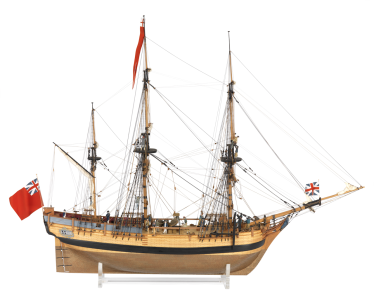
HMS BOUNTY (Artesania Latina)

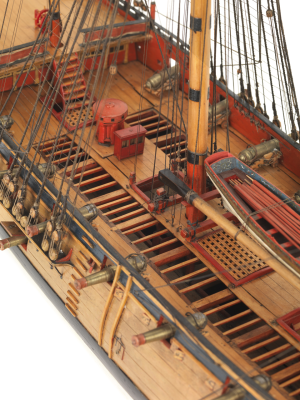
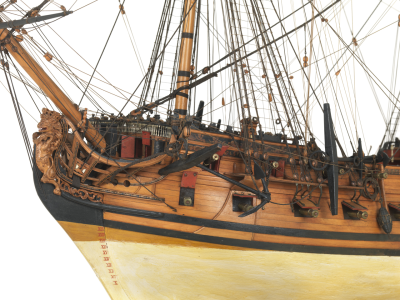
There were variations throughout the fleet for many things, but from what I could find, the following was probably the norm.
Masts were usually made of pine or spruce and treated with preservative treatments like Stockholm tar. While the hull was painted, the navy rarely authorized painting the wooden masts themselves during this period.
There are hundreds, if not thousands of photos of rigged models on the RMG Collections website for some ideas on what was done. A couple examples are below
Allan

1776938990842.png
1776939190459.png
 
Great progress, Patrick!

I think the colour of the deck planking goes well with the rest of the hull. Well done!
I’d be careful about painting the masts and yards completely black, as your hull already has a lot of black on it.

I’m looking forward to seeing your work on the rigging!
 
Great progress, Patrick!

I think the colour of the deck planking goes well with the rest of the hull. Well done!
I’d be careful about painting the masts and yards completely black, as your hull already has a lot of black on it.

I’m looking forward to seeing your work on the rigging!
Hoi Erik,
After some thinking... my idea too.
I've also think that painting everything black would be a bit too much... I'll definitely just varnish the masts.
To be continued..

Patrick
 
There were variations throughout the fleet for many things, but from what I could find, the following was probably the norm.
Masts were usually made of pine or spruce and treated with preservative treatments like Stockholm tar. While the hull was painted, the navy rarely authorized painting the wooden masts themselves during this period.
There are hundreds, if not thousands of photos of rigged models on the RMG Collections website for some ideas on what was done. A couple examples are below
Allan


View attachment 594044
View attachment 594045
Thanks for the nice pictures, love the details.... I know these modelbuilding is not my league I justly to do my best :rolleyes: and enjoy my hobby...
Patrick
 
enjoy my hobby..

The models from RMG are far beyond what 99.99% of us do, but I bet we enjoy it as much or more as those teams of master builders did. It is my understanding that they were usually built by teams of artisans so at least we can say "I built this model" rather than "We each built some parts of this model"

Allan
 
I'm starting on the masts, I'm not sure what colors they will get... I think I'll follow photos where the yards are black, with white ends, the masts with black tops. (or totally black?)
The bowsprit and cap black.
The unpainted parts are varnished.
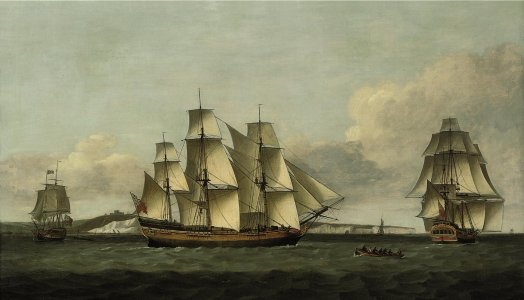
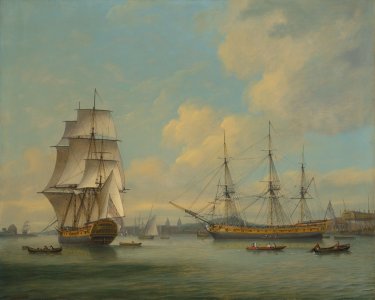
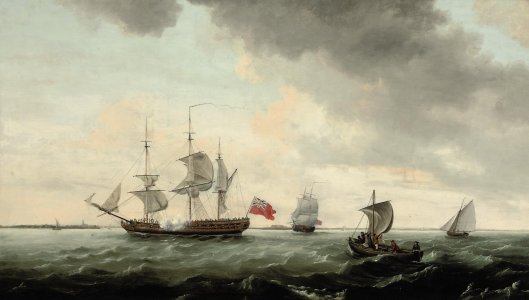
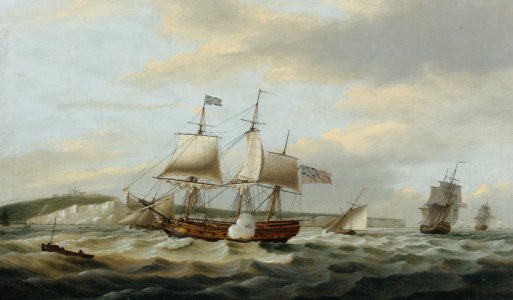
Dear Patrick, good afternoon! To get an idea of the paint schemes of English ships from the 1870s to 1790s, just look at the marine paintings of those years.
English ships in the 1780s had a standard paint scheme.

Red paint is iron minium, which protects wood and iron from seawater and also serves as a heat-resistant coating. Red iron minium was used to coat the structural elements of a ship's hull, the inside of its sides, gun ports, and gun mounts.
Black paint was made from carbon black. This paint was distinguished by its high wear resistance, making it the preferred paint for the lower hull and gunwale. It was also used to coat the tops of masts and topmasts.
White paint was made from lead white and was rarely used in the 1780s.
The primary paint used to coat the ship's hull and masts was dark yellow mineral ochre. This paint was not only durable but also provided excellent protection from seawater.
Yellow paint—usually a pale mineral ochre mixed with lead white. It was intended for painting decorative elements and sculptures. This paint was also used to imitate gold on figureheads.

The Bounty had a standard paint scheme for its hull and masts, exactly the same as in contemporary paintings.

Thomas_Luny_-_The_British_merchantman_Tyson_in_three_positions_off_Dover,_in-bound_for_London_...jpg
Thomas_luny_an_east_indiaman_in_two_positions_off_deptford_dockyard_wi055156) (1).jpg
Thomas_Luny_-_A_Royal_Navy_frigate_signalling_her_arrival_off_Harwich_(1777) (1).jpg
Thomas_Luny_-_A_merchant_ship_signaling_for_a_pilot_off_the_cliffs_of_Dover.jpg
 
Back
Top