- Joined
- Dec 30, 2024
- Messages
- 23
- Points
- 48

![]() |
As a way to introduce our brass coins to the community, we will raffle off a free coin during the month of August. Follow link ABOVE for instructions for entering. |
![]() |
![]() |
The beloved Ships in Scale Magazine is back and charting a new course for 2026! Discover new skills, new techniques, and new inspirations in every issue. NOTE THAT OUR NEXT ISSUE WILL BE MARCH/APRIL 2026 |
![]() |


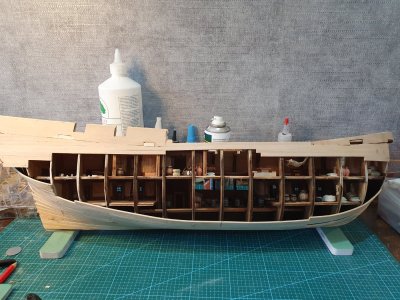
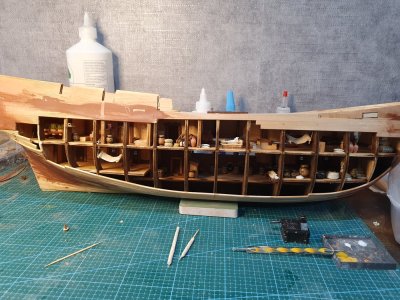
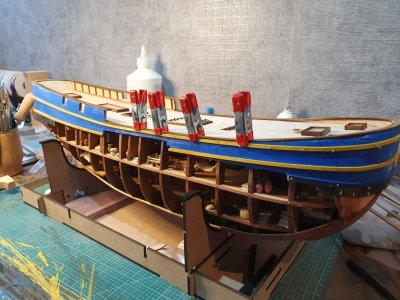
There's alot of space in the great cabin that is only being used for the bread plants, I'm thinking of putting a captains cabin in there, but not 100%Welcome aboard. Very nice work (really like the stove). Look forward to seeing your continues progress. Have been reading through the entire Hornblower series (C.S. Forester) and the Bounty certainly has more space than what those books describe - even for a Captain's cabin.

Patience is key for me, to long at the bench and I tend to start rushingAmazing, great job. I have just done my first six planks on a smaller first build today and it is fiddly. Had to use the electric plank bender but soaked the planks first in water.
Unfortunately do not have more than a couple of hours at anyone time to build the ship, but its rewarding.
Love your work


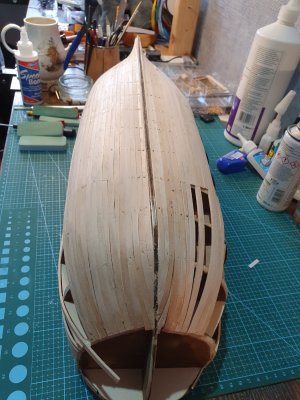
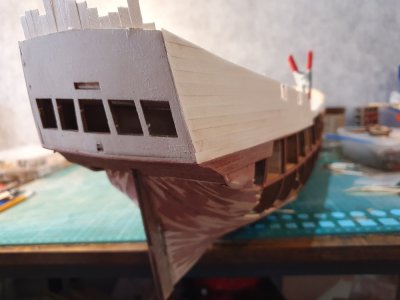
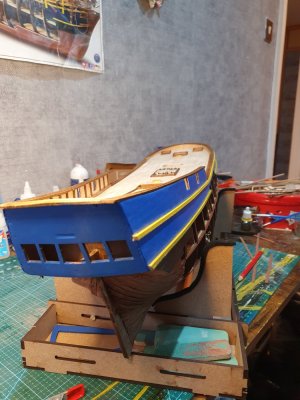
As a rule of thumb, planks which need to be narrowed toward the bow should not be reduced before half the full plank width. Assuming this model is double plank construction, the nailheads you see are pin heads necessary to hold the first layer of planking to the bulkheads or frames. All of the planking you currently see has only one purpose at this point, to form the shape of the hull, not look pretty. You can leave the pins in place, filll holes with scraps, and not lay the planks in the proper pattern for a ship's hull. It doesn't matter, as long as you can sand the hull to the proper and smooth shape The second, final layer is made of a good hardwood veneer, and is laid in a pattern that simulates the pattern used on ship hulls of the period. This layer may show trenails in the proper patterns used to hold planks to the frames on the real ship, joints arranged in the proper patterns, and planks narrowed to converge at the bow, and use of drop planks to further narrow the pattern there. At the stern, gaps which form as the planking need to expand beyond full width of a plank are filled using stealers.It’s coming along really well Steve, looking at the stern I see that you have done a lot of sanding. The starboard and port sides are full plank width at the bottom but taper to almost nothing at the topsides, presumably thats what the instructions say and I notice that there are no nails on the side. Is that intentional ?
I am in my first build so these questions might be obvious to experienced modellers

Thanks for the I depth reply, much appreciated, I know I'm making mistakes as I go, but enjoying the rectification process.As a rule of thumb, planks which need to be narrowed toward the bow should not be reduced before half the full plank width. Assuming this model is double plank construction, the nailheads you see are pin heads necessary to hold the first layer of planking to the bulkheads or frames. All of the planking you currently see has only one purpose at this point, to form the shape of the hull, not look pretty. You can leave the pins in place, filll holes with scraps, and not lay the planks in the proper pattern for a ship's hull. It doesn't matter, as long as you can sand the hull to the proper and smooth shape The second, final layer is made of a good hardwood veneer, and is laid in a pattern that simulates the pattern used on ship hulls of the period. This layer may show trenails in the proper patterns used to hold planks to the frames on the real ship, joints arranged in the proper patterns, and planks narrowed to converge at the bow, and use of drop planks to further narrow the pattern there. At the stern, gaps which form as the planking need to expand beyond full width of a plank are filled using stealers.
If the model is supposed to be made with a single layer of planks, it is more challenging in that the planking needs to be in the proper pattern AND form the hull shape, with no gaps between planks, proper narrowing at the bow and expansion using stealers at the stern, etc. Large pinheads are to be avoided, replaced with smaller markings or micro-thin pegs to simulate trenails or iron nails.
If you are on your first model, getting all the details right is a serious challenge not only in construction, but time spent researching the features of how a planked hull should appear. Reading is imperative. If you are on your first ship, you are occupied with getting the basics down, mistakes will be made, and simplifications of the details used in order to complete the first model as you train your hands and gain experience. You don't merely build a supremely great model and that's that. You build a series of models which improve in surprisingly great amounts. After about three models, you will be amazed at what you can do.


There will be some in the finished model, having trouble finding some miniature plants that look like the real thing, just got some grass in the pots for nowVery nice Steven, IMHO I would include the "bread plants". I just think with all the other tiny details you have created it would be a shame not to have the plants. Just a thought?


Thank you for your reply to my post. I clearly do not know enough and yes I have made several mistakes on my first model which is the Polaris by OcCre. I need to correct them before I try and fit the second planks. You have used several terms I am not familiar with so will have to research them to find what they mean. I know the first layer of planks will not be seen but I have very many nail heads that I need to get flat, presumably by filing and lots of sanding. I will persevere and try to sort out the problems I have created for myself, plus I am not in a hurry.As a rule of thumb, planks which need to be narrowed toward the bow should not be reduced before half the full plank width. Assuming this model is double plank construction, the nailheads you see are pin heads necessary to hold the first layer of planking to the bulkheads or frames. All of the planking you currently see has only one purpose at this point, to form the shape of the hull, not look pretty. You can leave the pins in place, filll holes with scraps, and not lay the planks in the proper pattern for a ship's hull. It doesn't matter, as long as you can sand the hull to the proper and smooth shape The second, final layer is made of a good hardwood veneer, and is laid in a pattern that simulates the pattern used on ship hulls of the period. This layer may show trenails in the proper patterns used to hold planks to the frames on the real ship, joints arranged in the proper patterns, and planks narrowed to converge at the bow, and use of drop planks to further narrow the pattern there. At the stern, gaps which form as the planking need to expand beyond full width of a plank are filled using stealers.
If the model is supposed to be made with a single layer of planks, it is more challenging in that the planking needs to be in the proper pattern AND form the hull shape, with no gaps between planks, proper narrowing at the bow and expansion using stealers at the stern, etc. Large pinheads are to be avoided, replaced with smaller markings or micro-thin pegs to simulate trenails or iron nails.
If you are on your first model, getting all the details right is a serious challenge not only in construction, but time spent researching the features of how a planked hull should appear. Reading is imperative. If you are on your first ship, you are occupied with getting the basics down, mistakes will be made, and simplifications of the details used in order to complete the first model as you train your hands and gain experience. You don't merely build a supremely great model and that's that. You build a series of models which improve in surprisingly great amounts. After about three models, you will be amazed at what you can do.

You don't need to pull the pins from the first planking layer, buut you should push the heads in an submerge them. You don't need to fill in the holes or depressions from pinheads either. Just use filler for filling low spots and flat spots in the hull. Good that you're not hurrying. The hull will be truly great.Thank you for your reply to my post. I clearly do not know enough and yes I have made several mistakes on my first model which is the Polaris by OcCre. I need to correct them before I try and fit the second planks. You have used several terms I am not familiar with so will have to research them to find what they mean. I know the first layer of planks will not be seen but I have very many nail heads that I need to get flat, presumably by filing and lots of sanding. I will persevere and try to sort out the problems I have created for myself, plus I am not in a hurry.
Thanks for your very helpful post