


I have described the unboxing of this kit in a kit review. I expressed a few reservations and will now see how I get on with building it.
Frames
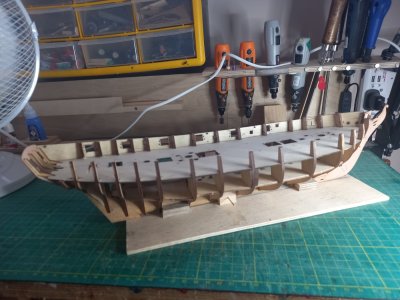
The keel and bulkheads are very accurately cut from MDF. They fitted together easily but firmly with no need for trimming. Longitudinal stringers either side of the keel are cross-halved into the top of the bulkheads to strengthen the structure and support the deck. The edges of the lower deck have slots to receive the bulkhead extension; these too were accurately cut.
There is a false upper deck that is ultimately covered by a second layer with pre-printed planking. The deck is cambered. The edges are held down by fitting into notches in the bulkhead extensions and the centre pushed up by the curvature of the deck beams. Very effective
In summary: this stage of the build went very smoothly to produce a robust skeleton on which to build.
Bulwarks
The outer surface is created with pieces pre-cut from 1mm plywood. A useful pair of lines are etched on their inner surface to mark their interaction with the deck. From the stern as far as bulkhead 6 these made good contact with the bulkhead extensions. From bulkhead 6 to the stem I encountered problems.
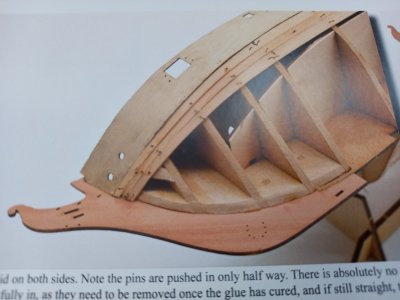
The bulkheads curve inwards above and below the deck level so the bulwarks are effectively curved about a horizontal line at the deck edge. The edge of the deck curves to the stem so the bulwarks are curved about a vertical axis. One cannot simultaneously bend plywood about two orthogonal axes! The net effect is for the bulwarks to flare outwards below the deck level by following a downward extrapolation of the tumble home. An attempt to mitigate this with pins did not achieve anything: a pin pushed into the edge of MDF is about as secure as trying to stand a fork in a bowl of porridge.
It is clear that the same problem was encountered in the “professional” build used to illustrate the instruction book. One picture shows the lower bulwark edge protruding outboard of the first planking strip; another shows the bulwark edge virtually sanded away.
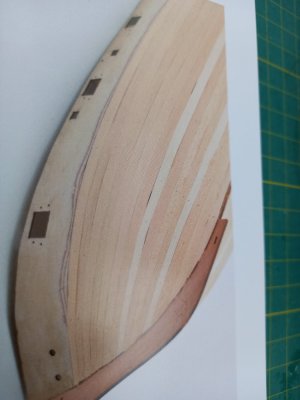
I tried to remove the portion of the bulwark that makes no contact with the bulkhead but this was a disaster: the poor quality plywood delaminated and splintered.
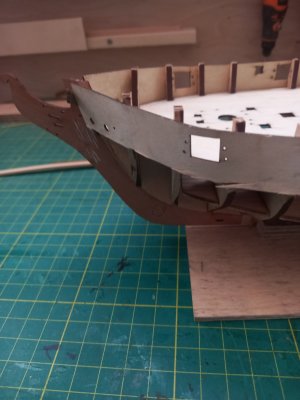
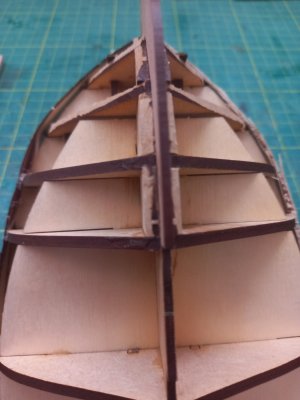
In the end I decided to remove the section of bulwark forward of bulkhead 6 and replace it with a redesigned piece cut from superior quality birch plywood.
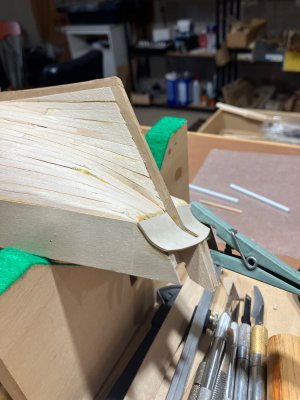
It transpired that the few spots of PVA glue holding the inner surface of the plywood to the edges of the bulkheads formed a better bond than that between the plywood layers over a much greater area. Was the cheap plywood of the kit made with wallpaper paste? This picture shows the inner layer of plywood still attached.
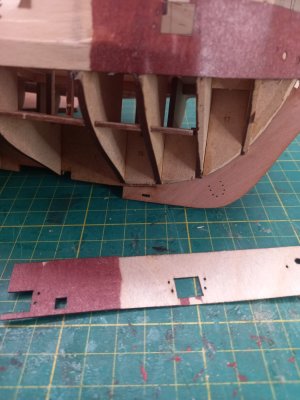
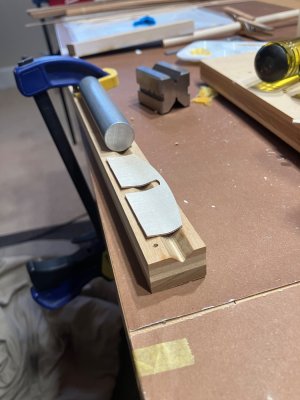
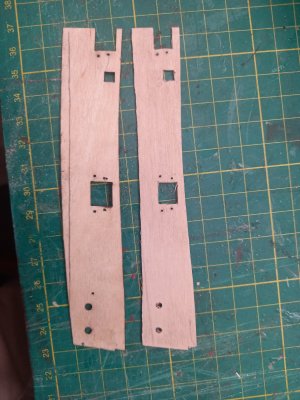
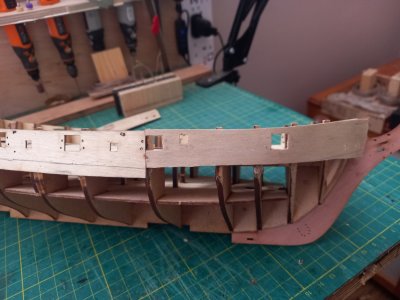
The pictures below show the new and old sections of bulwark and the new section fitted to the hull. The continuity of the line along the bottom of the bulwarks can be restored with two short planks. (why does that last sentence bring to mind the design of the original bulwarks?). The pencil line on the aft section of bulwark suggests where it could have been cut so that it stopped just below deck level with no disadvantage other than requiring one more plank. I Now need to repeat this process on the port side
Frames
The keel and bulkheads are very accurately cut from MDF. They fitted together easily but firmly with no need for trimming. Longitudinal stringers either side of the keel are cross-halved into the top of the bulkheads to strengthen the structure and support the deck. The edges of the lower deck have slots to receive the bulkhead extension; these too were accurately cut.
There is a false upper deck that is ultimately covered by a second layer with pre-printed planking. The deck is cambered. The edges are held down by fitting into notches in the bulkhead extensions and the centre pushed up by the curvature of the deck beams. Very effective
In summary: this stage of the build went very smoothly to produce a robust skeleton on which to build.
Bulwarks
The outer surface is created with pieces pre-cut from 1mm plywood. A useful pair of lines are etched on their inner surface to mark their interaction with the deck. From the stern as far as bulkhead 6 these made good contact with the bulkhead extensions. From bulkhead 6 to the stem I encountered problems.
The bulkheads curve inwards above and below the deck level so the bulwarks are effectively curved about a horizontal line at the deck edge. The edge of the deck curves to the stem so the bulwarks are curved about a vertical axis. One cannot simultaneously bend plywood about two orthogonal axes! The net effect is for the bulwarks to flare outwards below the deck level by following a downward extrapolation of the tumble home. An attempt to mitigate this with pins did not achieve anything: a pin pushed into the edge of MDF is about as secure as trying to stand a fork in a bowl of porridge.
It is clear that the same problem was encountered in the “professional” build used to illustrate the instruction book. One picture shows the lower bulwark edge protruding outboard of the first planking strip; another shows the bulwark edge virtually sanded away.
I tried to remove the portion of the bulwark that makes no contact with the bulkhead but this was a disaster: the poor quality plywood delaminated and splintered.
In the end I decided to remove the section of bulwark forward of bulkhead 6 and replace it with a redesigned piece cut from superior quality birch plywood.
It transpired that the few spots of PVA glue holding the inner surface of the plywood to the edges of the bulkheads formed a better bond than that between the plywood layers over a much greater area. Was the cheap plywood of the kit made with wallpaper paste? This picture shows the inner layer of plywood still attached.
The pictures below show the new and old sections of bulwark and the new section fitted to the hull. The continuity of the line along the bottom of the bulwarks can be restored with two short planks. (why does that last sentence bring to mind the design of the original bulwarks?). The pencil line on the aft section of bulwark suggests where it could have been cut so that it stopped just below deck level with no disadvantage other than requiring one more plank. I Now need to repeat this process on the port side