• Ships of Scale has incorportated an extra level of security when you log In. Please follow on-screen prompts to acknowledge that you are not a robot via a "Check Box" or a "Pictorial Check Box Puzzle". This is needed due to higher level of AI Activity Security.
  • SUBSCRIBE TO SHIPS IN SCALE TODAY!

    The beloved Ships in Scale Magazine is back and charting a new course for 2026!
    Discover new skills, new techniques, and new inspirations in every issue.

    NOTE THAT OUR NEXT ISSUE WILL BE July/August 2026
  • Win a Free Custom Engraved Brass Coin!!!
    As a way to introduce our brass coins to the community, we will raffle off a free coin during the month of August. Follow link ABOVE for instructions for entering.

I finally managed to build my vertical rope maker.

I’ve already posted photos of my vertical jig in the *Saint Philip* build thread. I took the path of least resistance and built it using Lego parts. I’m quite pleased with the result. For the thread, I used Gütermann 240 (shade 722, light beige) and 682 (brownish-black) for the standing rigging, along with some Russian-made polyester thread—though the specific manufacturer is unknown, as I simply found it in my wife's stash.
View attachment 637834
View attachment 637835

View attachment 637836View attachment 637837
View attachment 637840
The motor and the battery pack—which also serves as the control unit—come from a Chinese Lego-compatible set. These Chinese motors are more powerful and have a higher RPM, handling the task perfectly. Plus, the remote control feature is very convenient, and the battery lasts a long time.
View attachment 637838
Hi Etwas_63,
Your machine looks fantastic too, and best of all, you achieved the results you were hoping for. The ropes look great; I’ll check out the threads you use to see if I can spot the difference. I love the beige one, this color looks incredibly realistic. Thanks for your comments and for sharing your experiences; that’s what these forums are all about.
 
Question: so ideally, we choose one pinion spur gear with three or four larger in diameter spur gear with same module and bore number ? Only number of tooth will vary for these two set?

And I do not found brass spur gear, only pinion spur gear. In my head, the pinion spur gear is smaller in diameter and can be used as the central gear of the mechanism?

Sorry, I must be dummy.
 
Thank you for your review of the Domanov machine. I was contemplating buying one but will now pass on that purchase and build one like yours.
It’s so unfortunate that you had to go through that experience.
Could you please share information on the gears you are using?
If you could provide the sizes I would 3d print my own.
Thanks again for sharing your experience and wonderful build.
 
Question: so ideally, we choose one pinion spur gear with three or four larger in diameter spur gear with same module and bore number ? Only number of tooth will vary for these two set?

And I do not found brass spur gear, only pinion spur gear. In my head, the pinion spur gear is smaller in diameter and can be used as the central gear of the mechanism?

Sorry, I must be dummy.
You can keep the gears all the same if they are big enough to fit to eachother or you make the middle gear bigger.

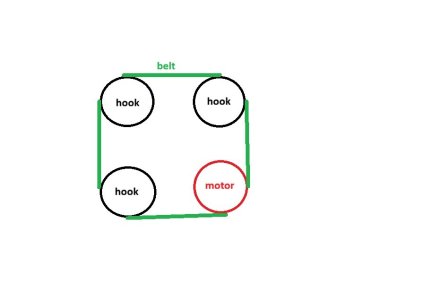
The parts I showed are T-belt gears. You can fit the motor on one of them and the others on the hooks. The belt around them to let them all go the same direction. The noise will be less with them. Gears make more noise.
 
One thing with the MARA, since it is made of strands, you have to be careful which way you turn the head. I can't remember if it's clockwise or counterclockwise that is needed.

so no luck with the PL4. It's interesting that you mentioned that. Is it because there is no easy way to control the tension?

But rather than talking I should go ahead and try to make some ropes with my ropewalk.
 
You can keep the gears all the same if they are big enough to fit to eachother or you make the middle gear bigger.

The parts I showed are T-belt gears. You can fit the motor on one of them and the others on the hooks. The belt around them to let them all go the same direction. The noise will be less with them. Gears make more noise.
Hi, Stephan. I Haven difficulté to figure out how to use 3 external T-Gear around a central one since Theys are made for belt Drive action. Could you please explain à litte but more. Thanks

Edit. After reading your post gain, may be use only four external Gears ans use one of them tobtheo attach motor ?


Michel
 
Last edited:
Hi, Stephan. I Haven difficulté to figure out how to use 3 external T-Gear around a central one since Theys are made for belt Drive action. Could you please explain à litte but more. Thanks

Edit. After reading your post gain, may be use only four external Gears ans use one of them tobtheo attach motor ?


Michel
For a 3 hook ropewalk buy 4 T-gears (all the same) and a belt in the correct distance. Make sure the boring is correct for the motor and for the hooks. And then like the drawing I made. Hope that makes sence.

belt.jpg
 
One thing with the MARA, since it is made of strands, you have to be careful which way you turn the head. I can't remember if it's clockwise or counterclockwise that is needed.

so no luck with the PL4. It's interesting that you mentioned that. Is it because there is no easy way to control the tension?

But rather than talking I should go ahead and try to make some ropes with my ropewalk.
Only when you use 1 yarn per strand. Then you turn LH. Even with Skala 360 is is a problem when you turn rope in the RH position (hawser) with one yarn. But with 2 yarns or more the problem is gone. That's because when you start turning with only one yarn (RH), it will unravel and then looses its strenght and it becomes longer first before getting shorter.
 
Only when you use 1 yarn per strand. Then you turn LH. Even with Skala 360 is is a problem when you turn rope in the RH position (hawser) with one yarn. But with 2 yarns or more the problem is gone. That's because when you start turning with only one yarn (RH), it will unravel and then looses its strenght and it becomes longer first before getting shorter.

Don't get me wrong please, but I like to mention that I don't have any problems with Skala or Mara and one yarn per strand to do it RH. So it might be a matter of individual experience and/or handling and/or machine :-)
 
I use MARA and twist right hand. Yes, you are un-twisting the threads, and there is some slack at first, but it is quickly taken up.
Un-twisting the threads actually increases the tension on the strands which results in a tighter lay in the end.
 
My expience is that the yarn quicker breaks under tension. I always use a lot of weight. And when that doesn't happen and I look to the yarn under the magnifier there are wrong parts in the rope. So if you make rope and you experience that too, turn it LH.
 
Question: so ideally, we choose one pinion spur gear with three or four larger in diameter spur gear with same module and bore number ? Only number of tooth will vary for these two set?

And I do not found brass spur gear, only pinion spur gear. In my head, the pinion spur gear is smaller in diameter and can be used as the central gear of the mechanism?

Sorry, I must be dummy.
Hi.
There is always a difference; the mechanics work the way they do due to several factors. For instance, I chose a small central drive gear because it represents the classic configuration for speed reduction while multiplying force (torque). The central gear has to make several rotations for the side gears to complete just one which makes sense, but this significantly boosts the output torque across the three side gears, resulting in better winding and tensioning of the cord. The three side wheels will spin much more slowly than the central gear; naturally, if the central gear turns clockwise, the three side gears will simultaneously turn in the opposite direction. This is where you need to decide whether you are creating an "S" or "Z" twist, but the most important thing is that the motor operates under less strain, benefiting from a mechanical advantage thanks to the gear ratio.
On the other hand, if you choose a setup with four gears of equal size, the force and speed remain constant (a 1:1 ratio). Since they have the same number of teeth as the side gears, there is no gain in force or loss in speed; the RPM and force delivered by the motor remain unchanged. Steff might be right that gears generate more noise of course, though it doesn't bother me much, and I don't think the noise level is excessive, but using a belt drive would certainly be quieter. Another important detail is that all the gears have the same center bore diameter; since the motor has a 4mm shaft, I decided to make everything 4mm. I bought a brass rod d=4mm, cut it into three pieces of the desired length, and drilled a hole at the bottom to hang the hooks where the threads would later be tied. I also added a brass sleeve with a 4mm inner diameter and 7mm outer diameter, to improve friction and prevent the wheel shaft from making direct contact with the Plexiglas plate.
 
Well, I can work from sketches and measurements, being a retired engineer myself.
Spanish, not so much, but numbers and arrows would be good. I can make up cad models, and offer them here for free. I will possibly even try 3d printing them. If that works, then I can provide STL or STEP files.
If that’s okay, dm me!
 
Thank you for your review of the Domanov machine. I was contemplating buying one but will now pass on that purchase and build one like yours.
It’s so unfortunate that you had to go through that experience.
Could you please share information on the gears you are using?
If you could provide the sizes I would 3d print my own.
Thanks again for sharing your experience and wonderful build.
I think I’ve saved a fellow hobbyist today! ROTFHonestly, my friend, it’s not just me, many friends who’ve commented on my various posts have gone through the exact same thing; they ended up getting frustrated and either buying or like me building their own machines. That whole Domanov design sounds great, but in practice, it’s a piece of garbage. Here are the details on the gears: I bought them on AliExpress, but you have to be careful which ones you pick. I made some mistakes and had to send a few back to the seller. I finally bought solid brass the ones with a 4mm bore and 20 and 47 teeth, that’s the gear setup I’m using in my machine.
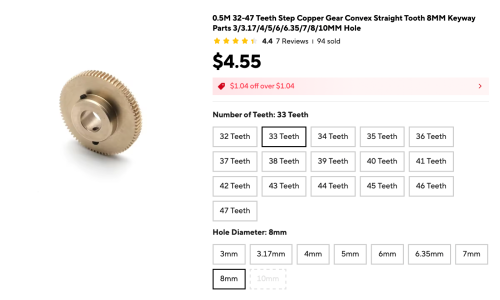
Screenshot 2026-09-20 at 5.39.35 PM.png
 
Back
Top