



• Ships of Scale has incorportated an extra level of security when you log In. Please follow on-screen prompts to acknowledge that you are not a robot via a "Check Box" or a "Pictorial Check Box Puzzle". This is needed due to higher level of AI Activity Security.
  • SUBSCRIBE TO SHIPS IN SCALE TODAY!

    The beloved Ships in Scale Magazine is back and charting a new course for 2026!
    Discover new skills, new techniques, and new inspirations in every issue.

    NOTE THAT OUR NEXT ISSUE WILL BE July/August 2026
  • Win a Free Custom Engraved Brass Coin!!!
    As a way to introduce our brass coins to the community, we will raffle off a free coin during the month of August. Follow link ABOVE for instructions for entering.

I have a question on models.

Apparently you have to buy the LIST of plans first, so you know what they have available: Smithsonian Ship Plans
and its not cheap! its basically a crap shoot list of plans that may or may not be of interest to a builder till you invest in the list.

then what do the plans look like?

perhaps someone that had experiance dealing with the smithsonian can better describe exactly what to expect with their list and plans?

it seems like a hudden gem. id like to see what they have.
 
Last edited:
There are plans available to scratch build 1000’s of modes if you know where to look. The Smithsonian can supply virtually all of Chapelle’s drawings plus 100’s of others. Cost? $10 per sheet plus $5 sipping; a bargain. A plan of a New Haven Sharpie rigged for racing arrived on my doorstep today. A beautiful large scale drawing in a tube.

I believe that the problem is that most builders don’t know how to use them to build a model.

Roger

When I started, there was the Model Boats magazine plans service which had all sorts of plans ranging from beginner (full modelling construction details), to expert (lines plans and arrangements and basic details, where the builder needed experience to develop the modelling details). I can't find a working link anymore on the Model Boats website, but some (or maybe most) of the plans seem to have been taken over by the following: https://www.sarikhobbies.com/product-category/model-boat-builder/plans/

Also popular in the 80s and 90s were the David MacGregor and Norman Ough plans. These are now available from Bristol Docks museum: https://www.bristoldockyards.org/ship-plans

Then the Harold Underhill plans which are still available from Brown, Son and Ferguson: https://www.skipper.co.uk/catalogue/drawings-and-plans/page

Ken
 
You could take a look at the reborn magazine "Ships in Scale", published by Seawatch Books, in which I have contributed a number of articles on this very point. They are all titled "Minor Warships, do not forget us,we also served" The greatest modelmakers are those who find something they wish to replicate in miniature, research it thoroughly, draw up plans and then build.
 
Actually you Don’t need to own the catalogs or the order form. I just wrote them a letter. Years ago they gave away catalogs at an NRG convention and have never revised them. I have the one that includes Chapelle’s drawings (except warships) and HAMMS drawings. I’m sure other SOS members have catalogs too. All that you need is the catalog entry. If you post a specific request here on SOS with a description of what you’re looking for I’m sure someone will respond. Chapelle’s drawings are cataloged by figure # in his various books.

Example: Book- American Small Sailing Craft
Figure #. 43
Catalog # ASSC43

I tried to use their website two days ago and got a 404 error message.

Roger
 
and its not cheap! its basically a crap shoot list of plans that may or may not be of interest to a builder till you invest in the list.

then what do the plans look like?

perhaps someone that had experience dealing with the smithsonian can better describe exactly what to expect with their list and plans?

it seems like a hidden gem. id like to see what they have.


did you go to the school here on the forum there are PDF files of the plans available

 
Last edited:
lack of plans available to scratch builders for unpopular models is also a contributing factor
I guess it depends on what ship a modeler wants to build. There are thousands of contemporary plans at RMG and the Danish archives and I imagine a lot more from places like the Musée National de la Marine in Paris and the Museo Naval in Madrid. Those at RMG on line are low res, but useable. The cost is high for high resolution drawings from RMG but there are 800 of them in high res for free on the Wiki Commons site. I downloaded and categorized them several years ago and added contracts to the folders when I could find one. I am not the swiftest to do this kind of thing, but If I could figure out, anyone else probably can. :) :) There are enough for many lifetimes of building from 1st rates to ships' boats.
Allan
 
and its not cheap! its basically a crap shoot list of plans that may or may not be of interest to a builder till you invest in the list.

then what do the plans look like?

perhaps someone that had experience dealing with the smithsonian can better describe exactly what to expect with their list and plans?

it seems like a hidden gem. id like to see what they have.


did you go to the school here on the forum there are PDF files of the plans available
oh yeah... i found your posts with some nice resources... o had it bookmarked but forgot i had it.

thanks!
 
I can't imagine anybody complaining about a lack of ship model plans for vessels later the 18th century. Since there's no lack of plans, it's got to be just a lack of knowledge about where to find them. While it is true that there may be gaps and specific vessels may be undocumented, this generally only occasions a bit of extra research to fill in the missing information.
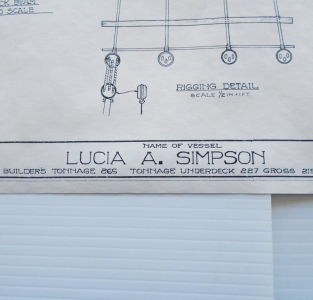
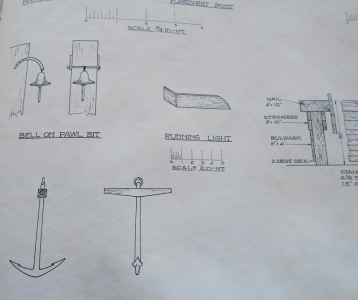
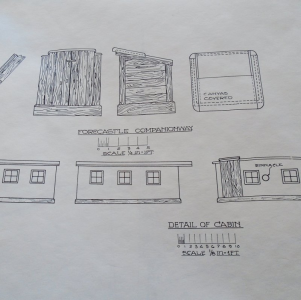
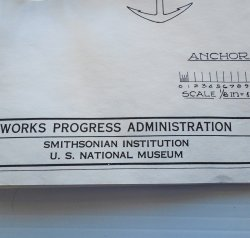
I've obtained a number of the HAMMS drawings over the years. I have the Smithsonian catalog which is quite detailed and easy to follow. Their plan sizes, scales, and so on are indicated in the catalog. The HAMMS collection is made up of black line drawings (and sometimes black and white photographs) made by a rag-tag collection of unemployed draftsmen, architects, and loftsmen as a Depression era Works Progress Administration white collar "make work" project. HAMMS' mission was basically to "go out and record the lines of every old boat you can find." Some of the work appears to be somewhat "quick and dirty." In fact, the WPA only existed for slightly less than two years when it was defunded well before the entire contemplated scope of the project was completed. It was only by the management's directly lobbying FDR, who was an amateur maritime historian and ship model collector, that enough life was breathed into it to enable the completion of the remaining work then in progress. Note also that due to its aborted lifespan, HAMMS only managed to document "historic American merchant marine" vessels in regions on the Eastern Seaboard, Great Lakes, and California coast and, as its title implies, only documented merchant marine vessels.

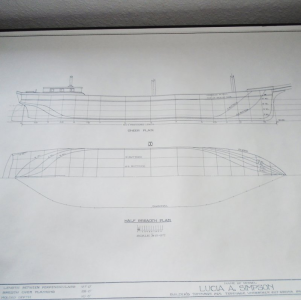
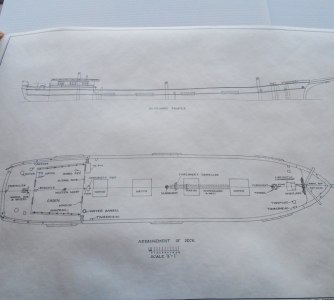
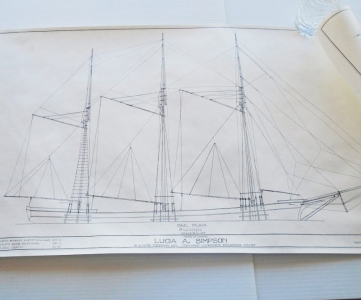
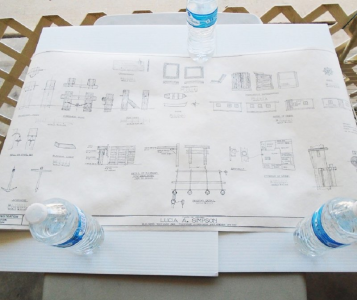
The HAMMS collection generally does not contain "ship modeling plans." It is primarily a collection of hull lines plans. It contains a variety of materials descriptive of various individual historic (i.e., "looking old") vessels that the HAMMS surveyors could locate, often in advanced states of deterioration, half-sunk up on one or another backwater in seven coastal "districts" around the country. Given the circumstances of the survey, some of these hull lines drawings are not entirely accurate. Some portray the hull, but not the rig, which would have been the first to go adrift when a vessel was abandoned on the mudflats. However, as indicated in the sample plans below, the HAMMS material includes drawings from other sources which were incorporated into the survey. The Great Lakes lumber schooner plans below were actually copied by HAMMS from a ship modeling book of the time and then the report supplemented by on-site examination and documentation. We do know from his books which sometimes incorporate HAMMS drawings that Howard I. Chapelle sometimes added entire sail plans to HAMMS hull lines, admittedly based upon nothing more than his (not inconsiderable) personal estimations. The HAMMS is a starting place if you are interested in modeling one of the vessels included in it, but, in most instances, you will also have to develop historically accurate details from other sources.

See: https://www.si.edu/object/archives/sova-nmah-ac-0240 and https://www.bing.com/search?q=Histo...efig=6ab5792f9b904cc1817fbfa449e3917e&pc=DCTS
1790280944463.png

1790280977649.png
1790281014577.png
1790281056841.png
1790281099832.png
1790281141453.png
1790281162518.png
1790281203066.png

As can be seen from the plans above, which are copied from a ship modeling book and drawn for ship modeling purposes, building a high-quality scale model from them would demand quite a bit of additional research and general knowledge of the modeler. It's a long way from the highly detailed monographs we see published these days. In the case of the plans above, the modeler that uses them had better know how deadeyes are properly mounted and their lanyards rove to avoid making the big mistake evident the drawing!

As for naval vessels, the highly detailed construction drawings for nearly every vessel ever on the Navy List used to be readily available from the Naval Sea Systems Command (NAVSEA,) but they apparently unloaded their hard file drawings onto the National Archives some time back and they are now reportedly available from the national archives. When they were held by NAVSEA, I had no problem ordering the complete set of lines, offsets, and construction details drawings for the U.S.S. Boxer, a sail training brigantine built in 1905 (the last wooden sailing ship built by the Navy.) They around $10 a page, as I recall. Unlike the Smithsonian's collection of ship's plans, the National Archives naval collection is digitally searchable online and digital copies can be ordered online.

See: https://www.bing.com/search?q=How+to+find+us+navy+ship's+plans+in+the+national+archives?&form=ANNH01&refig=6ab58728f5c1401a862cb39d8e81e932&pc=DCTS

Remember that the Smithsonian plans are often less detailed than the Navy's plans because the Navy kept their plans on file for use in repairing and refitting vessels and so they needed to preserve all the engineering details they could. It pays to carefully only select the plans sheets you need for modeling from the Navy because, as a scale modeler, you probably won't be interested in pages and pages of steam pipe plumbing, electrical schematics, and so on, and so those engineering detail sheets don't need to be purchased.

Another gold mine of plans for ship modeling subjects are the many books on the subject of ships and modeling published over the years. I've spent over a half-century scouring used bookstores (and now the internet) for just about any book that contains tables of offsets and/or lines drawings of just about any kind of sailing vessel. The many books of Howard I. Chapelle contain not only lines drawings, but also tables of offsets. There are even more such books full of boat and ship plans available from British authors, many of which catalog the amazing diversity of the inshore working watercraft of Britain and Ireland in a manner suitable for scale modeling.

Don't overlook old, outdated ship modeling books, either. Since the beginning of the 20th century, through the present, there has been an increasing level of quality in state-of-the-art ship models. We are a long way beyond the standards of a century ago when authors suggested readers use finishing nails for lifeline stanchions and cutting sheet metal fittings from flattened tin cans, but those dusty old volumes from the 1920's and '30's with titles like Ship Modeling Simplified, How to Build Clipper Ships, Five Historic Ship Models You Can Build, Ship Modeler's Assistant and Plank on Frame Ship Models that sell used on eBay for a few bucks can be gold mines of good ideas and long forgotten tricks of the trade. Some even have "pocket parts" in a sleeve on the back cover full of large-size modeling plans. The subjects are often quaint, and may be deplorably inaccurate. (Fantasy plans of ships we knew little or nothing about were quite popular back in the day.) Nevertheless, they will give you something to start working with and further focused research can permit producing a higher level of accuracy and detail.

There certainly are thousands and thousands of vessels that have never been modeled and are just waiting for a competent scratch-modeler to bring them to life in miniature. Modeling them doesn't require buying a four-figure ship model kit. All it takes, at the least, are the same tools one would require building a kit, plus some suitable wood and the research data that shows how the model is to appear. It does, however, require immersive study of the subject matter one models and that takes a lot of reading and research. Fortunately, those endeavors are every bit as enjoyable as model building when you get into them.

The catch, though, is that the aspiring modeler must, either through practical experience or through study, learn and understand how the ship that's being modeled was built and sailed. All that information is readily available in books, of course, but if a modeler doesn't know how all the maritime skilled trades of the applicable period operated to create the protype ship, the chances of the modeler producing an accurate scale model of the prototype are reduced exponentially. This knowledge cannot be bought in a box. It must be learned from experience and/or study. Books are the most essential tool of the high-quality ship modeler. I believe it is fair to say that, "The bigger the library, the better the ship modeler."
 
Last edited:
Back
Top