

• Win a Free Custom Engraved Brass Coin!!!
    As a way to introduce our brass coins to the community, we will raffle off a free coin during the month of August. Follow link ABOVE for instructions for entering.

I need help!

OMG, I don't know what to say. Those photos paint a terrible picture. I don't have the skills and knowledge to lend advice to other builders. I'm on my third Pavel Nikitin build and have found that his videos are a tremendous help and cotains steps that are not on the paper plans.

So with that in mind, my two cents worth.

One) some of the frames are oriented wrong.
Two) you must have missed the step for forming the frames before trying to mount them, see Pavel's videos #1-#4.
Three) you use way too much glue.
Four) I use vinegar to loosen PVA glue (If that is what you used), and then you can try to redo those frames.
Five) If the frames can't be salvaged, I would contact Denis in Pavel's shop and order a new flat that contains the frame pieces .
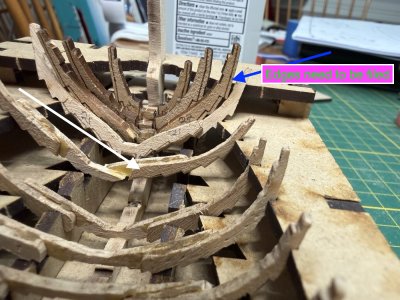
Image 2.jpeg

Jan
 
Yes, I think Jans advice is very good.

I should have done all frames, then I should have test fit all without glueing!
Its the same as with plastic-kits, test first, glue when you see everything is ok.

You should not use force in such a jig!

Mark, I looked at your Norwegian Pram and I think you did a good job with it!
Keep in mind that the advantage of a wooden building kit is that everything can be fixed.
In the worst case, you have to buy or make new parts.
 
Don't give up! I agree the pieces out of the box look pretty bad so maybe fight through it, but look at good quality kits for the next go 'round. I found the following photos of the same kit from 3 1/2 years ago posted by a "friend" of the manufacturer and there appears to be a world of difference with the advertised photos and what they are actually selling, if your kit is a typical example.
Allan

View attachment 559759
View attachment 559762

I'm building Nikitin's Oseberg and I have found the lumber quality to be quite good. The sheets with parts have been pre-sanded pretty well, but I still go over them (with all the parts still in place) with 240 then 320 grits on a sanding block with the grain. This gets the faces of the parts to a nice finish, without any cross-grain scratches, and then I only have to clean up the edges.
 
I am not familiar with this kit but are the particle board pieces just jigs and has the builder used the pop out pieces for ribs and not the actual supplied wood rib parts. I have done the bartolome and the wood quality was excellent
 
I know this model, What I can see on the photo is that frames 24, 23 and 22 are wrongly placed, they need to turn 180 degrees.
the angled sides of the frames should face the front; right now they are the wrong way around.
and regarding the broken frames, carefully take them apart and glue them back together. this is not a big issue.
and for a nice finish, sand the frames properly with 180-grit sandpaper.
 
Sorry, but I see something wrong here. Kinda looks like a troll. when is the last time you saw the face of factory kit parts come out like that? He ruffed those parts up, intentionally! He's after a reaction from folks!
I don’t think comments like this help anyone here. We all come to the hobby with different skill levels, tools, and experiences — and nobody should feel mocked or accused just because their parts don’t look the way someone else expects.
If a member asks for help, let’s give help, not question motives or assume trolling. Many kits come with rough edges, warped pieces, or QC issues, and plenty of beginners simply don’t know what’s normal yet. That’s why this forum exists.
Let’s maintain a supportive tone and remember that not everyone works at the same level — and that’s perfectly fine. We were all beginners once.
 
You must work to the jig.

If the parts don't fall in more or less - they aren't correct - and need to be reworked rather than forced into the main hull jig.
  1. First each rib must fit into its individual rib assy jig,
  2. Then it must drop readily into the main hull building jig.
If it doesn't fit then you have the wrong parts for the rib, or you fit em together wrong.

The rib assy jig can be confusing - as the ribs can be moved about in the jig - there are instructions for orienting the parts of the rib as you glue them together. You need to use some common sense along with the instructions - for deciding which way to slide the parts in the rib jigs - before gluing the ribs together.

Make sure that rib is gonna fit in the main hull jig - before you glue it together in the rib jig, for instance.

And the bevels must face the correct direction - those are the cut lines in the ribs for sanding them down so as to align the surface of the rib with the hull planks as they curve around the ribs. (Some of your ribs are facing the wrong way)
 
Last edited:
Hi all,
This is my 3rd build.
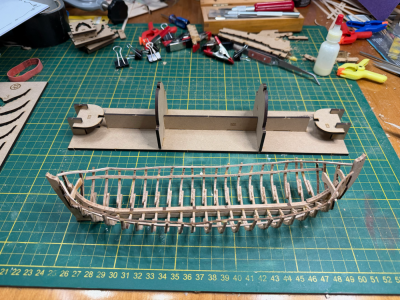
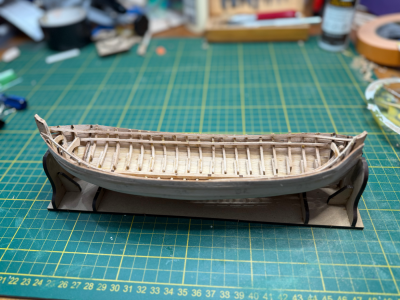
I am building the Nikitin Captain John Smith Shallop. I am assembling the skeleton. Most of the ribs are in place and glued but as you can see in the pictures the last few will not fit into the frame to be glued. I have broken a few ribs already by pressing and gluing them onto the frame.

I don’t know how to proceed.
Should I make more cutouts in the frame for the ribs?
Should I unglue the ribs and fit them in the frame and then glue?
Thoughts?
I have seen a few videos on YouTube and placing the ribs look so effortless on them. It is certainly not for me!
Thanks for your help in advance.
MarkView attachment 559646View attachment 559647View attachment 559648
Fear not. As Mr. "three steps forward, tow back" himself, if you are using white or yellow glue (I recommend white, longer set time to make adjustments and easier to undo) "rubbing" (isopropyl) alcohol will dissolve the glue. Be patient. Give it time. Don't force it. It will work. Just !GENTLY
Hi all,
This is my 3rd build.
I am building the Nikitin Captain John Smith Shallop. I am assembling the skeleton. Most of the ribs are in place and glued but as you can see in the pictures the last few will not fit into the frame to be glued. I have broken a few ribs already by pressing and gluing them onto the frame.

I don’t know how to proceed.
Should I make more cutouts in the frame for the ribs?
Should I unglue the ribs and fit them in the frame and then glue?
Thoughts?
I have seen a few videos on YouTube and placing the ribs look so effortless on them. It is certainly not for me!
Thanks for your help in advance.
MarkView attachment 559646View attachment 559647View attachment 559648
As Mr. "three steps forward, two back" himself, I recommend denatured "rubbing" alcohol (NOT denatured or "stove fuel") to undo yellow or white glue, if that's what you are using. I prefer white, longer set time for adjustment, easier to undo. Apply a little alcohol to the joint to be undone.
Wiggle the glued part GENTLY, eventually it WILL let go. Be patient!!! Don't force it. Granted these parts are very delicate, tiny and hard to file and/or sand. It will take some time, patience and practice in order to dress them to a satisfactory shape. Harder closer grained woods are better suited for these parts. Re-making them in a more suitable wood is a massive undertaking, however. A soft touch, LOTS of patience is required in any case. Each of the tiny parts and assemblies are best approached as little discreet projects unto themselves. I still have difficulty remembering and applying this caution to my own impatience.
You are doing a nice job. It's a steep learning curve.
Slow and steady gets it done eventually. Let each little success be its' own reward.
All the best, Pete
 
Fear not. As Mr. "three steps forward, tow back" himself, if you are using white or yellow glue (I recommend white, longer set time to make adjustments and easier to undo) "rubbing" (isopropyl) alcohol will dissolve the glue. Be patient. Give it time. Don't force it. It will work. Just !GENTLY

As Mr. "three steps forward, two back" himself, I recommend denatured "rubbing" alcohol (NOT denatured or "stove fuel") to undo yellow or white glue, if that's what you are using. I prefer white, longer set time for adjustment, easier to undo. Apply a little alcohol to the joint to be undone.
Wiggle the glued part GENTLY, eventually it WILL let go. Be patient!!! Don't force it. Granted these parts are very delicate, tiny and hard to file and/or sand. It will take some time, patience and practice in order to dress them to a satisfactory shape. Harder closer grained woods are better suited for these parts. Re-making them in a more suitable wood is a massive undertaking, however. A soft touch, LOTS of patience is required in any case. Each of the tiny parts and assemblies are best approached as little discreet projects unto themselves. I still have difficulty remembering and applying this caution to my own impatience.
You are doing a nice job. It's a steep learning curve.
Slow and steady gets it done eventually. Let each little success be its' own reward.
All the best, Pete
Case in point. It took me two tries just to get this post right! ;)
 
You must work to the jig.

If the parts don't fall in more or less - they aren't correct - and need to be reworked rather than forced into the main hull jig.
  1. First each rib must fit into its individual rib assy jig,
  2. Then it must drop readily into the main hull building jig.
If it doesn't fit then you have the wrong parts for the rib, or you fit em together wrong.

The rib assy jig can be confusing - as the ribs can be moved about in the jig - there are instructions for orienting the parts of the rib as you glue them together. You need to use some common sense along with the instructions - for deciding which way to slide the parts in the rib jigs - before gluing the ribs together.

Make sure that rib is gonna fit in the main hull jig - before you glue it together in the rib jig, for instance.

And the bevels must face the correct direction - those are the cut lines in the ribs for sanding them down so as to align the surface of the rib with the hull planks as they curve around the ribs. (Some of your ribs are facing the wrong way)
Sound advice.
 
Back
Top