
• Win a Free Custom Engraved Brass Coin!!!
    As a way to introduce our brass coins to the community, we will raffle off a free coin during the month of August. Follow link ABOVE for instructions for entering.
  • SUBSCRIBE TO SHIPS IN SCALE TODAY!

    The beloved Ships in Scale Magazine is back and charting a new course for 2026!
    Discover new skills, new techniques, and new inspirations in every issue.

    NOTE THAT OUR NEXT ISSUE WILL BE MARCH/APRIL 2026

Import Tax Question

Joined
Dec 31, 2017
Messages
298
Points
228

I received a model kit from Europe by FedEx over a month ago. I was not charged any import tax at the time
Today I got an email from Fed Ex asking me to pay a $37 import tax for that package. At first I thought it could be spam or fishing, but when I clicked on it it showed the name of the authentic sender and a picture of the delivered package on my front stoop.
So, I have three questions:
Weren't Trumps tariffs overturned?
Why are they charging me a month after delivery?
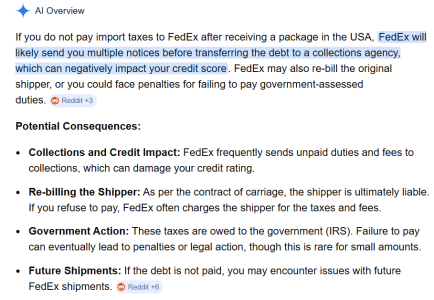
What happens if I don't pay it? Are they going to report me to the IRS or just keep dunning me for the $37?
 
I had the same experience with a package which I ordered from Greece and a couple months later received the notice from FedEx. I too was concerned that it was some type of spam however after checking with FedEx directly I sent payment. This day age it's always wise to verify before sending money.
 
This was happening before tariffs. Tariffs have just added to it. I have been assessed a customs charge of $6 and had FEDEX add a $12 processing fee. When a parcel arrives at the FedEx or UPS hub in the USA, there is a " clearing house " that it passes through that determines the fee you are assessed or not assessed.....it can vary. I ship other things than model ship kits.....I have found a lot depends on the declared value and the individual processing the item through the clearing house. The only consistency is that they want your money!
 
I've never been shy to deliver my speculation on things. Granted, it's based on LOTS of import experiences with various couriers that handle international imports (FedEx, UPS, DHL, etc.)... and it's also based on my experience getting items shipped into Canada, but here goes:

The bill may consist of a combination of regular sales tax for your state/region, coupled with brokerage handling fees that the courier company charges to get the package cleared through import customs. That brokerage handling fee can range from as low as $20 CAD to has high as $35 CAD. So, if you look at the detailed breakdown of charges, I think that's what you'll see. It may incorporate existing tariffs that were in place before Trump, or maybe it includes new tariffs.

What I find surprising is that they billed you after delivery. Normally what I see is that I get an email from the courier telling me that import and processing fees are due and require payment before delivery is made.

If you have even the slightest doubt that the charge is legitimate, I'd recommend calling the courier's 1.800 number and provide them with your tracking number so they can confirm if the charges are legit, and potentially answer any additional questions you may have about them.
 
This isn't about tariffs per se, it's about something called the de minimis exemption.

It used to be that Americans could import an item valued at $800 or less without paying a duty.

That changed last year so that the de minimis exemption is now much lower, only $100.

The long and the short of it is you're paying a duty on something that used to be duty free but this is not directly related to the massive issue of tariffs on a range of products being imported from foreign countries.

Also, many foreign postal services are (or at least were) refusing to accept parcels destined for the USA unless the value was $100 or less. That's because the duty had to be pre-paid. Why pre-paid? Because US Border and Customs Agents didn't want to deal with the duties that had to be collected on the massive number of parcels being shipped to the US every day and foreign postal services also didn't want to have to set up as collection agents. So many foreign postal services obliged shippers to use a private company (FedEX, UPS, etc.) if the value of the item was in excess of $100.
 
Last edited:
DHL sent me a notice that I have to pay $21 within the next week or the item will be returned to the sender. So I paid and in 3 days the kit was at home. This was last September.
 
Before tariffs, I would get a bill from FEDEX after the fact stating that they had been paid on my behalf and I owed them that amount plus their processing fees. After the tariffs, I now get a request for payment before delivery.
Recently, I had an item shipped from the UK. The brokerage company charged me the tariff fee ($785) for the EU(15%) not the UK(10%). (This was before the flat 15% recently imposed). So, I sent them an email asking for the 5% overcharge....totally ignored. It can be frustrating.
 
This isn't about tariffs per se, it's about something called the de minimis exemption.

It used to be that Americans could import an item valued at $800 or less without paying a duty.

That changed last year so that the de minimis exemption is now much lower, only $100.

The long and the short of it is you're paying a duty on something that used to be duty free but this is not directly related to the massive issue of tariffs on a range of products being imported from foreign countries.

Also, many foreign postal services are (or at least were) refusing to accept parcels destined for the USA unless the value was $100 or less. That's because the duty had to be pre-paid. Why pre-paid? Because US Border and Customs Agents didn't want to deal with the duties that had to be collected on the massive number of parcels being shipped to the US every day and foreign postal services also didn't want to have to set up as collection agents. So many foreign postal services obliged shippers to use a private company (FedEX, UPS, etc.) if the value of the item was in excess of $100.
So we have a similar exemption in Canada, but it only applies to goods we're bringing with us when returning home from an overseas location... it doesn't apply to web purchases of items getting shipped to us from overseas... unless those goods were a delayed shipment home to us while we were traveling and part of our customs declaration upon re-entry to Canada where we tick the box that says we have goods purchased while traveling that will be arriving at a later date. If the folks in the US get that exemption on goods they purchase and import while at home, that's great (or was great) for them... but we don't get that exemption here. Strange.

Also, as far as import tariffs go, is that not based on location of manufacture, not where the item is purchased from? I had a bit of an argument with DHL over some parts that I had imported from Italy that they had classified as coming from another country... but once I was able to prove the parts were also manufactured in Italy I got the import tariff reduced significantly. Given it was a $3500 part, that was an argument worth having... but man, trying to wade through those tariff tables is a painful process. That could be the reason why another forum member mentioned they were charged an EU tariff rate for an item purchased from a UK vendor. If for example, it was a ship kit manufactured in Italy but sold by a UK shop, I can envision how that would incur an EU tariff rate.
 
This isn't about tariffs per se, it's about something called the de minimis exemption.

It used to be that Americans could import an item valued at $800 or less without paying a duty.

That changed last year so that the de minimis exemption is now much lower, only $100.

The long and the short of it is you're paying a duty on something that used to be duty free but this is not directly related to the massive issue of tariffs on a range of products being imported from foreign countries.

Also, many foreign postal services are (or at least were) refusing to accept parcels destined for the USA unless the value was $100 or less. That's because the duty had to be pre-paid. Why pre-paid? Because US Border and Customs Agents didn't want to deal with the duties that had to be collected on the massive number of parcels being shipped to the US every day and foreign postal services also didn't want to have to set up as collection agents. So many foreign postal services obliged shippers to use a private company (FedEX, UPS, etc.) if the value of the item was in excess of $100.

There is tariff on imported goods even if under $100
 
Since when is a courier company a tax collector? I have used them and other couriers and never had such demands her in Australia. Must be an American thing. Oh the great US of A!
 
It's called bureaucracy.....regardless of the country we live in, we all have to deal with it one way or the other in some form or fashion.
 
Assuming the $800 De Minimis Still Applies: The most critical mistake in 2025 is assuming commercial shipments under $800 are duty-free; they are not, and failure to declare can lead to penalties.

i.e. the old **$800 “de minimis” exemption for foreign shipments into the United States no longer applies in the same way it used to.

Here’s the current situation as of March 2026:

What the De Minimis Rule Used to Be
Under Section 321 of the Tariff Act of 1930, shipments with a fair retail value of $800 or less could enter the U.S. without formal customs entry, duties, taxes, or many fees. This applied per consignee, per day, and was widely used for low-value international packages (including e-commerce orders).
Changes Effective August 29, 2025
The U.S. government suspended the duty-free de minimis treatment for low-value imports, including foreign shipments valued at $800 or less. ■
○ Effective August 29, 2025, all such shipments — regardless of country of origin — are subject to normal customs clearance and applicable duties/taxes instead of automatically entering duty-free.
○ Postal shipments are also assessed tariffs under new methods (e.g., ad valorem or set flat fees, with transitional rules), and carriers must collect and remit duties.
Yep, it hurts us 'little folks' but, unfortunately the way it will be for the foreseeable future.
ChatGpT and Google are your friends to look this kind of info up
 
I received a model kit from Europe by FedEx over a month ago. I was not charged any import tax at the time
Today I got an email from Fed Ex asking me to pay a $37 import tax for that package. At first I thought it could be spam or fishing, but when I clicked on it it showed the name of the authentic sender and a picture of the delivered package on my front stoop.
So, I have three questions:
Weren't Trumps tariffs overturned?
Why are they charging me a month after delivery?
What happens if I don't pay it? Are they going to report me to the IRS or just keep dunning me for the $37?

I live in Toronto in Canada and I usually get hit with fees like this from Fed Ex, UPS and/or Canada Post. It seems to be pretty common these days. Lately the couriers have been asking for payment of the extra fee before delivery. They won’t report you to the IRS but they will pester you until you pay the fee.I’m a professional artist and I used to order a lot of materials from the States but Canada is hitting us with import duties and when you combine that with currency exchange rates.
 
There is tariff on imported goods even if under $100
Yes but... as I said, the de minimis exemption is totally separate issue from tariffs. It may resemble a tariff as a payment to be collected by customs agents but it's not a tariff.
Tariffs affect a host of goods coming from a particular country or trading block. Some countries (Canada and Mexico) may have deals in place with the US that exempt many of their goods from tariffs.
But the de minimis issue is a duty on the value of goods regardless of origin.
 
Back
Top