• Ships of Scale has incorportated an extra level of security when you log In. Please follow on-screen prompts to acknowledge that you are not a robot via a "Check Box" or a "Pictorial Check Box Puzzle". This is needed due to higher level of AI Activity Security.
  • SUBSCRIBE TO SHIPS IN SCALE TODAY!

    The beloved Ships in Scale Magazine is back and charting a new course for 2026!
    Discover new skills, new techniques, and new inspirations in every issue.

    NOTE THAT OUR NEXT ISSUE WILL BE July/August 2026
  • Win a Free Custom Engraved Brass Coin!!!
    As a way to introduce our brass coins to the community, we will raffle off a free coin during the month of August. Follow link ABOVE for instructions for entering.

Internal and External Painting on 18th C Frigate

Joined
Jul 26, 2024
Messages
13
Points
13

Hi,

Can someone give me a definitive description of internal and external painting of a 36 Gun frigate in 1812?

Many thanks
James
 
I doubt that you can achieve "definitive." While there are some general patterns, what got painted what color depended on a number of factors, including:
  • preferences of the ship builders, captains, and bos'ns
  • availability of paint of various colors
  • mission of the vessel
  • location
Remember that the painting of a wooden vessel is almost a continuous process and that the color scheme of a vessel may vary over its lifetime. So perhaps a more nuanced question would be: What was the likely paint scheme of [vessel] during [period of time] when she was engaged in [service] in the area of [location]?
Fair winds!
 
mission of the vessel
This is an interesting comment. The only example I can think of is that Nelson's fleet at Trafalgar replicated his own paint scheme. Any other examples would be very interesting.

Looking at contracts most of them address painting hull, bulwarks inboard, cabins, and more. Very few mention colors are given, but there are exceptions.

One example with no mention of color

1790882803956.jpeg


From a contract for a 36
BOTTOM to be payedThe Bottom to be payed with tar boiled to a strong consistency or as shall be directed and to paint the sides from the Wales upwards with three good coats of paint, the last coat to be of a yellow colour.
PAINTINGTo treble paint the Great Cabin, Steerage, and all the Cabins, Rails, Stantions, Ladders, Gratings, Gangways, Bulkheads, Capstans, Upper Deck Beams and Knees, and all the Work in Wake of them, and without Board for finishing and completing the Hull of the said Ship, shall be done in a workmanlike Manner, equal in all respects to those of His Majesty’s Ships of the like Quality in the King’s Yards.

From a 1776 contract for a 28 gun
To Grave the ship with the usual Graving with white stuff under the Water taking care to bream and dry the bottom very well before it is laid on & to pay the sides from the upwards with Rosin and Tallow or Lawes varnish as fine as shall be had. ~~~~~~~~~~~~~~~~~~~~~~~~~

To treble paint the ship without board with good oil colours, & in like manner the Great Cabbin, Steerage, & all the Cabbins, Rails, Stantions, Ladders, Gratings, Gangways, Bulkheads, Capstands, upper deck Beams, & knees, & all the work both within and without board for finishing & completing the Hull of said ship, shall be done in a workmanlike manner, equal in all respects to those of his Majesty’s Ships of the like Quality in the King’s Yards. ~~~~~~~~~~~~~~~~~~~~~~~~

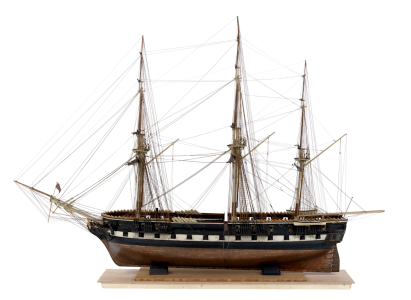
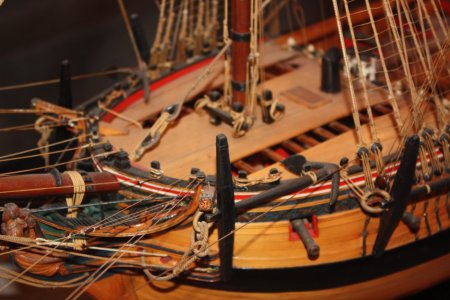
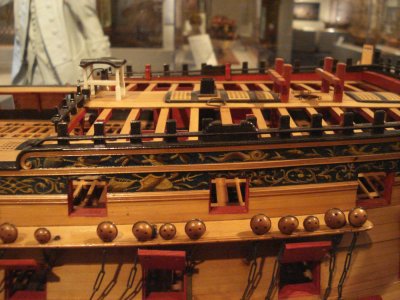
If you study contemporary models, there is very little painting done, especially the hull above the water line. Some 36 gun models can be seen here to give you an idea of what others did 250 years ago
https://www.rmg.co.uk/collections/objects/search/36 gun models

Two examples
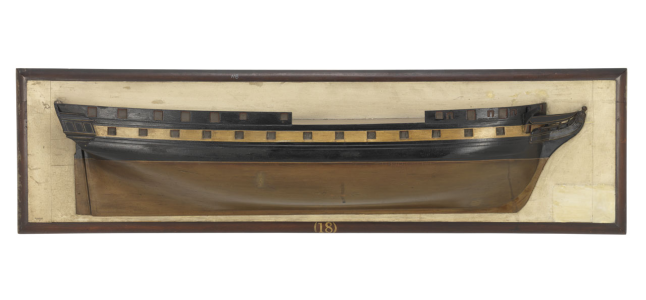
1790883430581.png
1790883485056.png


Allan
 
The only example I can think of is that Nelson's fleet at Trafalgar replicated his own paint scheme. Any other examples would be very interesting.
That's a wonderful example. I do recall a fictional example. In one of Patrick O'Brian's Aubry/Maturin series of books, Jack painted his vessel to look like another t fool the enemy. I'll have to try to track down the reference. Of course, this is fiction but I believe that O'Brian did a lot of research and based incidents in his books on real events. Fair winds!
 
If I had to live in the interior closed gun decks I would want the ceiling, beams and decking underside between the beams to be white. It is enough of a cave without having a coat of red ochre on those surfaces to suck up what dim candle lantern light that was allowed.
 
Many thanks; at present; i am looking for what would the internal planking (not deck planking) painting to be; i am assuming that it would be pitch in the hold, then white in the orlop, and gundeck (white-wash for cleanliness as that was crew living quarters); red on the gundeck, and no painting on QD or FC. All ceilings/under beam areas to be painted white for light reflection.

Luckily i have a contemporary drawing of the outside and half is coppered anyway!

Thanks
James
 
Many thanks; at present; i am looking for what would the internal planking (not deck planking) painting to be; i am assuming that it would be pitch in the hold, then white in the orlop, and gundeck (white-wash for cleanliness as that was crew living quarters); red on the gundeck, and no painting on QD or FC. All ceilings/under beam areas to be painted white for light reflection.
That all sounds reasonable. And it's good to know what and how everything was painted on the original ship. But you're building a model, and as you've probably noticed, many models have less paint on than the original. It probably depends a lot on the style of model. Admiralty models often have little or no paint, and most plank-on-frame models have little as well. The wood construction is highlighted, of course, but even finished areas are often left bare. No doubt this has something to do with the beautiful boxwood, cherry and pearwood used, which can be a display by itself. Look at group builds here on SoS and you'll find that different appearances for many of the models, despite known colors for the original subject. I think this is great, and shows individuality in modeling.

So, depending on your specific model, the style of the model, and your own taste and desires, there can be a wide range of color schemes, with much of it gloriously-finished wood. Research as you are, then decide what you want it to look like.
 
Admiralty models often have little or no paint, and most plank-on-frame models have little as well. The wood construction is highlighted, of course, but even finished areas are often left bare. No doubt this has something to do with the beautiful boxwood, cherry and pearwood used, which can be a display by itself.
Personal opinion - I think it's more likely to be that the build is better shown without paint. Even here, we see builds destined for paint that are filled and smoothed to normalise less than perfect planking fits and runs. Nothing wrong with that, unless you are the Admiralty.

Equally, I have it in mind reading somewhere about red being a paint of choice to make the bloodstains less obvious. Don't you find that getting blood stains off the walls is a terrible chore...

And, wasn't it the case that some captains painted their ships to suit themselves as far as decoration was concerned? Looks smart and shows how much wealth you have.

J
 
Equally, I have it in mind reading somewhere about red being a paint of choice to make the bloodstains less obvious. Don't you find that getting blood stains off the walls is a terrible chore...
I read the same - long ago. It was glib nonsense then and now. The decks would have caught most of it anyway.

Before the chemical industry started with Germans' synthesis of organic paint pigments in the later 19thC. - most if not all paint pigments were inorganic / mineral - rust was not difficult to obtain so yellow ochre (hydrated rust) and red ochre (dehydrated rust) were probably about as low cost as anything not black or white. Except for the decks - which were sanded continuously - every wood surface exposed to the elements HAD to be coated with a protective layer.

Painting with wood is nice. But there is a lot of painting done on models - but for the surfaces that were painted - all of the gratuitous and flattering compliments not withstanding - globs of over scale thickness paint jobs do not stand up to a close viewing. Aniline dyes - alcohol does not swell - can cover as a paint layer yet still show grain. It is close to being the best of two worlds.
 
I seem to remember that HMS Victory had something like 73 coats of paint when stripped in recent years.
 
Internal paint: According to Wikipedia spaces below decks in Royal Navy sailing warships were whitewashed. In addition to its white color it has anti bacterial properties. It’s also cheap and materials to make it were readily available. The article references a paper by Peter Goodwin published in Mariners Mirror.

Roger
 
Internal paint: According to Wikipedia spaces below decks in Royal Navy sailing warships were whitewashed. In addition to its white color it has anti bacterial properties. It’s also cheap and materials to make it were readily available. The article references a paper by Peter Goodwin published in Mariners Mirror.

Roger
Remember that whitewash is slaked lime and water. It has no pigment so it provides a translucent finish on wood. Painting a model with pigment-rich white paint is likely to appear too white and opaque. For a more accurate finish, it might be best to try a diluted paint, perhaps a water-based or alcohol-based type. Fair winds!
 
It has no pigment so it provides a translucent finish on wood. Painting a model with pigment-rich white paint is likely to appear too white and opaque.
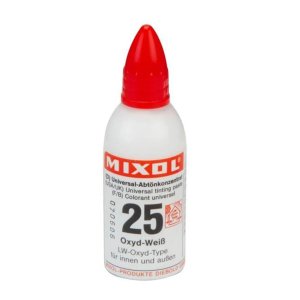
I bought some of this to try.

Mixol white.jpg
Mixol
Universal Pigment - 20 ml
Item #832410 Model S/25
Sale price $ 6 . 36 Was $7.49 Save $1.13 (15% off)
Mixol Universal Tints are the most concentrated, highest quality tints on the market today. They are compatible with most water, solvent, lacquer
 
Back
Top