
-
SUBSCRIBE TO SHIPS IN SCALE TODAY!
The beloved Ships in Scale Magazine is back and charting a new course for 2026!
Discover new skills, new techniques, and new inspirations in every issue.
NOTE THAT OUR NEXT ISSUE WILL BE July/August 2026 -

Win a Free Custom Engraved Brass Coin!!!
As a way to introduce our brass coins to the community, we will raffle off a free coin during the month of August. Follow link ABOVE for instructions for entering.
You are using an out of date browser. It may not display this or other websites correctly.
You should upgrade or use an alternative browser.
You should upgrade or use an alternative browser.


This does not give you much margin for errors. You must do the planking perfect first time.

Depends on who you ask.How much more difficult is it ?
 My first two models in the late 1970s were double planked and I was proud of how they looked. Then, like you, I wanted to frame and plank like a real ship. 50 years later and never did a double planking after those first two. I WISH we had the information back then that we have so readily available today, you are lucky.
There are many considerations from spacing of frames or bulkheads, to budget for high quality wood, to patience, to covered bottom (paint or copper) , lack of fear of do-overs and the list goes on. I think most would agree that the bow area is the most difficult. I am anxious to hear from members who have used both single and double planking why they prefer one or the other.
There are a lot of things to consider, but perhaps the easiest thing is to study a couple planking tutorials on lining off the hull and making the individual planks.
If you are going to spile the planks, the tutorial A Primer on Planking by well-known author and ship modeler David Antscherl is great (PDF attached) I have since relied more on the method of hot air edge bending, but both can work if you are diligent.
Edge bending video by Chuck Passaro.
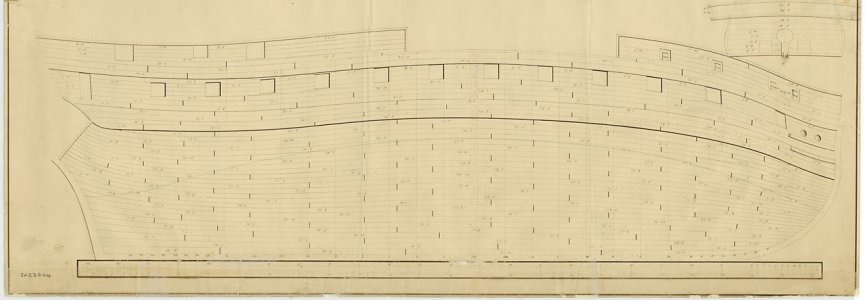
Perhaps the easiest single thing to look at to help you decide if you want to give a go at realistic planking is to study planking expansion drawings. There are a lot of drawings on the RMG Collections site available for free download. This will show you the shapes of the planks when they are laying flat. If this complexity does not worry you, go for it. One example follows.
Attachments

- Joined
- Oct 1, 2023
- Messages
- 2,233
- Points
- 488

It would be nice to see a source for these drawings where they are readable to older codgers like myself. Just thinkingDepends on who you ask.
There are many considerations from spacing of frames or bulkheads, to budget for high quality wood, to patience, to covered bottom (paint or copper) , lack of fear of do-overs and the list goes on. I think most would agree that the bow area is the most difficult. I am anxious to hear from members who have used both single and double planking why they prefer one or the other.
There are a lot of things to consider, but perhaps the easiest thing is to study a couple planking tutorials on lining off the hull and making the individual planks.
If you are going to spile the planks, the tutorial A Primer on Planking by well-known author and ship modeler David Antscherl is great (PDF attached) I have since relied more on the method of hot air edge bending, but both can work if you are diligent.
Edge bending video by Chuck Passaro.This is part one of four.
Perhaps the easiest single thing to look at to help you decide if you want to give a go at realistic planking is to study planking expansion drawings. There are a lot of drawings on the RMG Collections site available for free download. This will show you the shapes of the planks when they are laying flat. If this complexity does not worry you, go for it. One example follows.
View attachment 583550
- Joined
- Oct 2, 2025
- Messages
- 461
- Points
- 128

To explore this question at the theoretical - as an armchair experiment:
It should not matter whether the hull is single or double planked as far as the layer of planking on display is concerned.
They both should be laid identically.
To guess the situation:
A double planked hull has a barely adequate number of molds. if that.
A substantial thickness of first layer planking is supposed to rectify any deficiency with the molds and produce a fair and smooth surface for the second layer.
To do this job it should not matter how the planking is laid as long as it is smooth and fair. It can even be diagonal. It does not need to be laid in any official pattern. It just needs to be a solid hull layer.
Narrow gaps between the planks do not affect how the second layer lays so any sort of spackle to fill the gaps between planks is rather pointless.
Dips and hollows along the run must be addressed. A serious hollow is probably better repaired with a scab of wood.
If a hash is made of the first layer such that there is not enough stock to do the job, going to a home improvement center and buying a piece of construction Pine - getting it resawn and thickness sanded to the same thickness as the kit supplied first layer stock should fill the need.
Just using this Pine from the start for the whole job would probably be more satisfactory. The planks can be sawn wide enough to allow for spilling, and probably with fewer strakes overall.
If, as seems to be most often done, the bottom is then sheathed with copper, the second layer is redundant under it. Any layer of copper that is thicker than a micro foil is out of scale thick. The veneer second layer can start at the copper and go upside. It will probably be thinner and if not - backside tapering should fake it.
The second layer is often a thin veneer. More often than not it seems to be a species picked for its color alone. It often is open pore and brittle. There is no joy in working it. It is not wide enough to spill. It should probably be twice as wide and twice as much
A single planked planked hull needs to be 50% solid wall support.
The planking needs to be wide enough to spill.
For either method, if any tapering is done on the upper edge of the garboard strake, the job is already ruined.
Let the return barrages roll.
It should not matter whether the hull is single or double planked as far as the layer of planking on display is concerned.
They both should be laid identically.
To guess the situation:
A double planked hull has a barely adequate number of molds. if that.
A substantial thickness of first layer planking is supposed to rectify any deficiency with the molds and produce a fair and smooth surface for the second layer.
To do this job it should not matter how the planking is laid as long as it is smooth and fair. It can even be diagonal. It does not need to be laid in any official pattern. It just needs to be a solid hull layer.
Narrow gaps between the planks do not affect how the second layer lays so any sort of spackle to fill the gaps between planks is rather pointless.
Dips and hollows along the run must be addressed. A serious hollow is probably better repaired with a scab of wood.
If a hash is made of the first layer such that there is not enough stock to do the job, going to a home improvement center and buying a piece of construction Pine - getting it resawn and thickness sanded to the same thickness as the kit supplied first layer stock should fill the need.
Just using this Pine from the start for the whole job would probably be more satisfactory. The planks can be sawn wide enough to allow for spilling, and probably with fewer strakes overall.
If, as seems to be most often done, the bottom is then sheathed with copper, the second layer is redundant under it. Any layer of copper that is thicker than a micro foil is out of scale thick. The veneer second layer can start at the copper and go upside. It will probably be thinner and if not - backside tapering should fake it.
The second layer is often a thin veneer. More often than not it seems to be a species picked for its color alone. It often is open pore and brittle. There is no joy in working it. It is not wide enough to spill. It should probably be twice as wide and twice as much
A single planked planked hull needs to be 50% solid wall support.
The planking needs to be wide enough to spill.
For either method, if any tapering is done on the upper edge of the garboard strake, the job is already ruined.
Let the return barrages roll.
High resolution copies can be sent to you from RMG but they are not cheap. I was surprised when I downloaded and categorized the 800 high res RMG drawings on the Wikicommons site none of them were planking expansion plans. I still have a paper copy purchased from RMG about 20 years ago that you are welcome to. It is of HMS Squirrel (24) 1785. For many, marking off the hull then shaving the plank and pre-edge bending as has been discussed it the best way to go. Spiling works as well. If using the expansion drawings I would only do so if cut via computer controlled set up like a couple kiit makers are now doing.It would be nice to see a source for these drawings where they are readable to older codgers like myself. Just thinking
Allan

I love planking - and I'm good at it - been modeling my whole long life - so double planked hulls are a waste of my time. Putting gown a perfect set of planks, just to cover em up again. Geeze.
Anyway, turns out I favor the scale models where you can typically see the planks from outside and inside the hull - 1:12 to 1:32. Tried 1:64, hated it. Might do 1:48 again (just so I can get another Pavel Nikitin kit) - but prefer scales around 1:24.
Anyway, turns out I favor the scale models where you can typically see the planks from outside and inside the hull - 1:12 to 1:32. Tried 1:64, hated it. Might do 1:48 again (just so I can get another Pavel Nikitin kit) - but prefer scales around 1:24.
Hi Tim,I love planking - and I'm good at it - been modeling my whole long life -
Do you spile your planks or do use some other method for preparing the edge bend of the planks?
Thanks
Allan
Every plank gets shaped. I've done both kinds of kits - ones with a set of boards for planks, where I did all the shaping, and ones with the planks precut to shape - where I hardly need to trim em and maybe only need to bevel the edges. When I'm shaping each plank myself from a board - I work to the pattern provided in the plans - planks are wider in the boats midsection, than at the ends - and you gotta work those lines in the planks so they fit up right against each other - I only work one side, leaving the other side straight. When it's cut to shape and fits well - I glue it in and start cutting another. Sometimes I work 4 planks at a time - 2 on each side, before gluing - just to be sure I can live with the cuts I did. Spiling is a word I'm not sure how to use - so I described what I do using my own words, above,Hi Tim,
Do you spile your planks or do use some other method for preparing the edge bend of the planks?
Thanks
Allan
- Joined
- Jun 29, 2024
- Messages
- 1,874
- Points
- 488

I scratch build solid hull models so planking is not one of my skill sets. I have also been building ship models for 60 years and have been interested in observing changes in the model kit world during this time.
A ship’s hull is complex three dimensional shape. Replicating this shape in miniature is the basis for an accurate model. Carving a hull from a block of wood or more frequently from a laminated set of “lifts” allows creation of a highly accurate model. In fact, in the past, it was the only method accurate enough for creating experimental models to be towed to determine hull resistance (Towing Tank Models).
Prior to the 1970’s the solid hull technique was the basis for quality ship model kits. Here in the USA, in the 1970’s a new type of model kit, the Plank on Bulkhead kit, began to be imported from Europe. This type of construction depends on bending strips of wood around shaped bulkheads to define hull shape. ACCURACY IS TOTALLY DEPENDENT ON THE SPACING OF THE BULKHEADS and some of these earlier kits offered only widely spaced ones. To obtain a somewhat accurately shaped and smoothly flowing (fair) hull, the double planking method was used. This allows the first planking layer to be faired, with generous additions of putty before the second layer of planking is added. As a side benefit, this first planking layer allowed novice builders to make a hash of the first planking job before tackling the real thing.
It’s certainly possible to build an accurate ship model using the Plank On Bulkhead method if enough bulkheads are used to define hull shape. If this is done, and planking is carefully applied one layer of planking is sufficient. This also would require tossing the kit supplied strips in favor of wider material that can be correctly spiled; a topic I’ll leave to others.
Roger
A ship’s hull is complex three dimensional shape. Replicating this shape in miniature is the basis for an accurate model. Carving a hull from a block of wood or more frequently from a laminated set of “lifts” allows creation of a highly accurate model. In fact, in the past, it was the only method accurate enough for creating experimental models to be towed to determine hull resistance (Towing Tank Models).
Prior to the 1970’s the solid hull technique was the basis for quality ship model kits. Here in the USA, in the 1970’s a new type of model kit, the Plank on Bulkhead kit, began to be imported from Europe. This type of construction depends on bending strips of wood around shaped bulkheads to define hull shape. ACCURACY IS TOTALLY DEPENDENT ON THE SPACING OF THE BULKHEADS and some of these earlier kits offered only widely spaced ones. To obtain a somewhat accurately shaped and smoothly flowing (fair) hull, the double planking method was used. This allows the first planking layer to be faired, with generous additions of putty before the second layer of planking is added. As a side benefit, this first planking layer allowed novice builders to make a hash of the first planking job before tackling the real thing.
It’s certainly possible to build an accurate ship model using the Plank On Bulkhead method if enough bulkheads are used to define hull shape. If this is done, and planking is carefully applied one layer of planking is sufficient. This also would require tossing the kit supplied strips in favor of wider material that can be correctly spiled; a topic I’ll leave to others.
Roger
Thank you Tim,and ones with the planks precut to shape
This is something we did not see 10 years ago, spiled planks in kits so had to do it on our own.
I have never seen kit plans that show the actual shape of each strake. Do they look like those on contemporary planking expansion drawings such as the one posted above? Using the method demonstrated by master builder David Antscherl in his Primer on Planking paper has been the best way to go for many of us.When I'm shaping each plank myself from a board - I work to the pattern provided in the plans
Allan
I did one kit, the longboat from model shipways, which even showed me where and how to butt join the planks. And it laid out the garboard and sheer strakes and their neighbors. But for most planks, you were on your own, except for general instructions on how to determine how much to remove to get the planks to fit right. Yer expansion drawing ... none of my kits had dwgs close to that. Cept maybe my Falkusa from MarisStella, which had 3D computer pics of the planking.Thank you Tim,
This is something we did not see 10 years ago, spiled planks in kits so had to do it on our own.
I have never seen kit plans that show the actual shape of each strake. Do they look like those on contemporary planking expansion drawings such as the one posted above? Using the method demonstrated by master builder David Antscherl in his Primer on Planking paper has been the best way to go for many of us.
Allan
Not really sure, what you are looking for.

- Joined
- Feb 15, 2019
- Messages
- 435
- Points
- 168
I bend and spile, though spiling can be kept to a minimum, maybe just a last plank (see Kevin Kenny's planking of HMS Thorne. I think he only spiled the last plank?)Hi Tim,
Do you spile your planks or do use some other method for preparing the edge bend of the planks?
Thanks
Allan
I have planked with a majority of planks spiled.
If you look at the paper model kits the shapes and curves of all the planks are shown. So you can enlarge the drawings (they are always too small a scale for my purposes) and use them as a guide or templates.
Unless you are building a partially unplanked open framed hull (e.g., "Navy Board style,") it is far easier and faster to build a hull using the "lift" or "bread and butter" method. The current fad of plank-on-bulkhead and plank-on-frame hull construction is primarily a function of the kit model industry. POB and POF hulled kits are much less expensive to produce, package, and ship than the machine-carved solid hull blanks that were provided in the old style kits. The machine rough-shaped solid hulls required expensive heavy automated carving machines (many purchased as surplus after WWII when they were used to mass produce rifle stocks.) It's far easier and cheaper for kit manufacturers to simply print patterns or, or laser cut, parts on thin sheet stock and leave it to the customers to struggle with trying to assemble a planked hull using the far more exacting and tedious planked hull methods.
Even if one wishes to build a hull finished "bright" (not painted) or the model has a multitude of gunports one wants to portray open with the interiors visible, it is far easier to build a hybrid hull, solid where possible and planked where necessary. If an entire planked hull is desired to be finished "bright," (natural wood finish) it is still easier (and less expensive) to build a solid hull and plank it with very thin non-structural planking of a premier species glued onto the solid hull "plug."
Of course, once a modeler masters these tricks or the trade, it becomes exponentially more difficult to feel the need to spend three, if not four figures on a kit in the first place. (See: SoS School for Ship Model Building: https://shipsofscale.com/sosforums/categories/school-for-shipmodel-building.386/
Even if one wishes to build a hull finished "bright" (not painted) or the model has a multitude of gunports one wants to portray open with the interiors visible, it is far easier to build a hybrid hull, solid where possible and planked where necessary. If an entire planked hull is desired to be finished "bright," (natural wood finish) it is still easier (and less expensive) to build a solid hull and plank it with very thin non-structural planking of a premier species glued onto the solid hull "plug."
Of course, once a modeler masters these tricks or the trade, it becomes exponentially more difficult to feel the need to spend three, if not four figures on a kit in the first place. (See: SoS School for Ship Model Building: https://shipsofscale.com/sosforums/categories/school-for-shipmodel-building.386/
I'm ready to start my second boat, my first being the Beagle, a lot of the ships I'm looking at are single planked which is making me pause.
How much more difficult is it ?
I presume this will make tapering the planks a necessity ?
Single planking done correctly is no different in terms of difficulty than double planking done correctly. The main difference between the two is that you only have to do single planking once.
Shaping each plank to its proper shape which is defined by a lay-out process called "spiling," is a necessity for all types of planking jobs if they are to accurately depict a ship's planking, rather than just fastening laths over a framework to hold plaster and putty and sanded to a fair shape.