

- Joined
- Nov 24, 2025
- Messages
- 61
- Points
- 78

Instructions ?
They're more like guidelines.
Before beginning the build of a preserved ship model, such as the USS Constitution cross section, it helps to consider what era of the ship's life you want to present.
In this case, I decided to use the 1812 verson as my goal, since the USS Constitution museum is in the on-going process of restoring the ship to that configuration. Trouble is, many of the lower deck areas seem to be inconsistant, especially the hold and orlap deck areas.
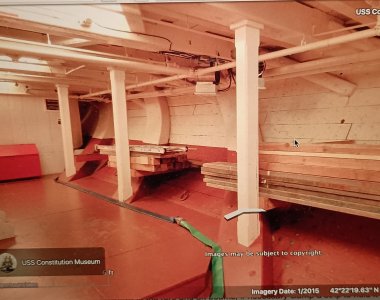
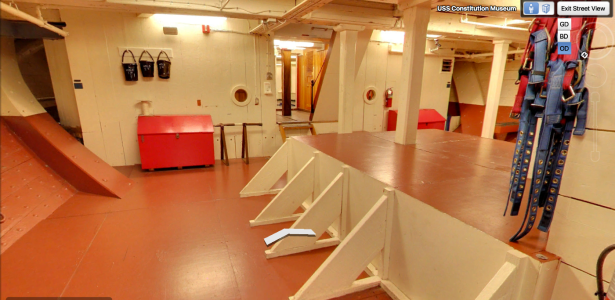
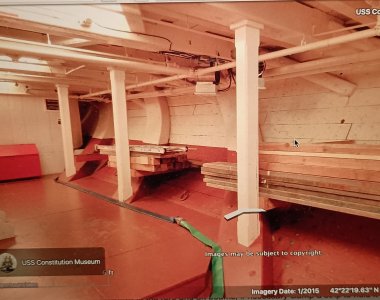
One of the great things about modeling the USS Constitution is that you can use Google Earth street view to walk any of the deck levels. ( Though the orlap deck access is limited to the midship area.)
I find the orlap deck area of the present day ship to be confusing, since part of the deck around the main mast area seems to be cut away, exposing the red-painted hold area.
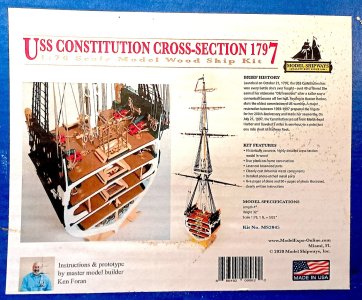
Apparently the kit is based on the ship's configuration when it was launched in 1797.
Something to keep in mind with this Model Shipways kit is that it is actually two models in one –– the hull is one kit, the main mast and rigging is another.
I decided to build them seperately.
One version would use the 7" allignment mast base in the hull. The chain plates would be rigged with lower deadeyes. ( Possibly I may use a piece of plexiglass fitted to the short mast to support the lower end of the mainmast shroudlines.)
Another possibility would be to use the lower section of the main mast so the shroudlines could run up to the fightig top. The fighting top would be duplicated to serve as a base for the rest of the upper mast.
I'm dissatisfied with the kit's presentation of the hold area and barrels.
I plan to line each side of the keelson with blackened pig iron, then put stone ballast above that.
I've bought extra barrels to fill up the hold.
I plan to have figures breaking down empty barrels in the hold.
Something that bothers me is that kit represents the barrels as just being stacked on the stone ballast in the hold with no restraint.
Seems to me that would just be asking for trouble in rough seas. Moving barrels could wear holes in their staves that are resting on stones. (Granted, most of the stone ballast photos I've seen are rounded river-run rocks, which are less likely to wear holes in barrels.) Loose barrels could shift, setting the ship on her beam ends. (The present day configuration has rings on the side of the hold area which may have been to used to secure barrels and crates.)
I've been researching how barrels were actually stored in holds. Did they rest on planks with chocks to hold them in position ? Were lines or nets used to secure them from movement ?
18 Dec 2025th
The trouble with trying to modify a kit is that one often has to figure things out on their own.
I've been stuck for a couple weeks trying to figure out how to get the proper spacing to simulate planking in the extended hold-orlap area I'm trying to create.
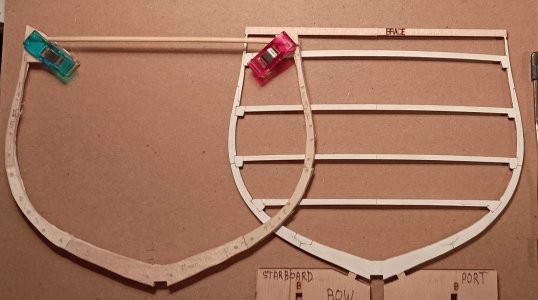
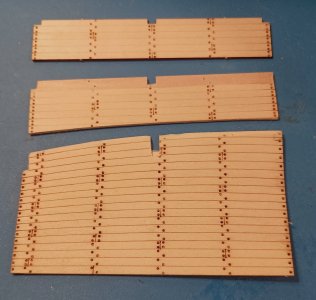
This is what the kit provides
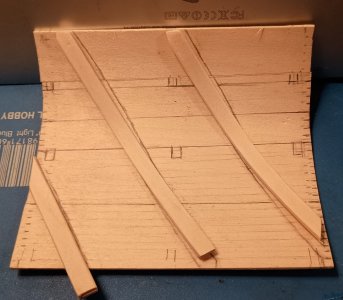
This is what I'm trying to fit in after removing deck beams
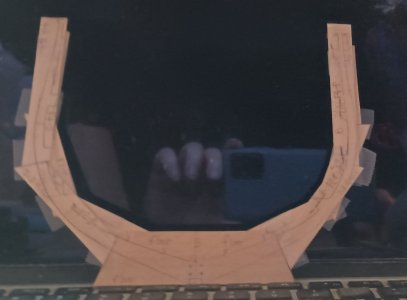
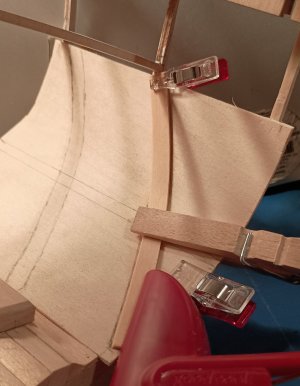
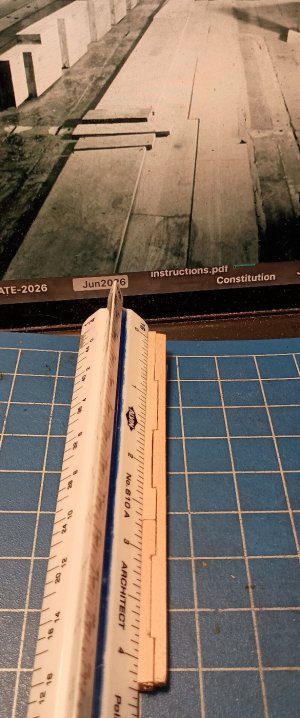
I've been making paper patterns of the planking
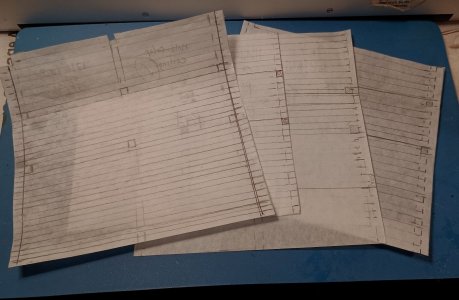
I think I've finally got a pattern that's workable so I can move ahead at last.
What a frustrating struggle.
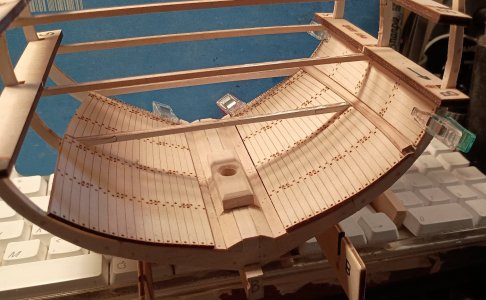
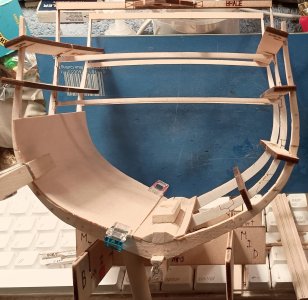
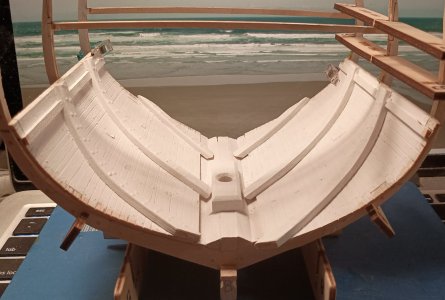
With the port-side hold/orlap custom planking scribed, I'm able to move ahead with installing the bracing the way I want it.
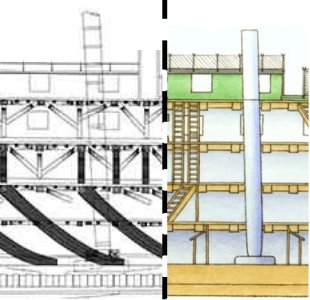
kit instructions
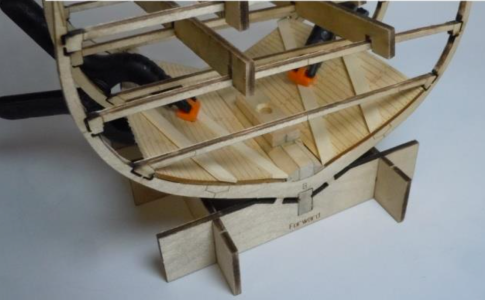
actual ship
modified model bracing
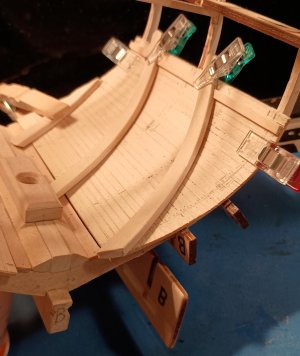
My braces are twice as thick as the kit braces.They look a lot better than the kit's original thin strips.
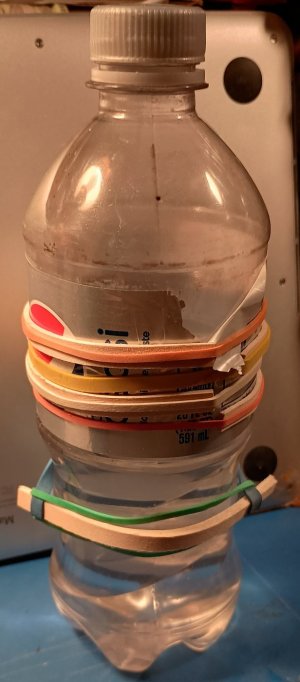
I made the diagonal braces out of pairs of 1/16" x 1/4" basswood strips glued together.
(I suppose 1/8" x 1/4" strips could have been used, but I found it easier to soak and pre-bend the thinner strips before letting them dry, then gluing them together.)
The longer bracing is notched to straddle the shelf plank that the berthing deck beams will rest on.
The extended hold-orlap ceiling does away with a gap that exists in the original kit design.
They're more like guidelines.
31 October 2025
Prebuild Thoughts
Before beginning the build of a preserved ship model, such as the USS Constitution cross section, it helps to consider what era of the ship's life you want to present.In this case, I decided to use the 1812 verson as my goal, since the USS Constitution museum is in the on-going process of restoring the ship to that configuration. Trouble is, many of the lower deck areas seem to be inconsistant, especially the hold and orlap deck areas.
One of the great things about modeling the USS Constitution is that you can use Google Earth street view to walk any of the deck levels. ( Though the orlap deck access is limited to the midship area.)
I find the orlap deck area of the present day ship to be confusing, since part of the deck around the main mast area seems to be cut away, exposing the red-painted hold area.
Apparently the kit is based on the ship's configuration when it was launched in 1797.
Two Fer One
Something to keep in mind with this Model Shipways kit is that it is actually two models in one –– the hull is one kit, the main mast and rigging is another.I decided to build them seperately.
One version would use the 7" allignment mast base in the hull. The chain plates would be rigged with lower deadeyes. ( Possibly I may use a piece of plexiglass fitted to the short mast to support the lower end of the mainmast shroudlines.)
Another possibility would be to use the lower section of the main mast so the shroudlines could run up to the fightig top. The fighting top would be duplicated to serve as a base for the rest of the upper mast.
Roll Out The Barrels . . .
I'm dissatisfied with the kit's presentation of the hold area and barrels.I plan to line each side of the keelson with blackened pig iron, then put stone ballast above that.
I've bought extra barrels to fill up the hold.
I plan to have figures breaking down empty barrels in the hold.
Something that bothers me is that kit represents the barrels as just being stacked on the stone ballast in the hold with no restraint.
Seems to me that would just be asking for trouble in rough seas. Moving barrels could wear holes in their staves that are resting on stones. (Granted, most of the stone ballast photos I've seen are rounded river-run rocks, which are less likely to wear holes in barrels.) Loose barrels could shift, setting the ship on her beam ends. (The present day configuration has rings on the side of the hold area which may have been to used to secure barrels and crates.)
I've been researching how barrels were actually stored in holds. Did they rest on planks with chocks to hold them in position ? Were lines or nets used to secure them from movement ?
18 Dec 2025th
Custom Hold Planking
The trouble with trying to modify a kit is that one often has to figure things out on their own.
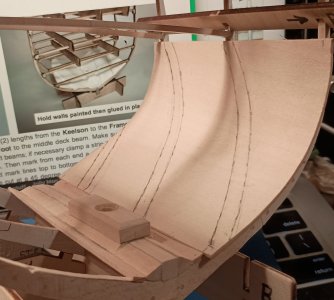
I've been stuck for a couple weeks trying to figure out how to get the proper spacing to simulate planking in the extended hold-orlap area I'm trying to create.
This is what the kit provides
This is what I'm trying to fit in after removing deck beams
I've been making paper patterns of the planking
I think I've finally got a pattern that's workable so I can move ahead at last.
What a frustrating struggle.
23 December 2025tu
Bracing Progress . . . at last
With the port-side hold/orlap custom planking scribed, I'm able to move ahead with installing the bracing the way I want it.kit instructions
actual ship
modified model bracing
My braces are twice as thick as the kit braces.They look a lot better than the kit's original thin strips.
I made the diagonal braces out of pairs of 1/16" x 1/4" basswood strips glued together.
(I suppose 1/8" x 1/4" strips could have been used, but I found it easier to soak and pre-bend the thinner strips before letting them dry, then gluing them together.)
The longer bracing is notched to straddle the shelf plank that the berthing deck beams will rest on.
The extended hold-orlap ceiling does away with a gap that exists in the original kit design.
Last edited: