
• Win a Free Custom Engraved Brass Coin!!!
    As a way to introduce our brass coins to the community, we will raffle off a free coin during the month of August. Follow link ABOVE for instructions for entering.
  • PRE-ORDER SHIPS IN SCALE TODAY!

    The beloved Ships in Scale Magazine is back and charting a new course for 2026!
    Discover new skills, new techniques, and new inspirations in every issue.

    NOTE THAT OUR FIRST ISSUE WILL BE JAN/FEB 2026

Longboat Thwarts

Joined
Jan 12, 2026
Messages
7
Points
3

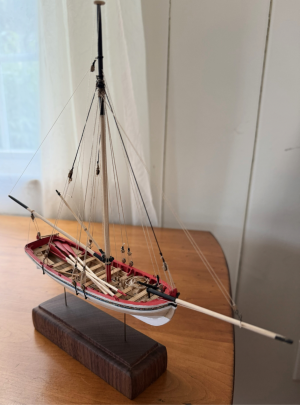
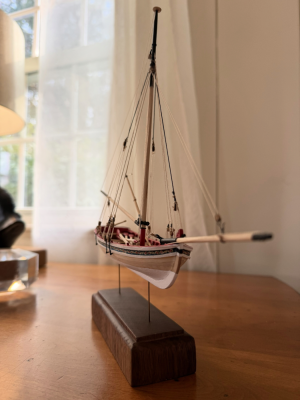
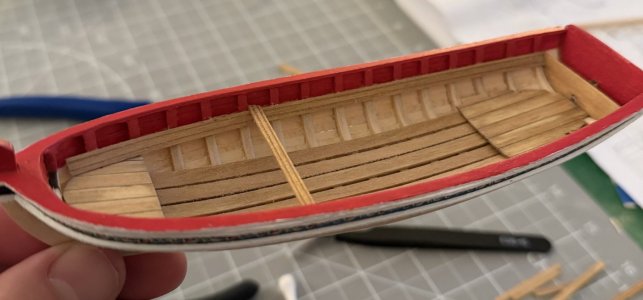
Hello all! New to the forum, but I thought I would share the current state of my longboat (and ask a question that's been bugging me while I'm at it). I've been working on this for about a month, usually after the kiddos go to bed. It's not the neatest (and I may have strayed from the instructions in a spot or two), but I'm pretty pleased with myself! Next step is to install the thwarts.

My question is regarding those thwarts. The instructions call for me to use 1/8" strips, but I think they look a little small. Also, the pictures I see in the kit (and build logs) show little cutouts in the thwarts so they hug the frames/ribs. Since my frames are about 1/8" wide, I don't see how I could do that. Maybe I was supposed to sand those down when I fared the interior? Regardless, if this is a 0.25" scale model, wouldn't that make these seats only 6" wide at full scale? Seems too narrow for a rower's seat, but I'm new to the hobby and certainly not a historian. Does anyone know if that's an accurate representation of a thwart on a longboat, or is this an artistic choice of the designer? Alternatively (and most likely) maybe I'm misinterpreting something?

I'm tempted to swap in 3/16" planks instead (shown in the pic for reference unstained), or join two 1/8" planks together, but I'll happily bow to historical accuracy. Thanks for your help, and let me know if you have any questions!
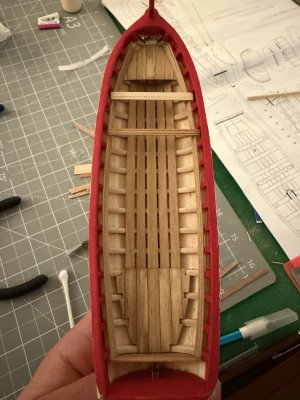
IMG_5993.jpegIMG_5996.jpeg
 
I like the wider planks better. I would not like to try rowing the boat sitting on a 6” wide seat.

Incidentally most of the thwarts in a longboat were removable in order to stow bulky cargo, especially large water barrels. Three were not; the one in the bow, the one supporting the mast and the one just forward of the stern sheets. These three permanent thwarts would have been reinforced with knees tied to the frames.

Roger
 
I like the wider version, and one has to remember two points in building old ship and boats.

First is plans are not always accurate, and ships Captains often change things to fit there personal whims.
Second, is that this is your model boat, and build to what makes you happy, as I don't think you will be displaying in a museum where folks will want to check it for accuracy.
 
My question is regarding those thwarts. The instructions call for me to use 1/8" strips,
First, when it came to boats, there was a lot of variation over time. Contracts are rare and not super detailed. But, there are lists of scantlings for all types and sizes of ship's boats available showing the actual sizes of all the parts. They can be found in Boats of Men of War, Scantlings of Royal Navy Ships and The Elements and Practice of Naval Architecture. What size longboat is your kit?

Examples:
For a 19 foot longboat, loose thwarts were 8 inches broad by 1.5" thick. The main thwart where the mast would be secured was 10" broad by 3" thick. Other fixed thwarts were 9" by 2"

For a 32 foot longboat the loose thwarts were 9X2, For the thwarts supporting the mast(s) 12X4, and for the other fixed thwarts they were about 9 X 2.5 aft to 10X2.75 forward.

Allan

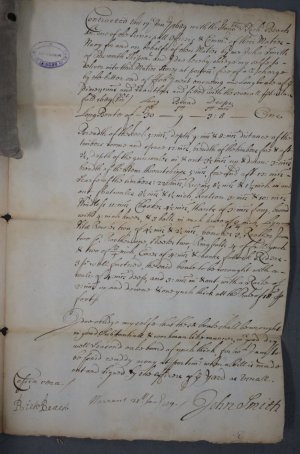
Example of a longboat contract of 1689

1770171051949.jpeg
 
The Russian ship modeling forum, about ship boats.
 
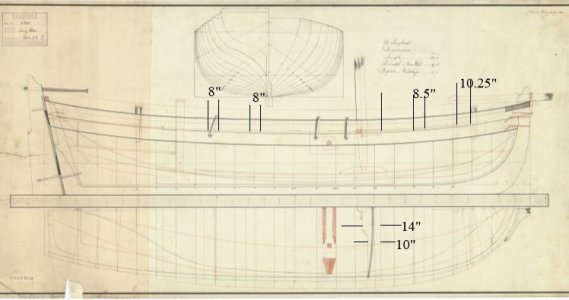
Another way to find dimensions. The drawing below is available on the Wiki Commons site in high resolution and in low res on the RMG Collections site. You can use these contemporary drawings as a source of dimensions as well.
Allan

31 foot longboat with some of the thwart breadths that I measured and noted as examples.
1770204172333.jpeg
 
This is such an incredible trove of information - thank you all so much! This solidifies my thinking of going with the thicker thwarts. By my calculations, that would make them about 7.5" wide in 1:1 scale - close enough for me. I think it looks better, and being a bit more accurate makes me happy. I joined a 1/8" scrap to make the mast-supporting thwart slightly bigger (13.5" in 1:1 scale).

Allan, to answer your question, my longboat measures 6.5" (not counting the bowsprit), or about 26' in 1:1 scale.

Y'all's depth of knowledge is truly impressive, matched only by your generosity in sharing it (not to mention the documents and annotations!). Hopefully one day, when my own knowledge base is deeper, I'll be able to do the same. Thank you again!
 
My question is regarding those thwarts. The instructions call for me to use 1/8" strips, but I think they look a little small. Also, the pictures I see in the kit (and build logs) show little cutouts in the thwarts so they hug the frames/ribs. Since my frames are about 1/8" wide, I don't see how I could do that.
Cap'n Gus:
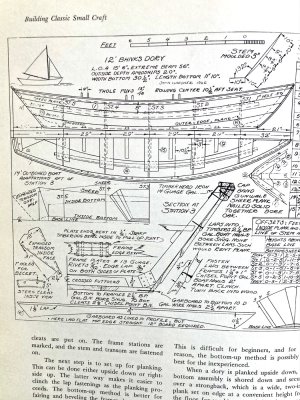
That boat is looking nice, especially considering how small the model is. Regarding the notches in the thwarts to secure them at the frames, I have attached plans that show that feature for a different type of traditional boat that also has removable thwarts: a banks dory. This plan is from Building Classic Small Craft by John Gardner. You can see how the thwarts are notched over the frames. In the case of this dory, the thwarts are specified as 7/8" X 9" white pine. The frames are of 1" oak. So the notches work fine. If I was to guess, I would guess that your ribs are sided too large for scale. So you will have to forgo the notches. That sort of thing is difficult to do correctly at small scales. Fair winds!

bank dory.jpeg
 
Yup, the frames are way over scale. Scantlings for longboats are published in Warships Boats by May. I believe that to scale they would be about 1/32” wide. This kit starts out as a POB build. The bulkheads are cut in such a fashion that the inner part can be easily removed after the hull is planked leaving just the frame. The thickness of the frames is therefore determined by the thickness of the bulkhead material.

Roger
 
The Russian ship modeling forum, about ship boats.
What a fantastic opportunity to view a valuable alternative resource/forum.
There must be many others out there, of which we are ignorant.
With 'translate' function there should be no obstacle, I for one would welcome similar 'heads up'.
 
More excellent information! Thank you, Andy for the kind words and additional plans. I've tinkered with the thought of building a full-size dory like that, but sadly I don't have a the space. And thanks to everyone else for the additional info and context too! I never considered that the frames themselves were out of scale, though in retrospect it makes sense. I'm also going to be spending a lot of time reading through the posts on the other forum - some great looking resources there.

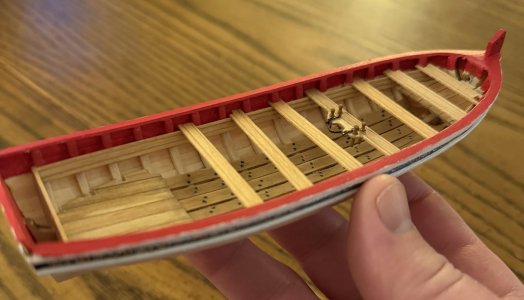
For anyone curious, I took a stab at the thicker thwarts - here they are stained & dry-fit. I also played around by adding tree nails. From my (very brief) research, it seems this might not be wholly accurate, and the color is way off. But, since so much space is being taken up with thicker thwarts, I thought this would give a little more visual interest/depth within the model. Was fun to play around with anyway!

IMG_6012-1.jpeg
 
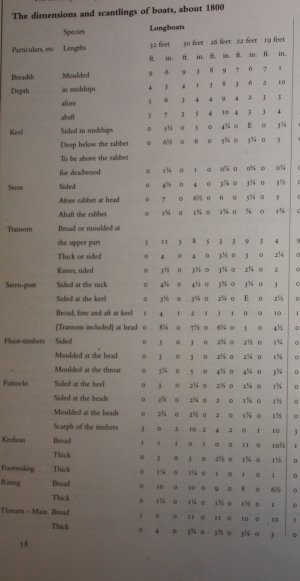
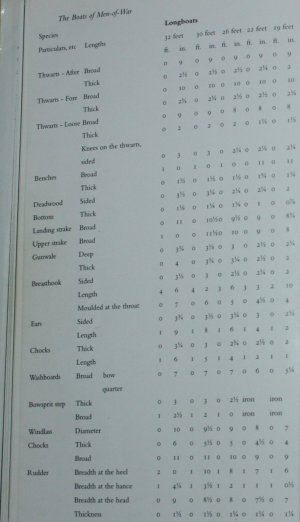
The following may be useful going down the road. It is circa late 18th century early 19th century, but quite useful. As mentioned above, it is from David Steel and can be found in several publications along with the scantlings for laucnhes, pinnaces, and more.

Allan

Page 1
1770308845910.jpeg

Page 2
1770308982713.jpeg


Sorry for the shine and otherwise unclear copies.

Allan
 
Back
Top