
• Win a Free Custom Engraved Brass Coin!!!
    As a way to introduce our brass coins to the community, we will raffle off a free coin during the month of August. Follow link ABOVE for instructions for entering.
  • PRE-ORDER SHIPS IN SCALE TODAY!

    The beloved Ships in Scale Magazine is back and charting a new course for 2026!
    Discover new skills, new techniques, and new inspirations in every issue.

    NOTE THAT OUR FIRST ISSUE WILL BE JAN/FEB 2026

Measuring Manga on 18th Century Spanish Ships (width at gun deck)

Joined
Sep 23, 2018
Messages
107
Points
88

Location
Bay Harbor, Michigan, USA
The introduction to several great books by nrique Garcia-orralba Perez defines Manga as:
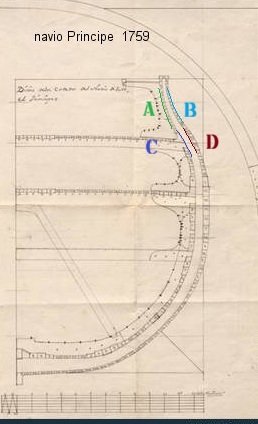
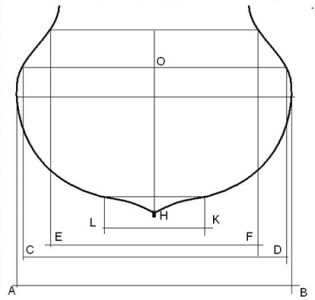
La Manga representa la anchura del buque; normalmente y por lo que aquí nos interesa, medida longitudinalmente a la altura de la Cuaderna Maestra y al nivel de la cubierta principal, de dentro a dentro, es decir, prescindiendo del grosor de los costados de la nave (C– D).

Frente a esta medida convencional, existe la Manga máxima, que se mide a la altura de la mayor anchura de la nave (A– B), que no tiene porqué coincidir con la de la cubierta principal; por el contrario, en las naves de guerra, ésta cubierta se encontraba por encima de la línea de máxima anchura, precisamente para conseguir que las portas de la artillería de esa cubierta quedaran a suficiente distancia de la línea de flotación, permitiendo utilizarla en cualquier tiempo.

Es preciso advertir que a partir de cierto momento temporal, las cuadernas anteriores y posteriores a la maestra, se mantienen iguales que ésta, permaneciendo así en todo el cuerpo central del buque, es decir, entre el redel de proa y el redel de popa, a partir de cuyas posiciones las cuadernas se van afinando.
1768187721886.png

Basically, "t]he Manga represents the width of the ship; Normally and for what interests us here, measured longitudinally at the height of the Master Frame and at the level of the main deck, from inside to inside, that is, regardless of the thickness of the sides of the ship (C–D).Opposite to this conventional measurement, there is the Maximum Beam, which is measured at the height of the greatest width of the ship (A–B), which does not have to coincide with that of the main deck ..."

However, in his book Las Fragatas de Vela de La Armada Espanola (1600 - 1850) on page 258 he says:


Notas.- ...

2ª.- Las dimensiones de eslora y manga ya no se miden por la parte interior del buque, o “de dentro a dentro”, sino por su parte exterior o “de fuera a fuera”, lo que resulta imprescindible tener en cuenta a efectos de comparación con unidades anteriores.

which means:

Notes.- ...

2nd.- The length and beam dimensions are no longer measured from the inside of the ship, or 'from inside to inside,' but from its exterior or 'from outside to outside,' which is essential to take into account for comparison with earlier units.

This refers to a table of Spanish Frigates Circa 1770-1773.

The book Spanish Warships in the Age of Sail 1700-1860 page 12 defines manga as "the beam of the ship, measured at its widest point at the midpoint of the length" which seems wrong to me as that is the Manga Maxima and the widest point of the ship would be slightly forward of the midpoint of its length. However, my understanding is that regular ship's width is at the main deck outside to outside. (I have seen one source using the frame, no planks, can't remember if that was inside or outside.)

I am trying to create a body plan for a Spanish jabeque in 1779. So, what do I do? I have several sources providing the manga measurement but is that inside to inside or outside to outside?

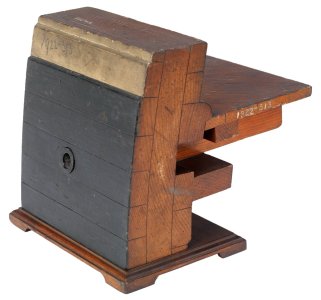
Now it gets interesting. The original plan book was circa 1750, my target ship Murciano ordered 1779 to modified, improved larger dimensions, and the dimensions simply stated by Perez (and other sources) without comment on whether the manga measure is inside or outside. The only plan is the plan book, made at the time of inside measure, and I presume the body plan inks the lines for the inside of the hull. Presumably, and regardless of whether the later ship order used inside or outside measurements, I need to add interior planking, the frame and exterior planking outside of that line to produce the cut-profile of the hull, right? Which is fun because although I can easily get the plank thickness for various layers, I have to punt on tapering the frame thicker as it nears the keel.

All advice, opinions, facts welcome.

Thanks!
 
Last edited:
.​

Hi Jeffrey,

It all depends on the context, both chronological (during that time, i.e. from the early modern period through the following centuries, design techniques changed) and that related to the type of ship. Therefore, taking Perez's explanations both too literally and holistically can indeed be misleading and certainly gives the impression of internal inconsistency.


This issue would require a longer explanation, and you are probably not particularly interested in ancient design techniques, but in short, ‘manga’ could mean both, i.e.:

— the width of the hull at deck level (but never higher than the level of max. breadth, as shown in the diagram above!) or at a level of a line parallel to the deck line, usually also indicated by the wale (collectively, one could say — at the level of the ‘bocca’ , ‘boca’, ‘bocha’ and similar), and this width could be measured both outside or inside the frame timbers, as well as

— the width of the hull at its actual maximum breadth, normally outside of the frame timbers.


A shebek, as a low-board vessel, typically has only two sweeps defining the shape of the frames (it lacks the breadth sweep characteristic of high-board vessels, where the above-water tumblehome began). Therefore, if it was designed in the ‘age-old’ Southern or Mediterranean tradition, the term ‘manga’ referred to the first indicated hull breadth.

.​
 
Last edited:
It may be different for English ships but here goes. The Establishments starting in 1719 gave the moulded breadth (outside of the frames) and the extreme breadth (including the thickness of the plank of the bottom, not the thickness of the wales) This would be a 10 inch difference overall for a first rate for example. Looking at several contracts in the mid 18th century they sometimes give the extreme breadth, not the moulded breadth, at other times, both, such as below.

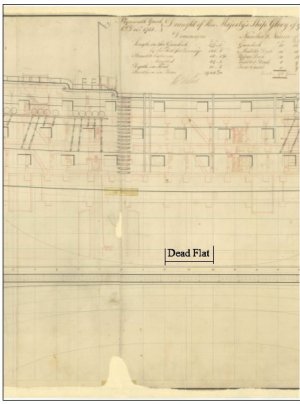
I am pretty sure this could be measured anywhere along the deadflat which is easily found on the majority of contemporary profile drawings, not necessarily in midships.

An example from the contract for a 28 gun of 1774

DIMENSIONS for casting the Ship’s Tonnage. Length of the Lower Deck from the Rabbit of the stem, to the Rabbit of the Stern Post 120 ft 6 ins. Breadth extreme, from Out to Outside of the Plank in Mids 33 ft 6 ins, & shall not be accounted more for casting the Ship’s Tonnage

Moulded 33 ft at the height of breadth where that breadth falls at the Counter from out to outside of the Planck
Deadflat example
1768216922768.jpeg
 
Last edited:
.​

Yes, it's good that you mentioned that. And it seems that this convention of measuring hull's width, which takes into account the thickness of the planking, is not unique to English ships of that period at all, but also applies to ships from other regions in those distant times (I think it's actually the other way around).

It is probably safe to say that in the initial design phase, when the general proportions of ship's hull were being assumed, they always/often took into account the thickness of the planking (for example, to establish the ratio of length to width). It was only in the next phase that the thickness of the planking was subtracted in order to proceed with the actual shaping of the hull lines, which are, after all, closely related to and were ultimately realised through the shape of the frame timbers. Hence the apparent duality of the convention.

My explanations above omit this aspect so as not to complicate matters unduly.


I am pretty sure this could be measured anywhere along the deadflat which is easily found on the majority of contemporary profile drawings, not necessarily in midships.

Usually, the lowest position of the line of the floor indeed coincided with the greatest breadth of the hull, but this was not always the case, and there could be longitudinal shifts from one to the other. Also, ‘deadflat’, understood as a straight line segment, could of course be used in designs, but this was by no means universal. Either way, it would probably be less risky to stick to the run of the maximum width line (alternatively the ‘bocca’ line) in this matter, which had to be defined beforehand anyway.

.​
 
Last edited:
.​

Hi Jeffrey,

It all depends on the context, both chronological (during that time, i.e. from the early modern period through the following centuries, design techniques changed) and that related to the type of ship. Therefore, taking Perez's explanations both too literally and holistically can indeed be misleading and certainly gives the impression of internal inconsistency.


This issue would require a longer explanation, and you are probably not particularly interested in ancient design techniques, but in short, ‘manga’ could mean both, i.e.:

— the width of the hull at deck level (but never higher than the level of max. breadth, as shown in the diagram above!) or at a level of a line parallel to the deck line, usually also indicated by the wale (collectively, one could say — at the level of the ‘bocca’ , ‘boca’, ‘bocha’ and similar), and this width could be measured both outside or inside the frame timbers, as well as

— the width of the hull at its actual maximum breadth, normally outside of the frame timbers.


A shebek, as a low-board vessel, typically has only two sweeps defining the shape of the frames (it lacks the breadth sweep characteristic of high-board vessels, where the above-water tumblehome began). Therefore, if it was designed in the ‘age-old’ Southern or Mediterranean tradition, the term ‘manga’ referred to the first indicated hull breadth.

.​
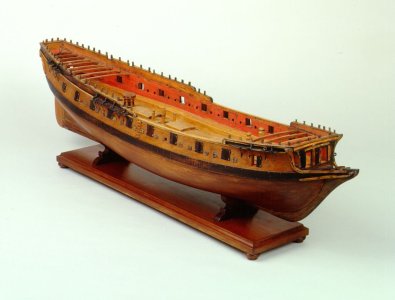
The ship I am building is Murciano, one of three great Xebecs and a chambequin (round [square} sails instead of Lateen). She is every bit the equivalent of a light frigate as to tumblehome and not at all what you would expect from, say, a Cazador or Mistique. That said, if you look at the gun-deck side wall of the first model ship the inside planking and outside planking look to be parallel rather than the outside being at a different angle. Of course, that is just one modeler's version and my poor eye-sight.

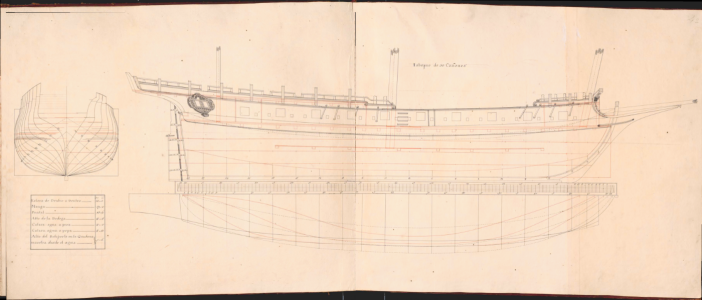
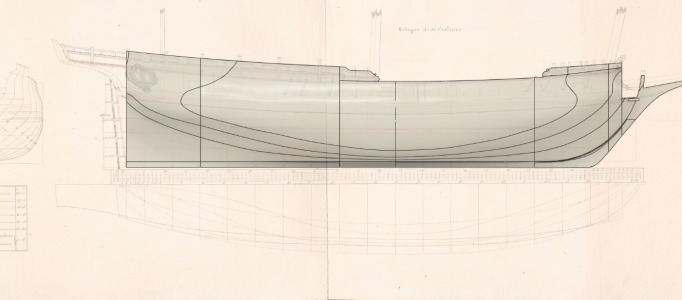
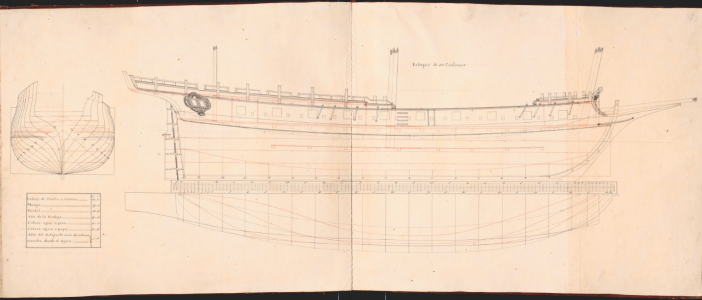
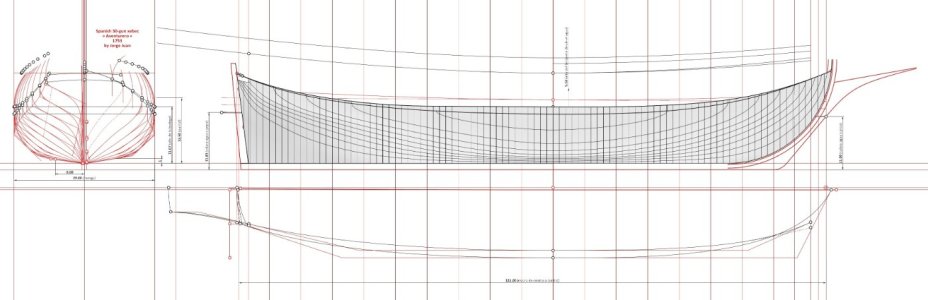
FYI, the plan book plan is "off" in several respects. First, it was actually in a book (crossing the seem) and the left and right sides of the capture are at different angles. Second, the body plans (at the top) do not perfectly match up with the sheer plan -- they are somewhat close but not at maximum amplification on a CAD. Next, the buttocks lines -- I think they are light grey buttocks lines -- do not appear to match a CAD model built from the body plan but even if they do, there is no demarcation on the top-down view of where they slice into the hull! On the other hand, the initial plan was just for a plan book.

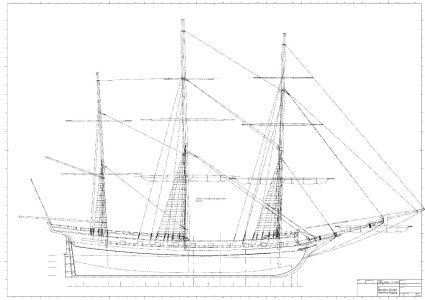
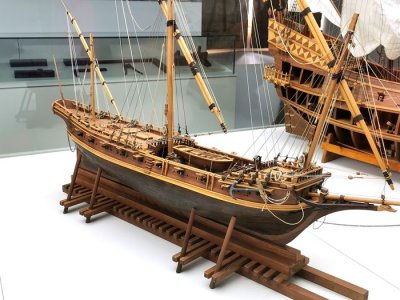
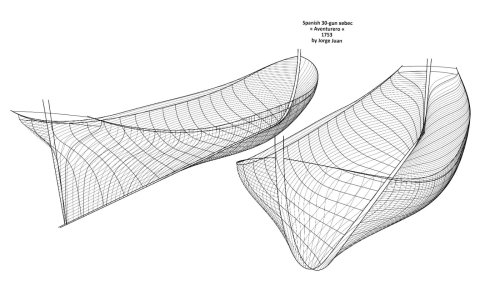
First photo is Aventurero, an earlier jabeque made basically according to the plan book. The museum put the wrong rudder on her during repairs but the initial model ship was likely contemporaneous. Second model photo is a 20th century-made Museum model of Murciano showing the wrong sail plan (it shows Lateen rather than Round sails). Jpg of drawing of Murciano standing rigging is from me, with an early version by me of her hull.

Murciano is basically the plan book modified to make her larger and adjust the hull width/depth/length/keel ratios to produce a better sailing ship. She is also "Gautierized" -- the plan book was written under the Jorge Juan system and when Gautier took over he had his own signature changes. He was the kind of guy who didn't mind spending Spanish government money to redo parts ordered before he took over so that they conformed to his method.

All this background info is great! Yes, my interest in design techniques does not start until the 18th century.

30 gun xebec adjusted file.png

Murciano Standing Rigging.jpg

J_MNM_2653_002.jpg

cartagena_2022_002.jpg
 
.​
The ship I am building is Murciano, one of three great Xebecs and a chambequin (round [square} sails instead of Lateen). She is every bit the equivalent of a light frigate as to tumblehome and not at all what you would expect from, say, a Cazador or Mistique.

Now it's fine, the whole context became clear.


That said, if you look at the gun-deck side wall of the first model ship the inside planking and outside planking look to be parallel rather than the outside being at a different angle

I'm not sure I understand. At the moment, I think you're talking about a double line of maximum breadth, which may be considered quite a typical feature for that period.


FYI, the plan book plan is "off" in several respects. First, it was actually in a book (crossing the seem) and the left and right sides of the capture are at different angles. Second, the body plans (at the top) do not perfectly match up with the sheer plan -- they are somewhat close but not at maximum amplification on a CAD.

Well, I still need to come across a hand-drawn plan from the past that would not require preliminary calibration (straightening, scaling, whether local or in one axis, moving fragments and individual projections, etc.) before its proper analysis, and which individual projections would be perfectly consistent with each other :).


Next, the buttocks lines

I cannot see the buttock lines on this plan...


Murciano is basically the plan book modified to make her larger and adjust the hull width/depth/length/keel ratios to produce a better sailing ship. She is also "Gautierized" -- the plan book was written under the Jorge Juan system and when Gautier took over he had his own signature changes.

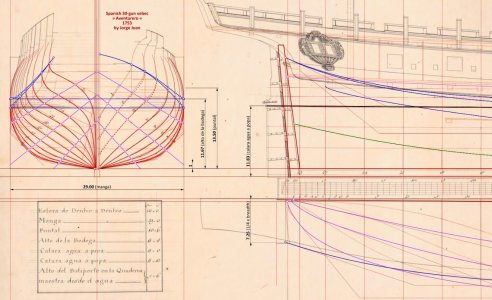
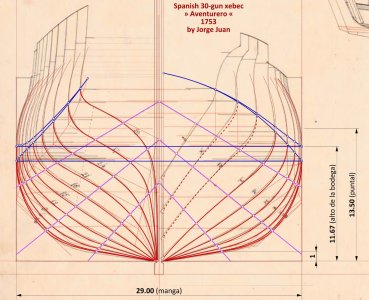
I understand that the chebec, which draught you are showing here, was designed by Jorge Juan, a Spanish designer trained in and consistently applying English methods, before any modifications made by Frenchman Gautier. I can see on the plan that the upper part of the hull (below the maximum breadth line) is defined by regular circular arcs, quite typical of English approach, and the areas below and at the extremities of the hull are formed with the help of diagonals.

Incidentally, by applying the correct/appropriate design method, which usually require also the reconstruction of the removed or distorted design lines (if based on an existing draught), it is possible to perfectly recreate the shape of the hull, at least in terms of its fairness, eliminating the problems arising from the direct reading of the frames' contours drawn on the plan, and which probably never gives completely satisfactory results. I have been trying to promote this approach for some time, however, with rather dubious success, probably mainly due to the need to first master the old design methods, and overcoming this difficulty does not seem to arouse much enthusiasm among the audience :).


All this background info is great!

Thanks! :)

.​
 
Last edited:
.​


Now it's fine, the whole context became clear.


I'm not sure I understand. At the moment, I think you're talking about a double line of maximum breadth, which may be considered quite a typical feature for that period.


Well, I still need to come across a hand-drawn plan from the past that would not require preliminary calibration (straightening, scaling, whether local or in one axis, moving fragments and individual projections, etc.) before its proper analysis, and which individual projections would be perfectly consistent with each other :).


I cannot see the buttock lines on this plan...


I understand that the chebec, which draught you are showing here, was designed by Jorge Juan, a Spanish designer trained in and consistently applying English methods, before any modifications made by Frenchman Gautier. I can see on the plan that the upper part of the hull (below the maximum breadth line) is defined by regular circular arcs, quite typical of English approach, and the areas below and at the extremities of the hull are formed with the help of diagonals.

Incidentally, by applying the correct/appropriate design method, which usually require also the reconstruction of the removed or distorted design lines (if based on an existing draught), it is possible to perfectly recreate the shape of the hull, at least in terms of its fairness, eliminating the problems arising from the direct reading of the frames' contours drawn on the plan, and which probably never gives completely satisfactory results. I have been trying to promote this approach for some time, however, with rather dubious success, probably mainly due to the need to first master the old design methods, and overcoming this difficulty does not seem to arouse much enthusiasm among the audience :).


Thanks! :)

.​
My bad. The light grey dotted lines on the top-down view correspond to the outline created using the diagonal lines on the body plan.

When I was talking about how I see the gun deck walls on the Aventurero model it looked like the frame (C-D in my first attachment) was of uniform width -- as though line D was a perfect duplicate of line C rather than getting wider (stronger) as you run down this side wall from top to keel.

What I need to figure out is whether on the Jorge Juan plan book, with a Manga from inside to inside, the body plan lines (e.g., T) correspond to A (inside the inside planks), C (inside the frame), D (outside the frame), or B (outside the outside planks). Any thoughts on that anyone?

590f6c94edabd_SanJuanNepomuceno.jpg.618bbae5fa88c6940299c60cdadee42f.jpg

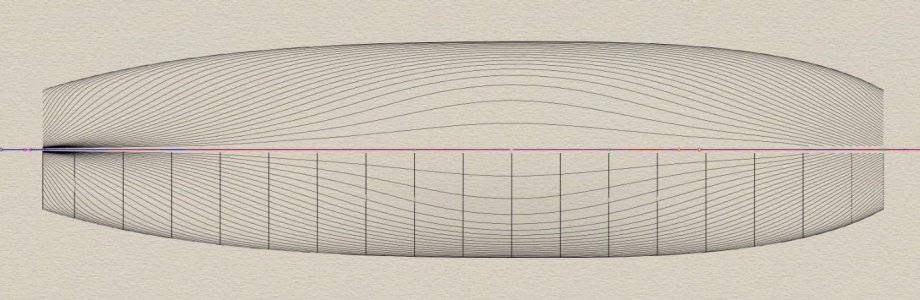
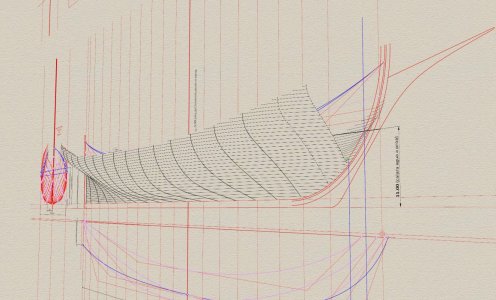
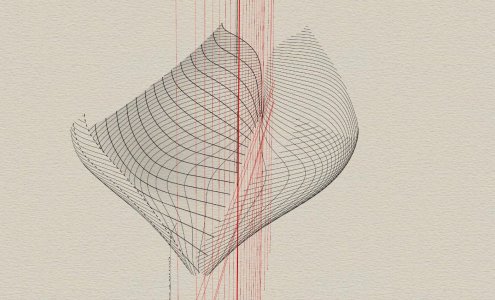
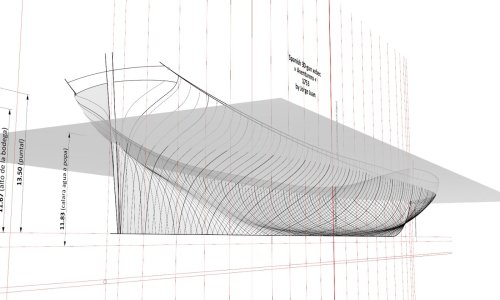
The last attachment shows buttocks lines derived from a 3d model complying with the plans (that do not show buttock's lines). Even taking into account the distance between body plan cut profiles and the impact on the CAD loft, the rear looks horrible. On the Murciano model I started fairing it and found that to get decent curves there I had to materially deviate from the body plan so I gave it up. It seemed like it was a choice between following the plan and materially deviating the hull shape. Maybe with your method I would have more confidence as no one wants an ugly hull.

l0412_001 Ramilles 1785.jpg

Jorge Juan 30-gun Xebec v420 - Buttocks Lines.png
 
Last edited:
.​
What I need to figure out is whether on the Jorge Juan plan book, with a Manga from inside to inside, the body plan lines (e.g., T) correspond to A (inside the inside planks), C (inside the frame), D (outside the frame), or B (outside the outside planks). Any thoughts on that anyone?

I believe that this does not apply to any of these, but rather to a vertical auxiliary line, tangent to the ship's side, and more precisely to the outside of frame timbers (as can be seen in the diagram with the ship Principe 1759).

.​
 
.​

Just above, what I meant was Manga. As to the body plan lines, accordingly, they would have to follow what you have marked by the letter "D" (outside the frame, or the same in other words — inside the outside plank) on the diagram of the Principe.
 
.​
The last attachment shows buttocks lines derived from a 3d model complying with the plans (that do not show buttock's lines). Even taking into account the distance between body plan cut profiles and the impact on the CAD loft, the rear looks horrible. On the Murciano model I started fairing it and found that to get decent curves there I had to materially deviate from the body plan so I gave it up. It seemed like it was a choice between following the plan and materially deviating the hull shape. Maybe with your method I would have more confidence as no one wants an ugly hull.

I am wondering how to remedy this quite common problem in your specific case without causing too much pain to all parties involved. Considering your ability to correct shapes in 3D software, which you mentioned above, and wanting to avoid the hassle of learning the old design methods, I suggest using the original diagonals to verify the contours of the frames as drawn on the plan, and that's it. You probably know how to proceed, but I'm happy to give you some tips if you wish.

.​
 
.​


I am wondering how to remedy this quite common problem in your specific case without causing too much pain to all parties involved. Considering your ability to correct shapes in 3D software, which you mentioned above, and wanting to avoid the hassle of learning the old design methods, I suggest using the original diagonals to verify the contours of the frames as drawn on the plan, and that's it. You probably know how to proceed, but I'm happy to give you some tips if you wish.
That is exactly what I decided to do and ultimately did! But if you can point me to the design methods, that is interesting to me TYVM
 
Attached is my maximum res file, obtained from a Spanish Museum. Nothing out there better that I know of. Note that the left-side and right-side pages have not been reset by me as in the earlier file (so they don't match even worse and the length of the ship is off). Measurements are Spanish in Burgos ft plus inches (by whatever name; just divide by 12 to get Burgos ft). One Burgos foot = 0.914157 imperial foot (a second authority reached a slightly different ratio).

Max AMN PB-album-06-04 type 2.png
 
Last edited:
.​

Unfortunately, this copy has exactly the same dimensions in pixels as the previous one, i.e. 1400 x 599, which obviously does not improve the situation. I suspect, or rather hope, that the copy you have on your hard drive is somewhat better, but its size is reduced when it is posted in this content-visible way on the forum, which is a normal phenomenon, deliberately arranged by the forum administrators to avoid overloading the forum server.

Let's check it out — can you post this reproduction again, but after packing it into a ZIP or similar format? Or, you can send me this compressed file via PM. Of course, in this case, its content will not be visible after posting it here, instead there will only be a kind of download link. You don't need to do anything else, because I will calibrate this plan myself.

Out of curiosity, I have already played around with this plan a bit and have come to some interesting conclusions about the probable design method of this chebec. As luck would have it, this method seems to fit very well into my current area of research, which includes Dutch designs from the early 18th century and American designs from the late 18th century.


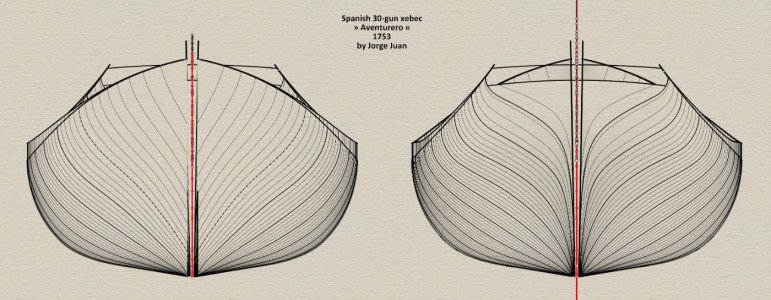
ViewCapture20260113_085537.jpg

.​
 
Back
Top