
• Win a Free Custom Engraved Brass Coin!!!
    As a way to introduce our brass coins to the community, we will raffle off a free coin during the month of August. Follow link ABOVE for instructions for entering.
  • SUBSCRIBE TO SHIPS IN SCALE TODAY!

    The beloved Ships in Scale Magazine is back and charting a new course for 2026!
    Discover new skills, new techniques, and new inspirations in every issue.

    NOTE THAT OUR NEXT ISSUE WILL BE MARCH/APRIL 2026

Measuring Manga on 18th Century Spanish Ships (width at gun deck)

1) Great work.
2) What CAD program do you use? How do you get the parchment paper background?
3) I have been closely reading Steel's Vade Mecum on drawing ship plans. Without the plates/drawings, it is pretty difficult to understand (the online copies and reprints skip the plates) the compass work. Might buy Stallkart - Steel's originals are unaffordable.
4) Same problem with jpg size you had. Would it be possible for you to email the dxf/jpg you want me to use?
5) FYI, I was originally researching Murciano for a small kit maker in Eastern Europe (no $ compensation, just personal satisfaction and a copy of the kit to me to inspect -- it's a hobby), but he has become backlogged so the odds of this being more than my personal scratch build have declined. If a kit ever goes forward of Murciano, is it ok if I base the hull at least in part on your work? Happy to be sure a credit to you goes in, but that's as far as I can go. If not, I will try to use same methods on Murciano myself.
6) Regardless, I still want to learn how to do this kind of work. When I read about the creation of the Le Flueron bow by Jean Boudriot, it seems to me a useful and fun skill.

Thanks Again!
 
1) Great work.

:)

2) What CAD program do you use? How do you get the parchment paper background?

Personally, I use Rhino, which has several predefined workspace display modes, either more technical or more artistic and visual in nature, and this set also includes the Artistic mode (that with a ‘parchment’ background, but one can specify other, individually selected background as well).

3) I have been closely reading Steel's Vade Mecum on drawing ship plans. Without the plates/drawings, it is pretty difficult to understand (the online copies and reprints skip the plates) the compass work. Might buy Stallkart - Steel's originals are unaffordable.

You don't need to do so. Admittedly, some time ago, back in the analogue era, I even invested quite a lot of money to purchase all these textbooks in hard copy format. Unfortunately, the size of the plates is too large for home scanning, or it would indeed require a troublesome and costly order in a specialist printing company. Either way, Steel's Vade-mecum only has two rather ‘poor’ plates (in terms of its content), and it's not even worth bothering with them (incidentally, this is why the Vade-mecum could originally be much more affordable for less affluent buyers than its complete version, i.e. Naval Architecture, from the same year). Much more numerous, containing incomparably more information, and in this sense more attractive, are the plates from other works. And they are available online: those from Steel's Naval Architecture via Abraham Rees' The Cyclopaedia, 1820. And some plates from Stalkartt are available online from the Danish museum archive. All are of very good or good enough quality.

4) Same problem with jpg size you had. Would it be possible for you to email the dxf/jpg you want me to use?

Yes, of course, I can send you everything that has been done so far, including in CAD format, but in this case I need some time to prepare the project for such transfer and direct use by someone else (than me). Fell free to use it in any way you like.

6) Regardless, I still want to learn how to do this kind of work. When I read about the creation of the Le Flueron bow by Jean Boudriot, it seems to me a useful and fun skill.

Well, I think it is fair to say that almost no one is much interested in what is happening below the waterline (in terms of shape). For almost everyone, it is enough that there is nothing there that would offend even absolute laymen in these matters, i.e. something that one could almost physically trip over, such as a protruding piece of a cannon barrel or a tiller. In this context, large investments of time and money in such matters may indeed be seen as a rather unnecessary undertaking. You have been warned :).

Apart from that, to be on the safe side, it can also be pointed out that the ancient design methods and the subsequent effective lofting of those difficult surfaces are actually two separate issues and skills. And, obviously, obtaining the correct surfaces through lofting is not possible without a previously prepared, correctly drawn up design. Unless, of course, someone is satisfied with just ‘whatever’.
.​
 
It would probably be less work to just send a single file (and no pdfs). I use Fusion360: *.f3d, *.3mf, *.ipt etc. Not sure which one of those is a project file other than *.f3d. If that works for you. And thank-you ever so much.
 
Just sent OBJ and 3MF files via WeTransfer. Due to the different specifity of software (Rhino – NURBS 3D geometry, Blender – mesh 3D geometry), there is no direct correlation in terms of the content of the original and derivative file formats. In 3MF format, basically only lofted 3D surface has been left, and in very high density, perhaps much too high. OBJ is not complete either (text and dimensions entities, and also layer assignment, have been lost upon converting, and maybe something else). Just look at it, and possibly let me know if another try, with different parameters or in a different way, is needed.

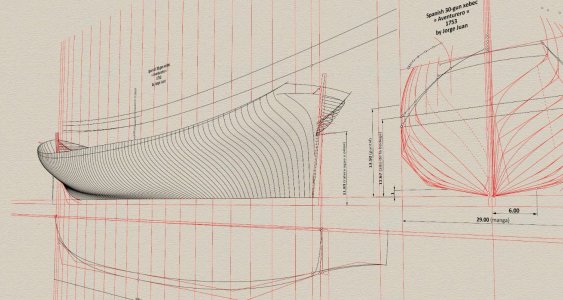
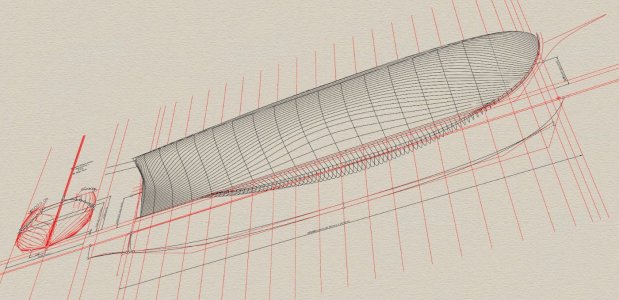
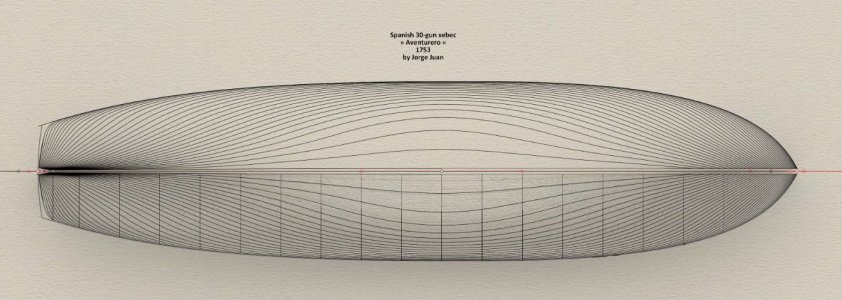
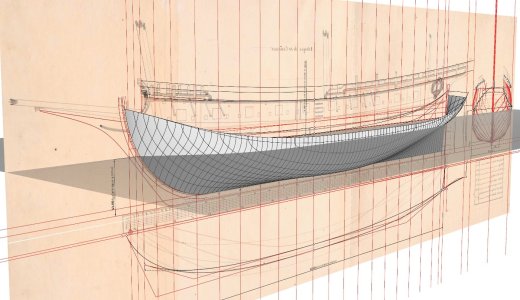
Now, making renders is quite trouble-free, so another batch depicting how it currently looks, and what you can expect, at least in the OBJ file (more or less):

ViewCapture20260119_213333.jpg

ViewCapture20260119_213613.jpg

ViewCapture20260119_213956.jpg

ViewCapture20260119_222257.jpg
.​
 
I have the files, thank-you! The ratios for Murciano are very similar to those of the Jabeque 30 but, as I said privately, I am trying to reconstruct Murciano using the English method of her original plan book. To that end, I have been looking at the location of the Stem Centre for sweeping the aft side of the stem (Vade Mecum p.268) for the 36-gun frigate, Jabeque 30 and Jabeque 14. The distance for the center in from the first perpendicular/up from the upper edge of the rabbet (x/y) are, in the same order: 0.98, 0.95, and 0.96. While this could be the work of a pencil, my gut feel is there is something more going on. The keel/length ratio for all 3 ships is 0.83. However, I have been unable to derive anything whatsoever as calculating Steel's table entries, nor did I notice the formulae in Vade Mecum or Steel's Elements of Naval Architecture. Any thoughts? TYVM again!!!!!!!!!!!!!
 
.​

The pleasure is all mine. In a way, I also benefited from this case.

It seems to me that in your ambitious scenario, finding the center of the stem sweep will be the least of your problems, as will finding the ratio of the keel length to the hull length (which you have already determined to be 10/12). By the way, you can also check if there are any regularities within the 2/12 that remains for the sum of the stem and aft rakes, that is, if the rake of the stem is always in the same ratio to the rake of the post in all the designs you have at your disposal. Incidentally, searching for confirmation of specific proportions of this kind in textbooks from that era may prove to be a rather futile endeavor, as various designers had their own individual habits and preferences in this regard anyway.

The thing is that the real challenge will be to form the hull shapes of the Muriano by replicating the design method originally used by Jorge Juan for the xebec Aventurero. In my assessment, in this case one cannot talk about the classic English method of designing, understood as the consistent use of circular arcs to define the shape of all frames (except those at the extremities of the hull). It seems that Juan only preliminarily defined the master frame as a combined curve of two circular arcs (floor and breadth sweeps). Next, he created diagonals as a regular parabolas and, based on the coordinates of these diagonals, traced the contours of all the remaining frames. In fact, in this case, in order to maintain the fairness of the shapes, the master frame itself should also be plotted like all the other frames, i.e., practically using conical curves.

.​
 
Back
Top