

- Joined
- Oct 22, 2018
- Messages
- 158
- Points
- 253

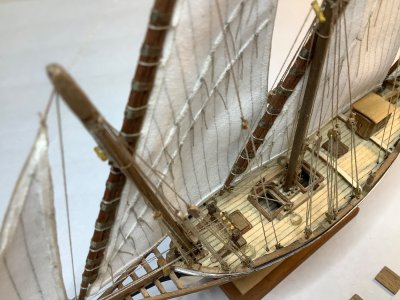
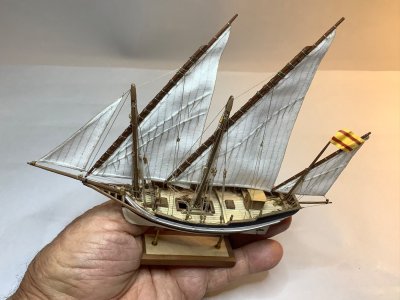
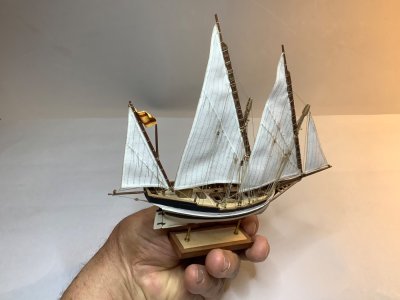
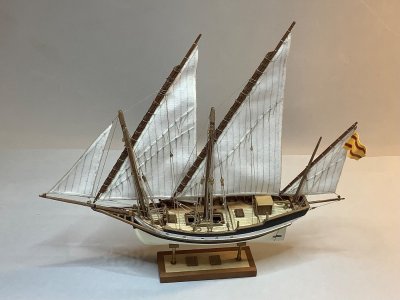
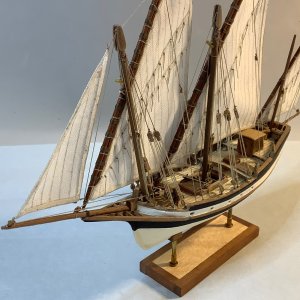
The xebec was a vessel of unmistakable appearance, bearing distinct Mediterranean characteristics: a three-masted lateen rig, a projecting prow, and a round or flat stern topped by two prominent projecting wings that supported a grating, thereby extending the vessel's apparent length. It typically carried three raked masts: fore, main, and mizzen. Many xebecs also featured small openings in the lower part of the hull sides through which oars could be deployed if necessary. Due to their specific design, xebecs were rarely used outside the Mediterranean; however, it is known, for instance, that in 1700 Algerian pirates used their xebecs to launch several raids into the Atlantic, reaching as far as the English coast—on one occasion, taking advantage of the fog, they even ventured into the Thames Estuary. It is also known that the Spanish employed xebecs to combat pirates in the Caribbean. The use of typically Mediterranean vessels in the open oceans is a little-explored chapter of naval history; for example, it is not widely known that the Spanish Royal Navy long maintained a fleet of galleys in the Caribbean to combat pirates, privateers, and smugglers, and that a small detachment of galleys operated for a brief period off the Peruvian coast in the Pacific.
The xebec is certainly of Arab origin. Arab sources mention a vessel called a "shabak" as early as the 10th century; of particular interest is the fact that the Arabic term "she-beke" also designates a type of fishing net. This reveals a clear connection to Spanish, where—alongside "*jabeque*"—we find "*jábega*," the name of a specific fishing net that also gives its name to the vessel used to deploy it. It is therefore logical to assume that it was originally an Arab fishing vessel, possibly used for operations involving that type of net.
The earliest evidence of xebecs in Western navies dates back to the 14th century; by the end of that century, the vessel is mentioned in a Sicilian document and, somewhat later, in a Portuguese chronicle. However, the xebec did not see widespread adoption; references to its existence are sporadic, suggesting it was rarely used—initially in Sicily and Calabria, and later in Spain and Portugal. The golden age of the xebec in European navies began in 1700. The vessel's rise in popularity can be attributed to the Spanish Navy's decision to adopt it as a means of combating piracy. There is a reason for this: during the early decades of the 18th century, Western navies were gradually abandoning the use of galleys and other light vessels (such as half-galleys and *fustas*) due to their proven ineffectiveness against robust, heavily armed square-rigged ships. Yet, galleys and similar craft were the only vessels capable of countering the agile ships used by North African pirates, so the decision was made to fight them using their own type of vessel. The pirates primarily used xebecs, and the Spanish government decided to begin constructing them on a large scale a few years prior to the mid-18th century. It must be said that commercial shipyards in Catalonia and the Balearic Islands possessed extensive experience in the construction of xebecs, a field in which they long remained the masters.
Between 1750 and 1779, the Spanish Royal Navy built around forty of these vessels. They proved highly effective against pirates—so much so that the French Navy began building them as well, starting in 1750 with four ships constructed under the supervision of a Majorcan shipwright.
War xebecs impressed as sailing vessels, leading merchant shipyards to begin building cargo xebecs during the second half of the 18th century. The golden age of the xebec was short-lived, lasting only until the 1830s or 1840s, after which shipowners rapidly and widely abandoned them.
This shift must be viewed in the context of the broader situation in the Mediterranean, where the French occupation of Algeria had finally brought Maghrebi piracy under control. Cost was likely another factor: while the vessel was beautiful, fast, and capable of sailing closer to the wind than any other, it required a large, experienced crew to maneuver its three massive lateen yards.
The early decades of the 19th century saw, among other developments, the introduction of the schooner—a fast vessel that was equally capable of sailing close-hauled yet less expensive to operate. The emergence of mixed sail plans—combining square sails and lateen sails on xebec hulls—can be attributed to cost factors as well as the fact that crews skilled in handling large lateen yards were becoming increasingly scarce everywhere.
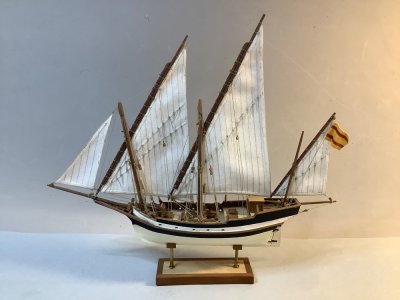
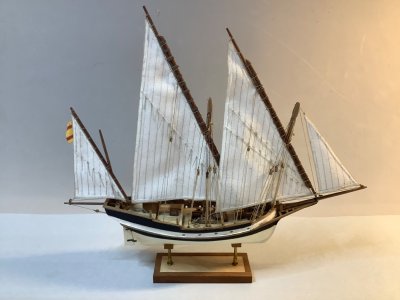
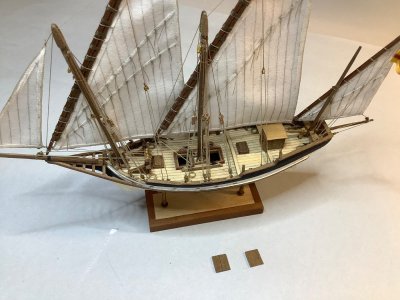
Although the model I am presenting is based primarily—with some modifications—on the *sciabecco* featured in the book *Vele italiane della costa occidentale* by Sergio Bellabarba and Edoardo Guerreri, I have taken the liberty of adapting it into a Spanish vessel by flying the Spanish merchant marine ensign used from 1785 to 1927.
Model specifications:
• Length (hull): 110 mm
• Total length: 185 mm
• Beam: 26 mm
• Scale: 1:170
The xebec is certainly of Arab origin. Arab sources mention a vessel called a "shabak" as early as the 10th century; of particular interest is the fact that the Arabic term "she-beke" also designates a type of fishing net. This reveals a clear connection to Spanish, where—alongside "*jabeque*"—we find "*jábega*," the name of a specific fishing net that also gives its name to the vessel used to deploy it. It is therefore logical to assume that it was originally an Arab fishing vessel, possibly used for operations involving that type of net.
The earliest evidence of xebecs in Western navies dates back to the 14th century; by the end of that century, the vessel is mentioned in a Sicilian document and, somewhat later, in a Portuguese chronicle. However, the xebec did not see widespread adoption; references to its existence are sporadic, suggesting it was rarely used—initially in Sicily and Calabria, and later in Spain and Portugal. The golden age of the xebec in European navies began in 1700. The vessel's rise in popularity can be attributed to the Spanish Navy's decision to adopt it as a means of combating piracy. There is a reason for this: during the early decades of the 18th century, Western navies were gradually abandoning the use of galleys and other light vessels (such as half-galleys and *fustas*) due to their proven ineffectiveness against robust, heavily armed square-rigged ships. Yet, galleys and similar craft were the only vessels capable of countering the agile ships used by North African pirates, so the decision was made to fight them using their own type of vessel. The pirates primarily used xebecs, and the Spanish government decided to begin constructing them on a large scale a few years prior to the mid-18th century. It must be said that commercial shipyards in Catalonia and the Balearic Islands possessed extensive experience in the construction of xebecs, a field in which they long remained the masters.
Between 1750 and 1779, the Spanish Royal Navy built around forty of these vessels. They proved highly effective against pirates—so much so that the French Navy began building them as well, starting in 1750 with four ships constructed under the supervision of a Majorcan shipwright.
War xebecs impressed as sailing vessels, leading merchant shipyards to begin building cargo xebecs during the second half of the 18th century. The golden age of the xebec was short-lived, lasting only until the 1830s or 1840s, after which shipowners rapidly and widely abandoned them.
This shift must be viewed in the context of the broader situation in the Mediterranean, where the French occupation of Algeria had finally brought Maghrebi piracy under control. Cost was likely another factor: while the vessel was beautiful, fast, and capable of sailing closer to the wind than any other, it required a large, experienced crew to maneuver its three massive lateen yards.
The early decades of the 19th century saw, among other developments, the introduction of the schooner—a fast vessel that was equally capable of sailing close-hauled yet less expensive to operate. The emergence of mixed sail plans—combining square sails and lateen sails on xebec hulls—can be attributed to cost factors as well as the fact that crews skilled in handling large lateen yards were becoming increasingly scarce everywhere.
Although the model I am presenting is based primarily—with some modifications—on the *sciabecco* featured in the book *Vele italiane della costa occidentale* by Sergio Bellabarba and Edoardo Guerreri, I have taken the liberty of adapting it into a Spanish vessel by flying the Spanish merchant marine ensign used from 1785 to 1927.
Model specifications:
• Length (hull): 110 mm
• Total length: 185 mm
• Beam: 26 mm
• Scale: 1:170