Love to know if these things work? If anyone has had an opportunity to work with them, any comments reflecting your experience would be greatly appreciated.

-

Win a Free Custom Engraved Brass Coin!!!
As a way to introduce our brass coins to the community, we will raffle off a free coin during the month of August. Follow link ABOVE for instructions for entering. -

SUBSCRIBE TO SHIPS IN SCALE TODAY!
The beloved Ships in Scale Magazine is back and charting a new course for 2026!
Discover new skills, new techniques, and new inspirations in every issue.
NOTE THAT OUR NEXT ISSUE WILL BE MARCH/APRIL 2026
You are using an out of date browser. It may not display this or other websites correctly.
You should upgrade or use an alternative browser.
You should upgrade or use an alternative browser.

This sounds interesting. If it is the jack stay loop maker they show it says it makes them at 1.5mm which seems limiting considering the range of eye bolt sizes on a given ship and the many scales we build to. Hope someone has more details. Worse comes to worst, wrapping copper (not brass for several reasons) wire around various size drill bits that matches the inside diameters that you need is a quick and easy way to make these by the dozen.
Thanks
Thanks
Last edited:

Kurt Konrath
Kurt Konrath
Look in your local hobby shop in jewelry department for many wire bending and loop making tools.

These come in three sizes and from the description may be very innovative. I have the 1.5mm on order. Will let you know how it works.
Update: I received the eye bolt loop pliers yesterday. Very well made and they work easy peasy. Yes, there are many options for formatting your own eye bolts but these pliers make the job so simple and easy that one can make dozens quickly...perfect every time. The only limitation is the pliers come in only three sizes so scale becomes an issue. Even so, I highly recommend the plier and suggest they are worth the price. Not the cheapest tool but the best for its purpose. I plan on ordering the remaining two larger size options at some point but the 1.5mm is adequate for now.
Update: I received the eye bolt loop pliers yesterday. Very well made and they work easy peasy. Yes, there are many options for formatting your own eye bolts but these pliers make the job so simple and easy that one can make dozens quickly...perfect every time. The only limitation is the pliers come in only three sizes so scale becomes an issue. Even so, I highly recommend the plier and suggest they are worth the price. Not the cheapest tool but the best for its purpose. I plan on ordering the remaining two larger size options at some point but the 1.5mm is adequate for now.
Last edited:
- Joined
- Jul 17, 2022
- Messages
- 44
- Points
- 58

Orthodontic pliers have a selection of instruments that should prove helpful they have a very tiny loop set try to check into those, just get the less expensive Pakistan variety instead of the German stainless Dr. Bill
- Joined
- Jul 17, 2022
- Messages
- 44
- Points
- 58
Just checked plenty of varieties on Amazon very reasonable..
- Joined
- Jun 29, 2024
- Messages
- 1,688
- Points
- 488

Oversized ring bolts on hatches are often right up there with bowling pin sized belaying pins that spoil the looks on an otherwise nicely made model. The model that I am currently building has wooden hatches and the original builder’s plan detail for these hatches shows ringbolts with an outside diameter of 6in. Ring bolts needed to be only large enough to put the end of a hook through or in my case to handle with a short wooden “hatch bat.”
At 1:48 scale, a ring bolt would be 1/8” in diameter. At the popular wooden sailing warship scale of 1:64 they would scale to 3/32” and at my scale of 1:96 they are only 1/16” in diameter. These are OUTSIDE diameters of the ring. The inside diameter or “hole” is smaller by twice the diameter of the wire that you are using.
To avoid making these prominent details over scale, using a wire sized drill bit as a mandrel as Allan writes is a better method than using these specialized pliers.
Roger
At 1:48 scale, a ring bolt would be 1/8” in diameter. At the popular wooden sailing warship scale of 1:64 they would scale to 3/32” and at my scale of 1:96 they are only 1/16” in diameter. These are OUTSIDE diameters of the ring. The inside diameter or “hole” is smaller by twice the diameter of the wire that you are using.
To avoid making these prominent details over scale, using a wire sized drill bit as a mandrel as Allan writes is a better method than using these specialized pliers.
Roger
I have the 1.5mm on order.
Hi Daniel
Another example...... Scaling gun carriage loops from drawings based on contemporary sources, they are about 2 inches inside diameter and the metal is about 3/4" diameter to 1" diameter.
1:48 1mm ID and 0.5mm diameter material
1:64 0.8mm and 0.3mm diameter material
1:96 0.5mm ID and 0.25mm diameter material.
Allan

Last month they ran a sale $49.99 for the 3 pliers….

My wife has the 1.5mm size, from working on jewelry. They work fine, but at 1/48 scale, inside diameter is almost 3", so I never use them. The round needle nose pliers I have can make them 10 1mm ID, and I can coax/sqeaze them a bet tighter.
Here's a photo of eyes I just made using 24ga, 22ga and 19ga wire:
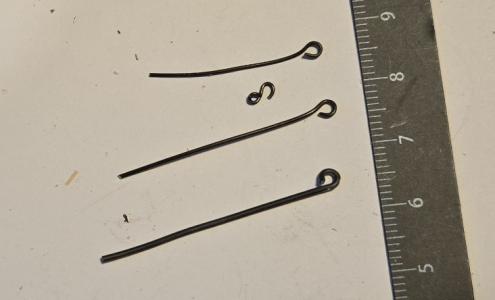
The outside diameter of each loop & wire combination are 2.75mm, 2.96mm and 3.4mm. The 1.5mm ID looks better with heavier wire, but then that 19ga wire is 0.94mm diameter (1.78" in 1/48), and loop OD 6.42". The small hook I made by hand using pliers. In the smaller wire sizes, the finished eye ID comes out closer to 1.60mm.
You'll also notice the small straight area at the end of the bend, which prevents them from looking, IMHO, quite like the eyes normally used on gun carriages and such, which usually have a closed loop, with no straight portion.
Here's a photo of eyes I just made using 24ga, 22ga and 19ga wire:
The outside diameter of each loop & wire combination are 2.75mm, 2.96mm and 3.4mm. The 1.5mm ID looks better with heavier wire, but then that 19ga wire is 0.94mm diameter (1.78" in 1/48), and loop OD 6.42". The small hook I made by hand using pliers. In the smaller wire sizes, the finished eye ID comes out closer to 1.60mm.
You'll also notice the small straight area at the end of the bend, which prevents them from looking, IMHO, quite like the eyes normally used on gun carriages and such, which usually have a closed loop, with no straight portion.

- Joined
- Oct 1, 2023
- Messages
- 2,214
- Points
- 488

Love to know if these things work? If anyone has had an opportunity to work with them, any comments reflecting your experience would be greatly appreciated.
I used them. But found them to be out of scale enough that I replaced the eyeboltsLove to know if these things work? If anyone has had an opportunity to work with them, any comments reflecting your experience would be greatly appreciated.